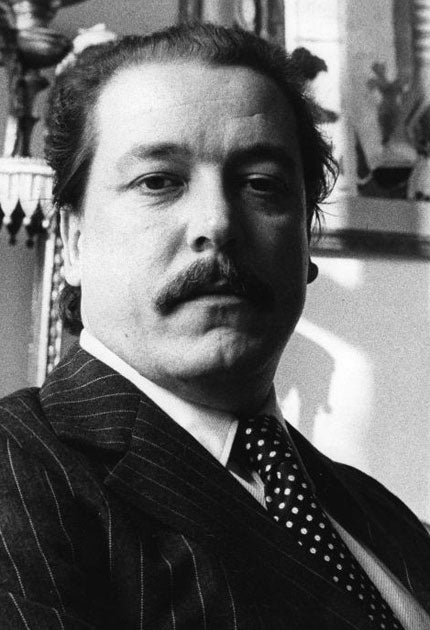
David Hart: Flamboyant banking heir who made his name as Thatcher’s political fixer during the 1980s miners’ strike

For free real time breaking news alerts sent straight to your inbox sign up to our breaking news emails
Sign up to our free breaking news emails
David Hart, the Thatcherite banking heir, was a property magnate, defence industry lobbyist who came to prominence as the scourge of Arthur Scargill and the National Union of Miners during the strike of 1984-85.
The Old Etonian, who was physically likened to Lord Lucan in his younger years, was also a playwright and farmer and a producer of avant-garde films. He even had time to be bankrupted.
Hart was a flamboyant businessman with lavish wealth and a lifestyle to match, entertaining the rich and powerful. He had a talent for political annihilation, masterminding Margaret Thatcher's operation to break the miners' strike from his luxury suite at Claridge's. "It got to the point where she really let me run it," he recalled in 2003.
At Chadacre Hall, Hart's 18th-century Suffolk estate which he restored at great expense to more than its original glory, there were all the trappings of a man who had rubbed shoulders with the world's movers and shakers. In his downstairs toilet, pictures of Hart with the British Army in the Balkans or standing beside an RAF fighter were interspersed with political cartoons, original artwork for anti-EU advertising and, in pride of place above the cistern, a letter from the Soviet Politburo, authorising a payment from the Kremlin to Scargill.
Born in 1944 in London, David Hart was the son of Louis Albert "Boy" Hart, Jewish by birth and the founder and chairman of Henry Ansbacher merchant bank. His mother was Irish, though Hart was baptised into the Church of England. Educated at Eton, he was bullied as "Spiv" or "Jewy Hart" but took retribution on his tormentor and was thence left alone.
Leaving school at 16, Hart dabbled with producing and directing avant-garde films before moving into the world of property, where he earned his first million during the boom of the late 1960s. However, Hart's ostentatious lifestyle was leading him to the bankruptcy courts. While running a fleet of cars, he commuted by helicopter between his home in London and his country estate in Somerset; he kept two mistresses, with whom he had two sons, in separate London flats at a cost of £250 a month (over £2,300 in today's money), in addition to utilities and school fees.
In 1975 he found himself owing close to £1m. "You give me the impression you have lived in cloud cuckoo land," the official receiver told him, reprimanding Hart for his "delusions of grandeur" and taking exception to the fact that many of Hart's creditors were small tradesmen.
Hart lost everything down to his fountain pen – though help was on hand when his mother sent her butler round to look after him. In 1978, his brother paid off most of his debts and Hart moved to Coldham Hall, near Bury St Edmunds in Suffolk, later sold to the supermodel Claudia Schiffer. Around the same time he inherited a substantial sum from his father, which he added to with further dealings in the property market during the 1980s boom.
In the late 1970s, he entered politics as a speechwriter for the MP Archie Hamilton, an old schoolfriend. He met Margaret Thatcher shortly after the 1979 election when she became Prime Minister and became a regular visitor to Downing Street as an "unpaid" advisor on a number of issues, particularly defence. Some at No 10 and in the Conservative Party disliked him immensely, likening him to Rasputin.
Thatcher used him as an intermediary with the Reagan administration when the Americans were planning their Star Wars missile-defence shield. But Hart really made his name during the miners' strike, in which he became involved after meeting a miner's wife whose son was continuing to work in the local pit, and who had, as a result, been targeted for retribution by Scargill's NUM
"It made me so fucking angry," he said, "that I said, 'Right, I'm going to get involved with this and I'm going to sort these bastards out,'."
Following a meeting with Sir Ian McGregor, the Coal Board chairman, he acted as a conduit between McGregor and Thatcher. Hart bankrolled the breakaway Union of Democratic Mineworkers and arranged for legal proceedings against the NUM. This he accomplished while conducting affairs from his suite at Claridge's. He once explained, "Conflict is something whose technicalities I study, understand and enjoy."
In 1987, Hart co-founded The Committee for a Free Britain, a right-wing pressure group whose first public act was to place advertisements in national newspapers warning of the consequences of a Labour victory in the 1987 election. They then supported a number of controversial government campaigns and policies, including the Education Bill, NHS reforms and the Poll Tax, which it described as a "progressive measure".
Hart's access to Downing Street diminished thereafter and many thought that after the fall of Thatcher, who in her memoirs referred to him as "a friend", the unpaid confidante's career was finished. However in 1993 he resurfaced as an advisor to Malcolm Rifkind, the Defence Secretary, a position Hart retained when Michael Portillo succeeded Rifkind. He was believed to have played a key role in the £2.5bn helicopter contract that went to Westland rather than British Aerospace and GEC.
In the mid-1990s, Hart argued against an upgrade of Britain's Tornado aircraft strike force in favour of leasing F-16 fighters from America. On that occasion he was lobbying against BAE, which eventually prevailed and went on to carry out the Tornado upgrade. In 2003, BAE Systems, Britain's biggest defence contractor, paid Hart – who was also a consultant for Boeing, the US aerospace giant – to broker a merger with an American defence group. Sources revealed he was being paid £220,000 a year by BAE. As well as a lobbyist for BAE, Hart was also a prominent figure and mentor in Portillo's brief challenge for the Conservative leadership in 2001. Portillo subsequently became a non-executive director at BAE and was a frequent visitor to Chadacre, as were many "high-ranking politicians and film stars and people from theatre and the arts", according to Hart's son Charles.
In 2004, an arrest warrant for Hart was issued concerning his alleged involvement in the coup attempt in Equatorial Guinea, supposedly masterminded by another schoolfriend, Simon Mann, and involving Thatcher's son Mark. In 2007 it was alleged that Hart had received £13m in secret payments from BAE Systems, via Defence Consultancy Ltd, an anonymously registered company based in the British Virgin Islands. While BAE was under investigation for corruption at the time, Hart himself was not thought to have done anything illegal.
Hart wrote numerous plays including Victoriana, The Little Rabbi and The Ark & the Covenant, and two novels, The Colonel and Come to the Edge. In 2004, he was depicted in David Peace's GB84, a thriller based on the miners' strike, as the compellingly creepy Stephen Sweet, a vain and obsessive character referred to throughout by his driver as "the Jew".
In 2003, Hart was diagnosed with primary lateral sclerosis, a form of motor neurone disease. He became confined to a wheelchair and was forced to communicate with the help of a letterboard. He sold Chadacre Hall, where he had lived for 20 years, to be closer to his children.
In an interview in 2009, he said, "Despite all this [his illness], I feel lucky to be alive. I have a loving family and a loving partner. I live in the countryside in England and that is a real pleasure. I watch the seasons turn and feel very satisfied. Food tastes as good as ever. I like the feel of the sun on my skin as much as I did before I was ill."
Hart is survived by his five children and their four mothers. In 1976 he married Christina Williams, a divorcée with whom he had two sons. He had a son with Karen Weis, and daughters by two long-term girlfriends, Hazel O'Leary and Kate Agazarian.
David Hart, author, playwright, political activist; born London 4 February 1944; married 1976 Christina Williams (two sons), three other partners (three children); died 5 January 2011.
Subscribe to Independent Premium to bookmark this article
Want to bookmark your favourite articles and stories to read or reference later? Start your Independent Premium subscription today.
Join our commenting forum
Join thought-provoking conversations, follow other Independent readers and see their replies