Dmitri Nabokov: Editor who guarded his father's legacy
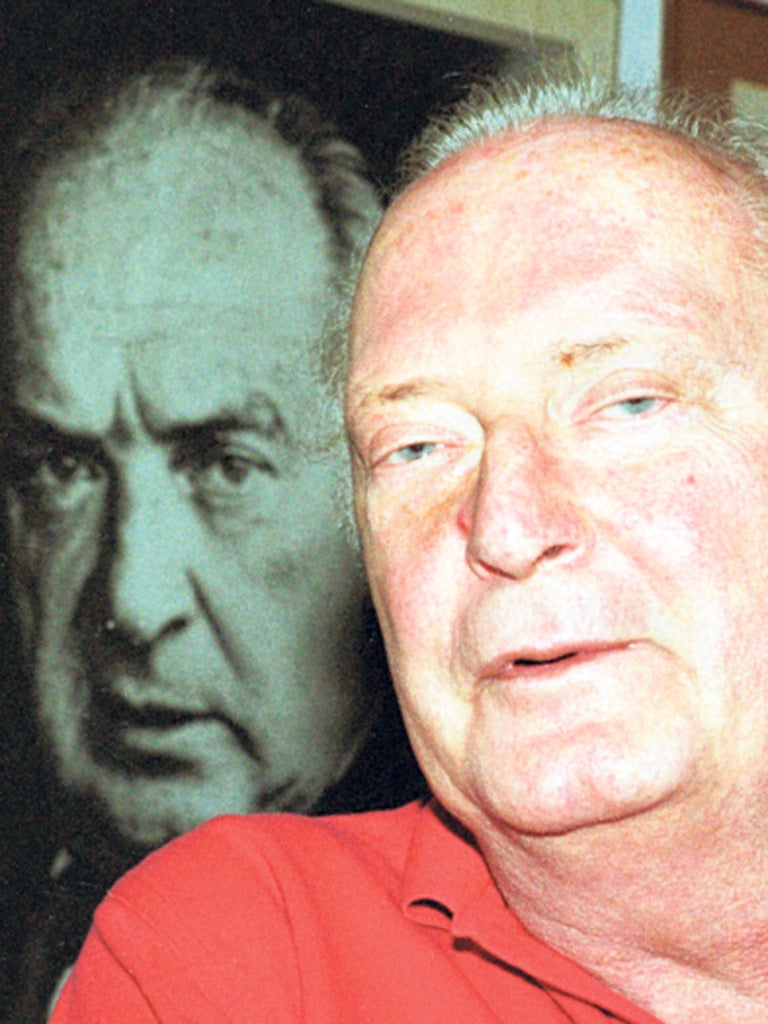
Dmitri Nabokov, the son of the Russian novelist Vladimir Nabokov, tried to escape the shadow of his father's legacy, pursuing interests as diverse as opera singing and racing-car driving. But it was to the translation, preservation and championing of his father's work that he returned time and again.
He was born in Berlin in 1934, the only son of Vladimir and Vera Nabokov. Fearing the rise of Nazism, the family escaped Germany for Paris in 1937 and three years later emigrated to New York. In 1951 he joined Harvard University to study History and Literature and graduated cum laude, despite his father's observation at the time that his interests had been in "mountaineering, girls, music, track, tennis and his studies, in that order..."
Following the international success of Lolita (1958), Vladimir Nabokov decided to make more of his works available in English. Dmitri's first major translation project with his father was the Kafkaesque Invitation to a Beheading (1959), which the author called his "dreamiest and most poetic novel", first published in Russian in 1938.
Nabokov's operatic debut came in April 1961 in the role of Colline in La Bohème. The performance, at the Teatro Municipale di Reggio Emilia, was the result of his winning the basso division of the city's International Opera Competition. Luciano Pavarotti, also debuting that day, as Rodolfo, had won the prize for tenor. While Pavarotti's career took off, Nabokov's principal role for the following decade was as translator and editor of his father's works, including The Eye (1966), King, Queen, Knave (1968) and Glory (1971). Many shorter pieces were published in the New Yorker, and other magazines, throughout the 1960s and '70s, with Dmitri credited as the translator.
Nabokov enjoyed the bon vivant lifestyle that the family name and wealth brought him and indulged in mountaineering and motorsport driving. This was to change in September 1980, when he crashed his competition-prepared Ferrari on the Swiss motorway and sustained third-degree burns over much of his body. Recalling his near-death experience, Nabokov said, "I am enticed by a bright light at the far end of the classic tunnel, but restrain myself at the last instant when I think of those who care for me and of important things I must still do."
When Vladimir Nabokov died in 1977, he left behind an unfinished novel, The Original of Laura, handwritten on 138 index cards. His instructions were that any incomplete work should be burned upon his death. His wife, Vera, had been his literary secretary during his lifetime, editing his texts and dealing with publishers. So, when his mother died in 1991, without having complied with the instructions, the dilemma passed to Dmitri: Should he respect his father's wishes or should he edit and publish the novel?
Opinions were divided but tended to favour destruction. Tom Stoppard expressed the view that "It's perfectly straightforward. Nabokov wanted it burnt, so burn it", while Aleksandar Hemon wrote, "Not only does it go against his expressed wishes, it goes against his very aesthetic sensibility, against his entire life as an artist".
Eventually Dmitri announced in April 2008 that the family would proceed with publication. Defending the decision, he told BBC Newsnight in 2008: "My father told me what his most important books were. He named Laura as one of them. One doesn't name a book one intends to destroy. He would have reacted in a sober and less dramatic way if he didn't see death staring him in the face. He certainly would not have wanted it destroyed. He would have finished it."
And was it worth the wait? Thomas Leveritt, reviewing for this newspaper in early 2010, called it "a bewildering act of brand dilution" and pointed out: "...there's nothing there. The gimmick is that you can take the index cards out (they're perforated), to shuffle them as if you were the author yourself. The actual purpose, it strikes me, is literally to create the hole that is already metaphorically there." In contrast, Professor David Lodge, in the Literary Review, observed, "Is it, as the blurb claims, Nabokov's 'final great book'? No. Does it contain brilliant, funny, astonishing sentences only Nabokov could have written? Yes. Should it have been preserved and published? Definitely."
Dmitri Nabokov, translator, editor and literary custodian: born Berlin 10 May 1934; died Vevey, Switzerland 22 February 2012.
Join our commenting forum
Join thought-provoking conversations, follow other Independent readers and see their replies
Comments