Doris Eaton Travis: Last surviving member of the 'Ziegfeld girls' who worked with Al Jolson and Eddie Cantor
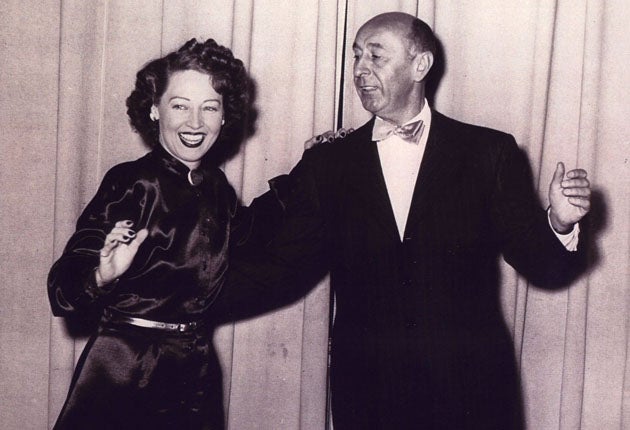
The young Doris Eaton Travis performed in feathers and silk, and sported Cupid lips and bobbed hair embellished with saucy curls.
President Woodrow Wilson once waved to her from the audience and George Gershwin ("a nice young man") composed at her family piano. By the time she died, she was not only the last of the legendary "Ziegfeld girls" but one of the few remaining links to the Broadway of the Jazz Age. And Doris was still dancing.
Her final performance on the Great White Way came on April 27 2010, during the Easter Bonnet Competition, Broadway's annual charity show to help Aids victims that she regularly attended. Steadied by two bare-chested young male dancers – at the age of 106, a more than permissible concession to physical frailty – she managed a couple of kicks before departing the stage under her own steam.
How different it had been back in 1918, when Doris was taken on as the youngest ever dancer in the Ziegfeld Follies, the most famous show of its time on Broadway, created by Florenz Ziegfeld 11 years earlier as New York's answer to the Folies Bergère of Paris. The girls were hand-picked by the boss. On his business card Ziegfeld termed himself "Impresario Extraordinaire", an accurate description of a man of boundless energy and ambition, who as much as any other invented modern American show business.
The Follies, of a scale and extravagance hitherto virtually unknown, were designed to "glorify the American girl." Ziegfeld, as a biographer pointed out, "knew the subtle line between desire and lust, between good taste and vulgarity. He came close to the line sometimes, but never crossed it." In a 2005 interview with The New York Times, Doris remembered the revue as "beauty, elegance and loveliness, like a French painting of a woman's body." The one improper aspect of her recruitment into this distinctly adult world was her age of 14.
In fact she was already a veteran. She and her siblings were child actors when the family lived in Washington DC; Doris had her first role when she was five. Her sisters Mary and Pearl were already Ziegfeld Girls when she was taken on – and given the stage names of Doris Levant and Lucille Levant until she was 16 to get round the child labour laws of the day.
Despite working with the likes of Al Jolson, Fanny Brice and Eddie Cantor, Doris never became one of Ziegfeld's headline attractions. Having started as a "hoofer", or chorus girl, she was promoted to "special girl", with roles that included the red-costumed part of paprika in a "salad dance". In 1920, her third and final season in the troupe, she performed a solo tap routine.
The following year she left for Hollywood and a string of unremarkable appearances in silent movies. On stage however, in the Hollywood Music Box Revue of 1929, Doris would claim a separate place in entertainment history, as the first performer of "Singing in the Rain", the Nacio Herb Brown song that Gene Kelly would make immortal a quarter of a century later.
During the Great Depression acting work largely dried up for the Eatons, as for countless others, and Doris's sisters never really recovered from the setbacks: Mary died of alcoholism at the age of 47 while Pearl, by then a virtual recluse, was murdered in her apartment in 1958. Doris, by contrast, re-invented herself.
It wasn't easy at first – she briefly considered working as a dime-a-dance saloon hostess before becoming a teacher at an Arthur Murray ballroom dancing school in New York. She then moved to Michigan to set up her own franchise, where one of her pupils was Henry Ford II.
Another student was an engineer and inventor named Paul Travis who in 1949 became her second husband. By 1970, pop music had, in her words "put a damper on the ballroom dancing business," so the couple moved to Oklahoma, where they bred horses on a ranch, and Doris set about completing some unfinished business.
First she gained the high school diploma that she had had to pass up when she joined the Ziegfeld Follies. Then in 1992, at the ripe old age of 88, she took a degree in history at the University of Oklahoma. Briefly, Doris planned to add a Masters to her CV, but chose instead to produce The Days We Danced, a touching memoir about her life and family published in 2003. Throughout her life she never smoked or drank. However, the real secret of her longevity, she insisted, was something she practiced daily, even into her second century: dancing.
Doris Eaton Travis, dancer and actress: born Norfolk, Virginia 14 March 1904; married 1923 Joseph Gorham (died 1923), 1949 Paul Travis (died 2000); died Commerce, Michigan 11 May 2010.
Join our commenting forum
Join thought-provoking conversations, follow other Independent readers and see their replies
Comments