Dr Horst-Eberhard Richter: Peace activist and psychoanalyst
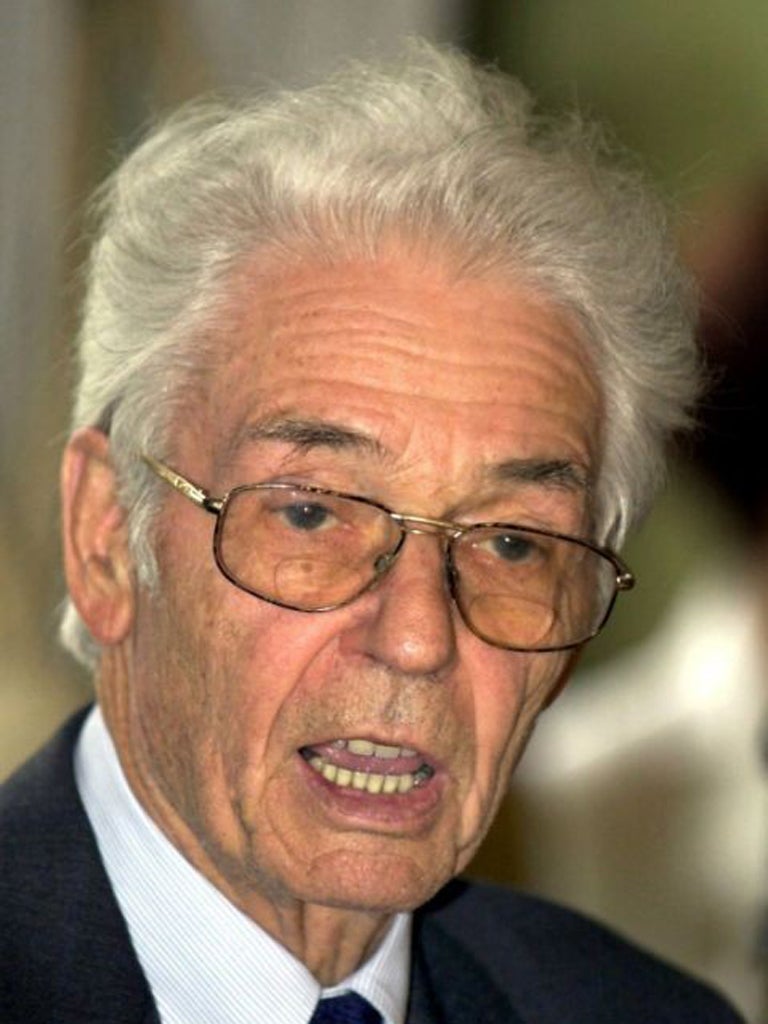
Horst-Eberhard Richter was a pscyhoanalyst best known for his study of what he called the "god complex".
He was also a leading peace activist. He was born in Berlin in 1923, the only child of an engineer, and could not help being one of the Hitler Youth generation. After compulsory labour service he was called up to the German army. From 1942-43 he served in Russia as a gun aimer in an artillery unit.
After surviving life-threatening diphtheria he was transferred to the medical corps. Service on the Italian front followed, and Richter deserted in the closing weeks of the war. Discovered by French troops as he hid in a hut in the Alps, he was lucky not to have been shot as a Werwolf, the Nazi fanatics who carried on guerrilla warfare. He succeeded in convincing a French military tribunal that he was not. Back home, he discovered that his parents had been murdered by drunken Soviet troops.
Greatly influenced by all these experiences, Richter studied medicine, psychology and philosophy in Berlin. He wrote his doctoral thesis on the philosophical dimension of pain gaining a DPhil in 1949. He graduated as a doctor of medicine in 1957. Between 1952 and 1962 he headed an advice and research centre for disturbed children and teenagers. This led to his first book, Parents, child and neurosis: the role of the child in the family... (1962). After training as a psychoanalyst and specialist in neurology and psychiatry, he was appointed professor of psychiatry, in 1962, at Geissen, in Hesse, West Germany. The war followed him in that it had been 75 per cent destroyed by Allied bombing. A sub camp of the Nazi concentration of Buchenwald had been located there.
Richter founded the Psychoanalytical Institute at Geissen University. He pioneered the development of Freud's work on the child-parent relationship, which led to The Family as Patient: the Origin, Structure and Therapy of Marital and Family Conflict (1974). This work brought him international recognition, following on from his 1972 work The Group: Hope for a new way to free oneself and others: psychoanalysis in cooperation with group initiatives was published. During this time he developed, with Elmar Brähler, the Giessen Test, which consists of 40 statements that test social resonance, dominance, control, basic mood, penetrance, social potency.
Among his best-known and most commented on books was Der Gotteskomplex (1979), which appeared in Engilsh in 1984 as All Mighty: A Study oft he God-Complex in Western Man (1984). In it he asserted that children of a certain age begin to lose trust in their parents, and the feeling that they can no longer rely on parental protection often throws them into a panic. They attempt to overcome their feelings of helplessness and to fulfill the same fantasy of omnipotence they earlier projected on to their parents.
Often, they become remote, hostile and rebellious, and unable to relate to those they need and love. Richter draws a parallel between these events of the child's world and developments in society at large. He describes a psychological rift that has "permeated the psyche of Western Man, a neurotic disturbance of mythic, even tragic proportions: the Narcissistic Ideal or Illusion of Man's Omnipotence."
Among his many other works, his autobiography A Wanderer between the Fronts: Thoughts and Memories, appeared in 2000.
In 1980 Richter became a co-founder of the German section of the International Physicians for the Prevention of Nuclear War (IPPNW) founded in 1980. He spoke at many international conferences, including, in 1982 in Cambridge, on, "Psychological effects on life under the threat of nuclear war"; "The Physicians Role in the Prevention of Nuclear War" (Moscow, 1985) and "The Danger and Prevention of Nuclear War" (Washington, 1986). In 1987 he join Mikhail Gorbachev and others in the International Foundation for the Survival and the Development of Humanity working, among other things, for better understanding between Russian and German students. He opposed both Iraq wars. After retiring in 1991 he led the Sigmund-Freud Institute in Frank-furt/Main until 2002.
Horst-Eberhard Richter, psychoanalyst and peace activist, born Berlin 28 April 1923; died Giessen 19 December 2011.
Join our commenting forum
Join thought-provoking conversations, follow other Independent readers and see their replies
Comments