Dr Michael Creeth: Scientist who helped pave the way for Watson and Crick
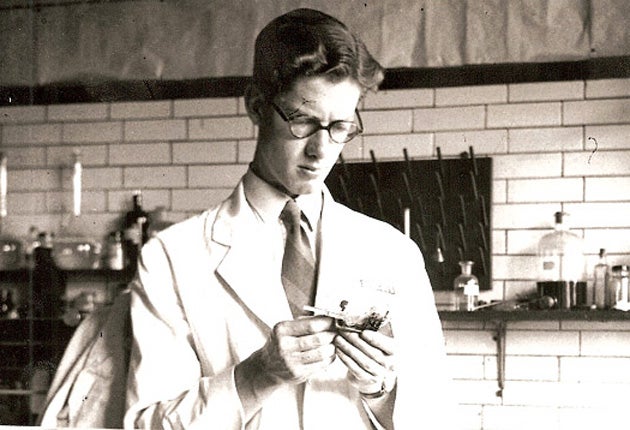
Michael Creeth had a long and distinguished scientific career and made a significant contribution to one of the greatest scientific discoveries of the last century, when as a young PhD student his experiments confirmed the existence of the special bonds known as hydrogen bonds which hold the two strands of the DNA molecule together. This finding, based on measurements of the viscosity of highly purified solutions of DNA, was published in 1947 and proved crucial for the Nobel Prize-winning discovery of the double helix six years later by James Watson and Francis Crick.
Creeth was born in Northampton in 1924 and went to the local Northampton Town and County Grammar school. He stayed in the East Midlands to read Chemistry at what was then University College, Nottingham, and after graduation commenced a PhD under the supervision of D.O. "Doj" Jordan and J.M. Gulland. Working on a highly purified DNA sample from calf thymus, a carefully performed series of measurements clearly showed the hydrogen bond link between the residues, a finding which was reported in the Journal of the Chemical Society in 1947.
In his PhD thesis – which also appeared in 1947 – he proposed a model for the assembly of the DNA molecule, with a phosphate-sugar backbone and the sugar-linked bases available for pairing. The model has two strands each made up of overlapping short chains linked by inter-chain hydrogen bonds built up into a very long and elongated molecule leading to a high relative viscosity.
At extremes of pH the hydrogen bonds are disrupted and the two-chain structure falls apart, leading to a large reduction in viscosity. Apart from the breaks in the chains – and the absence of a helix – the model is not too far removed from what was discovered in 1953 by Watson and Crick. They acknowledged how important a step the discovery of the Nottingham team was for their ultimate evaluation of the structure of DNA.
Creeth then took up a research fellowship at the Courtauld Institute of Biochemistry at the Middlesex Hospital Medical School in London, where the focus of his research switched to insulin. His subsequent research path took him to Wisconsin, Adelaide, and the former Lister Institute at Chelsea Bridge Road, London, where he became one of the leading international authorities on nature's natural lubricant – mucus, and in particular the changes in mucus associated with respiratory disease. His research helped to make significant inroads towards our understanding of the nature of diseases like cystic fibrosis, chronic bronchitis and asthma: he himself was an asthmatic.
There was a temporary setback: in the late 1970s the Lister Institute was one of the first major UK research institutes to close its laboratories after increasing financial difficulties. However, from the sale of the property part of the proceeds were used to provide the funds to enable him to continue and complete his work at the University of Bristol until his retirement in 1984.
Reflecting on the early days he had remarked that after completing his doctorate he applied to the University of Cambridge for a research fellowship. He wasn't offered this but was offered a chance instead to do another PhD there, which he politely declined. Had he done so he would have been a near-neighbour to Watson and Crick and it is interesting to speculate how different the DNA discovery story may have turned out. Mike Creeth, like his former supervisors Jordan and Gulland, was a true gentleman and highly meticulous towards his science – an approach passed down to all those privileged to have been trained by him. Scientific colleagues join with family and friends in the mourning of the loss of this good man.
Steve Harding
James Michael Creeth, scientist: born Northampton 3 October 1924; married 1954 Pat Kohout (two sons, one daughter); died Shrewsbury 15 January 2010.
Join our commenting forum
Join thought-provoking conversations, follow other Independent readers and see their replies
Comments