Elizabeth Cramp: Artist celebrated for her watercolour depictions of what she termed ‘people in their environment’
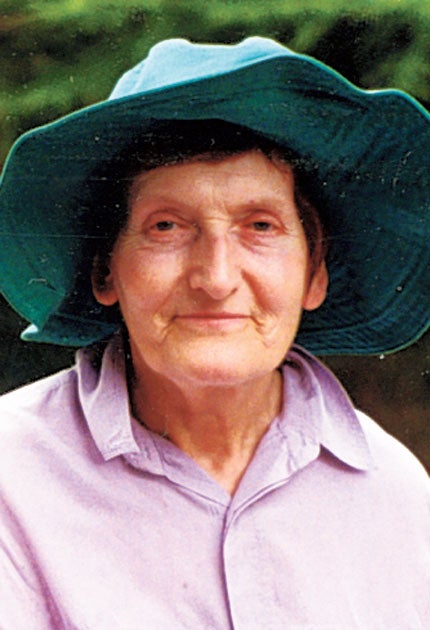
The artist Elizabeth Cramp's most considerable work was a tapestry inspired by a rather absurd footnote to history: the invasion of Fishguard by the French.
On 22 February 1797 the Irish-American Colonel William Tate's ship the Légion Noire landed in the town with 1,400 men intending to win local support and then press on to attack and burn Bristol; the 190-strong Fishguard Fencibles retreated, but a landowner, Lord Cawdor, assembled 600 men against the French and within two days the invasion collapsed and the troops fled. In 1997 Cramp was commissioned by the Fishguard Arts Society to create the Last Invasion Tapestry – as a sort of local Bayeux Tapestry – to mark the bicentennial of this event.
For almost two years, more than 70 stitchers came and went every day to Cramp's house to discuss their work and check it against the original design in her dining room, which doubled as her studio. The resulting embroidery was divided into 37 panels, in all 100 feet long and 20 inches deep. Like most artists, she was unused to working with other people but she recalled the camaraderie of the time with great pleasure and some disbelief that it had gone so well: "A lot of good things happened in this room." The tapestry was eventually shown at St Mary's Church Hall in Fishguard and now hangs permanently in the town.
Cramp was born Elizabeth Hall in 1929 in Chitcombe, a hamlet near Rye in Sussex, where her father was a gamekeeper. She attended the local school before training at the Hastings school of art under the artist Vincent Lines, before going on to the Royal Academy schools in London. For the rest of her life she regarded Lines as the greatest influence on her work.
In 1952 she married the painter Jonathan Cramp, whom she had met at Hastings, and when his National Service finished in 1954 they moved to Pembrokeshire, where Jonathan taught at Fishguard school. Theyintended to stay for a year but remained for the rest of their lives. They had a daughter, Thea, now a professional flautist. Elizabeth taught art privately and at evening classes between 1973 and 1983.
Cramp painted invariably in watercolours. She described her favourite subject matter as "people in their environment" and her work included a series of portraits of local people. She also drew inspiration from a visit to Turkey in the 1960s, and Dylan Thomas's Under Milk Wood in the 1970s. She made two visits to Japan, a country with which she felt an affinity, first in 1987 on a Welsh Arts Council grant. The resulting work was exhibited at the West Wales Arts Centre, Fishguard.
In 1991 Cramp travelled again to Japan, this time with the BBC Welsh Orchestra, where she sketched the players as they rehearsed during the day and from the wings at night while they played. The resulting pictures were exhibited in Cardiff to coincide with 1991's Japan Festival. In 1994 she was appointed artist in residence for the silver jubilee celebrations of the Fishguard music festival. Her last finished work was a commissioned portrait of Jim Wortley, the retiring head of wind instruments at Eton.
In its individuality and poetry, Cramp's work is reminiscent of that of David Jones, one of her favourite artists. Her technique was to construct intricate and idiosyncratic pictures employing subtle, delicate colours and washes. The drawing developed from this and her draughtsmanship she called "discovering the line". Cramp's lines often revealed multiple viewpoints and she frequently used wax resin in her watercolour drawings.
Already as a student she was exhibiting her work at the New English Art Club, and she went on to show at many other galleries in both Wales and London. There were one-woman exhibitions in Rye, at the Bach Festival, St Davids, at the West Wales Art Centre and at the Ceri Richards Gallery, Swansea. In 1954 she created murals at Red Lake primary school, Hastings, and for the West Wales Association for the Arts Library Scheme in 1975. Private collectors included the Prince of Wales and Cramp's work is held by the Welsh Arts Council, among many other art and educational institutions. In 1970 she was elected to the Royal Watercolour Society in London.
Elizabeth Cramp had striking red hair, loved gardening, cooking and biographies, and in character was determined and strong-willed. "To look at, she is small and bird-boned with pin-sharp eyes that miss nothing", Sir Hugh Casson, a former President of the Royal Academy, said of her at the opening of an exhibition of her work.
She suffered from cancer for over two years, having to shuttle back and forth between Fishguard and thehospital in Swansea for treatment and operations. "I discovered in hospital that I must see green – a tree oreven a leaf," she wrote in one of her last letters to a friend, the artist Maurice Sheppard.
Elizabeth Hall, artist and teacher: born Rye, Sussex 29 April 1929; married 1952 Jonathan Cramp (one daughter); died Fishguard, Pembrokeshire 1 November 2010.
Join our commenting forum
Join thought-provoking conversations, follow other Independent readers and see their replies
Comments