Elizabeth Jenkins: Novelist and biographer acclaimed for her lives of formidable women
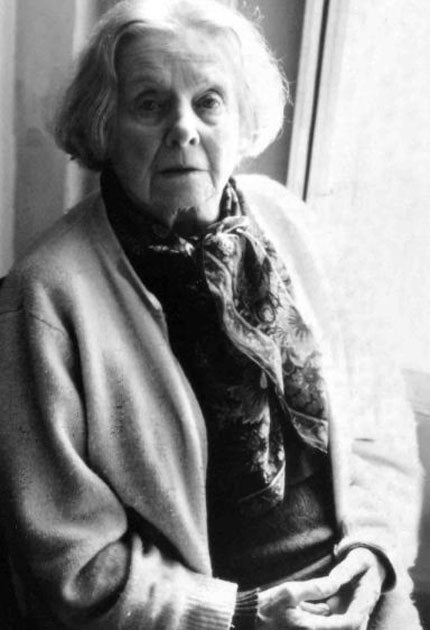
At the noble age of 100, the novelist and historical biographer Elizabeth Jenkins published The View from Downshire Hill. She subtitled it modestly "A Memoir" but that word enshrines a host of recollections of time past. It was her 24th book. Her nephew, Sir Michael Jenkins, recalls in his fine introduction how he encouraged her to write it, he tells us, as being personally "rather like her books, a combination of understanding and insight".
Elizabeth Jenkins was born in 1905 in Hitchin, Hertfordshire. Her father had opened a preparatory school there but she was educated at other establishments in the district, including a Methodist school she hated and fled to enter St Christopher's "progressive" co-educational school, from which she went on to read English Literature at Newnham College, Cambridge. She graduated in 1927.
Two years later, she published her first novel, Virginia Water, which was well received but subsequently disowned by the author. It was published by Victor Gollancz, who was to become a lifelong friend and adviser. He was to encourage and publish many of her later works.
She entered the literary Bohemian life of London, and had several encounters with Virginia and Leonard Woolf. She gives in her memoir a brilliant description of her first meeting with Virginia: ". . . she was tall and angular. Her face, despite a slightly exaggerated length, was very beautiful. Her nose was delicately aquiline, her eyes a bluish-grey, very large and deep-set . . . It was an era when skirts were very short, and her extended legs were exposed, stretched out, long and fragile, like stems of old-fashioned clay pipes."
While still at Newnham, Jenkins had been asked to take care of Edith Sitwell, who was coming to "give a reading":
"Her very tall figure, with the long oval face, the delicately aquiline nose and the domed eyebrows were familiar from photographs. The dress in which she appeared was high-necked, long-sleeved, with a wide, floor-length skirt of grass-green brocade embroidered with gold palm leaves, and she had enormous aquamarines on her fabulously long fingers."
Jenkins' father had bought her a small Regency house on Downshire Hill, Hampstead, in north London, where she was to live for the next 50 years, the most productive era in her life. In the 1930s, she published four novels, of which Harriet (1934) won the Femina Vie Heureuse Prize, presented to her by EM Forster; others were The Winters (1931) and The Phoenix' Nest (1936).
Her best-known novel came later. The Tortoise and the Hare (1954) is a roman à clef about the collapse of a marriage due to the husband's infidelity. It is, as one reviewer wrote, "a novel many women will read with horror and identification". It has been regularly reprinted over the years, most recently by Virago in 2008.
Jenkins' first biography was the deliciously "period" Lady Caroline Lamb (1932), a subject on whom nobody had ever thought of writing a book before. It was followed by Portrait of an Actor (1933 – an account of Edward Alleyn) and the sublime Jane Austen (1938).
There are many wonderful moments and flashes of wit in the portrait of "Caro", a true original who when dancing at Devonshire House boldly lifted up her lace petticoats and asked her dumbstruck partner in her bewitching lisp: "How many pairth of thilk thtockingth" she was wearing. As he just gaped, she informed him: "Thixth." She was trying to improve the appearance of her rather frail legs.
From time to time, Jenkins enjoys employing comic period archaisms, as in: "Lady Elizabeth Foster had – it boots not to inquire how – a daughter." Many other entertaining quotations adorn her biography, like the remark by Caroline's rather staid husband William Lamb:
"The general reason against marriage is this, that two minds, however congenial they may be, or however submissive the one may be to the other, can never act like one. The elegance of the form conceals the banality of the concept."
When Elizabeth, in the cause of truth, has to survey Byron's "less estimable traits", she excuses herself gracefully: "It is an ungracious task to vilify Byron, to whom everyone who is fond of poetry owes a debt of gratitude, and who had so much in his character that it is more interesting to dwell on than his faults."
But dwell on them she does, of course, and with the utmost relish, at the same time pointing out the deficiencies in Caroline, who, when she is informed that her hero has a club foot and gnaws his nails, retorts: "If he is ugly as Aesop, I must see him." When she did at last encounter her idol, she confided to her diary the famous opinion that he was "Mad, bad and dangerous to know". Jenkins slyly adds: "Much of the voluminous body of Byron biography has hardly improved on that." Byron aptly compares his "Caro" to "a little volcano".
In 1816 Benjamin Constant visited London intending to read the manuscript of his "sensational" novel Adolphe to a select few in high society. Lady Harrison Leveson-Gower remarked: "I have begged that Caroline Lamb may be there to cry and make a sensation for us." The astringency that is one of the hallmarks of the period's style is a quality often found in Jenkins' own delightful prose. Yet it can strike a noble note in describing the ultimately tragic end of a charming flibbertigibbet's existence.
While Elizabeth Jenkins's rare gift of a sympathetic style makes her book compulsively readable, it is also impeccably researched and an exemplary work of literary historical scholarship, its seriousness amply dosed with a unique wit. Its great success is remarkable when we consider that it was her first venture into biography; and that as a teacher at the King Alfred School in Hampstead she disposed of only three hours a day for her research at the British Museum Reading Room. She also paid visits of inspection to related sites like Melbourne House, then occupied by the War Office.
Her second major biography, Jane Austen (1938), is a work of total enchantment, packed with unusual information and rare contemporary details. She leads us like a companion who carries her learning very lightly through the Austen family history with its surprisingly large number of changes of residence before settling at Chawton.
Jenkins was a founder member of the Jane Austen Society, and became a leading authority on the author and her times. Her discussions of the novels reveal a mine of knowledge and human sympathy. Sense and Sensibility, for example, is treated in a style whose terms and rhythms might have been used by Austen herself. A characteristic paragraph reads:
"It is this most unusual calibre of mind that she possessed which is the inmost secret of her skill and explains, in so far as words can explain, the miracle of her achievement; and an attempt to understand it, however faintly, provides a strong warning against the folly and uselessness of attempting to establish definite connections between the world she lived in and the world of her imagination."
Jenkins had an expert eye for the fashions of the Regency. But also for the smallest, humblest items of daily life, as when Jane Austen writes to her sister, beloved Cassandra: "You know how interesting the purchase of a sponge cake is to me . . ."
The account of the acceptance of Austen's work by "Mr Murray the publisher" is a bright note before the sadness of her end, that nevertheless Jenkins does not linger unduly over. Instead, she ends with a little prose elegy for the death of literature in our times:
"This is not an age favourable to the development of artistic genius; it may be that for a time all forms of art will pass away into the domination of those who think that a good picture can be painted only if the artist's political views record with theirs, and that it is only possible to write a good novel provided the author follows the rules they have laid down."
Such calm insights, made on the eve of the Second World War, nearly 70 years ago, are even more pertinent, alas, today.
Elizabeth Jenkins's greatest biographical work is undoubtedly Elizabeth the Great (1958) which even met with the approval of AL Rowse, a scholar extremely difficult to please, but who became one of her greatest admirers. It begins:
"The aim of this book was to collect interesting personal information about Queen Elizabeth . . . There is nothing in the book which has not already been published in some form; but some of it is, I believe, very little known."
Then she follows this with a "taster" proving that Elizabeth was not bald, thus quietly but firmly putting in their place those popular historians who, like Hilaire Belloc, asserted that "at 30 she was bald as an egg". This quiet insistence on accuracy on even the smallest details was one of the creative gifts that made Elizabeth Jenkins another Elizabeth the Great.
Margaret Elizabeth Heald Jenkins, writer: born Hitchin, Hertfordshire 31 October 1905; OBE 1981; died 5 September 2010.
James Kirkup died in May 2009.
Join our commenting forum
Join thought-provoking conversations, follow other Independent readers and see their replies
Comments