Eloy Gutiérrez-Menoyo: Fidel Castro's dissident Spanish comandante
He told Castro that he would follow the family tradition and die for his beliefs

For free real time breaking news alerts sent straight to your inbox sign up to our breaking news emails
Sign up to our free breaking news emails
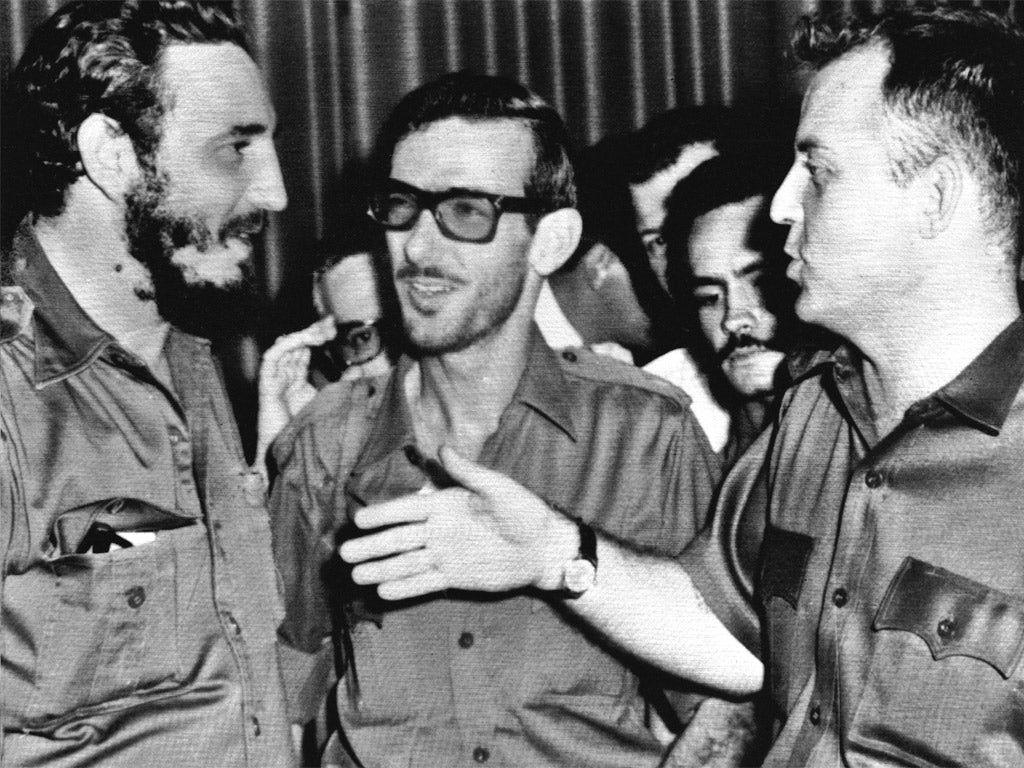
The Spanish-born Eloy Gutiérrez-Menoyo was one of three foreign comandantes of Fidel Castro's 1950s Cuban revolution – the others were the Argentinian Ernesto Ché Guevara and American William Morgan – but like Morgan he was quickly disillusioned by Castro's embrace of communism and sought to overthrow el Jefe Maximo. Unlike Morgan, shot by a firing squad on Castro's orders, Gutiérrez-Menoyo's death sentence was commuted, although he endured 22 years of harsh treatment in jail, losing the sight of an eye and hearing in one ear.
After years in exile, mostly in Miami, he was allowed back to Cuba on holiday in 2003 and, citing his Cuban citizenship, refused to leave. He was tolerated by the regime as a leading but powerless dissident, denied an identity card or office space. Castro ignored him, yet he was criticised by hardline exiles in Miami as a dialoguero, one who sought democratic change through dialogue with the regime.
Eloy Gutiérrez-Menoyo came from a family of freedom fighters, the youngest of six children of a doctor in Madrid. His father and teenage brother Jose Antonio fought in the streets as Republicans against Franco's nationalists during the Spanish Civil War. Jose Antonio was killed.
The family went into exile in France and then at the end of the Second World War emigrated to Cuba, only to find another dictator there, the US-backed General Fulgencio Batista. They became involved in anti-Batista politics and Gutiérrez-Menoyo, by then 22, joined another brother, Carlos, in a 1957 attack on the presidential palace in Havana. Carlos was killed but Gutiérrez-Menoyo escaped, fleeing to the Escambray mountains where he became commander of the Second National Front of Escambray; "Second" because Fidel Castro, with Ché Guevara, had landed in a small boat from Mexico and established a front in the south-east, near Guantanamo.
After Batista fled the country on New Year's Day 1959, Gutiérrez-Menoyo and his 3,000 men made it to Havana several days before Castro, who arrived on 8 January after crossing the island slowly by road, among cheering crowds. Gutiérrez-Menoyo's Front had always acted independently of Castro, who made sure Gutiérrez-Menoyo and his lieutenants had no significant roles in the regime.
The antagonism was obvious but the Spaniard toed the line until Castro showed his communist bent. In 1961, Gutiérrez-Menoyo fled by boat to join other exiles in Miami, and learned there that Castro had ordered a firing squad to execute the critical American comandante Morgan, who had fought beside Gutiérrez-Menoyo in the Escambray. Castro declared Cuba a socialist nation and began his long relationship with the communist Soviet Union.
Determined to see democracy in Cuba, Gutiérrez-Menoyo returned clandestinely to its mountains with men from Alpha 66, hoping to topple Castro as Batista had been ousted. But they were soon caught by Castro's forces. He was blindfolded, and taken on a 90-minute plane ride. When the blindfold was removed, he was in an office facing a cigar-puffing Fidel Castro. "Eloy, I knew you would come, but I also knew that I would catch you," said Castro. "You realise that we are going to shoot you and all of your men." Gutiérrez-Menoyo replied that, in the family tradition, he was prepared to die for his beliefs. Castro promised to spare the group if Gutiérrez-Menoyo went on television to say Cubans supported Castro. For the sake of his men, he did so and, after a half-hour trial, was sentenced to 30 years. He said his prison years were "brutal, violent and savage". The Spanish socialist Prime Minister Felipe Gonzalez negotiated his release.
He settled in Miami, where, in 1992, he set up Cambio Cubano (Cuban Change), a moderate group to promote reconciliation among Cubans, on the island and in exile. It was scorned by hardline exiles. Having retained his madrileño accent, he was nicknamed el Gallego, the Galician, often used by Cubans as a nickname for people of Spanish origin. Cambio Cubano had little effect and, during that 2003 holiday, he decided to stay in Cuba.
He wanted to die here," his daughter Patricia said. "No one loved this island more than he did." He died there of a heart attack.
Eloy Gutiérrez-Menoyo, revolutionary and dissident: born Madrid 8 December 1934; married firstly Gladys Teresa Martinez (three sons), secondly Flor Ester Torres Sanabria (one daughter); died Havana 26 October 2012.
Subscribe to Independent Premium to bookmark this article
Want to bookmark your favourite articles and stories to read or reference later? Start your Independent Premium subscription today.
Join our commenting forum
Join thought-provoking conversations, follow other Independent readers and see their replies