Frank Munro: Tough but stylish footballer who was a key figure for Wolves in their most successful period since the 1950s

For free real time breaking news alerts sent straight to your inbox sign up to our breaking news emails
Sign up to our free breaking news emails
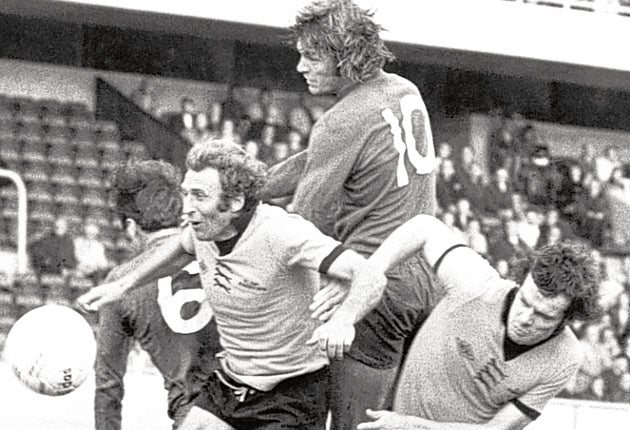
Once described unforgettably by a Wolverhampton Wanderers fan with an inspired turn of phrase as "an E-type Jaguar inside a Sherman tank", Frank Munro was not only a redoubtable bulwark of the Black Countrymen's defence during the late 1960s and most of the 1970s, but also a stylish and occasionally audacious entertainer. The Scottish international was an imperious cornerstone of the accomplished Wolves side which reached the Uefa Cup final in 1972, then won the League Cup two years later, and after they were relegated in 1976 he captained them back to the First Division – the equivalent of today's Premier League – at the first attempt.
The rock-like six-footer from Broughty Ferry was strong enough to slug it out with the most physical of centre-forwards when required, never yielding an inch when the going got tough, but he could also bring to the game an engaging touch of elegance a tad surprising in a stopper so mountainously built. When not tackling ferociously or soaring combatively into aerial duels, Munro could control the ball assuredly, pass it perceptively and even embark on a deft dribble which was clearly a legacy of his earlier days as an inside-forward.
Invariably, too, he radiated confidence and composure, precious qualities at the heart of any rearguard, and beyond that, for all the raw physical endeavour demanded of any top-flight defender, somehow his play was infused with his own personality, which was sunny. He loved playing football for his living, the Molineux fans picked up on that happy circumstance, and they adored him for it.
The Munro career, which yielded four caps each at youth and under-23 level, and then a further nine for the senior team, got off to a false start when he headed south to join Chelsea as a promising teenage forward in 1961. He failed to make the grade and never turned professional at Stamford Bridge, heading back to his home city to sign for Dundee United in July 1963.
His star began to rise so rapidly that soon he was spoken of as "the Scottish version of Duncan Edwards", a memorably daft and unrealistic tag of which he made light to become established at Tannadice as an attacking midfielder in 1964-65. Somewhat surprisingly, in October 1966 he was sold to top-tier rivals Aberdeen for £10,000 and made a rapid impact at Pittodrie, appearing in that season's Scottish Cup final defeat by Celtic.
That qualified the Dons for the European Cup-Winners' Cup, as that season Jock Stein's Bhoys won every major trophy available to them, and thus in 1967-68 were attempting to retain the top prize, the European Cup. Munro made the most of the opportunity, netting a hat-trick – including the club's first goal in continental football – as the Dons kicked off the campaign with a 10-0 home annihilation of the Icelandic side Reykjavik in their opening match.
By then, however, the young Taysider's footballing destiny had been decided by an eye-catching display, and another hat-trick, during a tournament that summer in the US. While playing for Aberdeen, in the guise of the Washington Whips for the purposes of the competition, he shone against Los Angeles Wolves (actually the men from Molineux) in the final, in the process riveting the attention of their manager, Ronnie Allen; the upshot was a £55,000 transfer to Wolverhampton in January 1968.
Mirroring his previous under-achievement in England, at first he struggled to make a mark, and it was not until he was converted frommidfielder to centre-half by Allen's successor, Bill McGarry, that he began to excel. First partnering JohnHolsgrove and then, for three-quarters of a decade, John McAlle, Munro became a key figure in an exhilarating side featuring the likes of midfielders Mike Bailey, Kenny Hibbitt and Jim McCalliog, winger Dave Wagstaffe and forwards Derek Dougan and John Richards.
In 1970-71 they finished fourth in the League title race and picked up the low-key Texaco Cup at season's end. In the following spring Munro starred and captained as Juventus were overcome in the quarter-finals of the Uefa Cup, then he scored in both legs of the semi-final win over Ferencvaros and put in a mighty shift as Wolves lost the final, 3-2 on aggegate, to Tottenham Hotspur. However, his best-remembered goal that term arrived in its closing night in a 2-1 victory over Leeds United which meant Don Revie's side missed out on the Championship, and thus a League and FA Cup double.
In 1972-73 Munro and Wolves suffered the mortification of semi-final defeat in both domestic knock-out competitions, but there was a major trophy to brandish at last in 1974 when Manchester City – Law, Lee, Bell, Summerbee et al – were beaten 2-1 in the League Cup final at Wembley.
Meanwhile Munro's exertions for his club had earned him full international honours, with four caps in 1971, the first being as a substitute for Frank McLintock in a 1-0 reverse to Northern Ireland at Hampden Park. In truth, his Scotland career never really ignited, and there followed a hiatus until he was picked five more times in 1975, his frustration highlighted by the fact that he finished on the winning side for his country only once, again against the Ulstermen in Glasgow. There were those who believed he deserved to be an international regular throughout his prime, but given that his competitors for a central-defensive berth included Billy McNeill (at first), Martin Buchan, Gordon McQueen, Jim Holton, Bobby Moncur and Colin Jackson, that was never likely.
Still, Munro remained a potent force for Wolves, even when they weredemoted in 1975-76, and after a fleeting loan stint with fellow Second Division side Hereford United he returned to Molineux to captain the West Midlanders to promotion as champions at the first attempt. Differences arose with the new manager Sammy Chung, however, and in October 1977 he was loaned to Celtic, the club he had idolised as a boy.
After being made temporary captain for his debut, at home to St Mirren, his day turned sour as he scored an own goal in a 2-1 defeat. Still, manager Jock Stein saw enough in the 30-year-old to pay £20,000 for his services that December, ending a contribution to the Wolves cause of 371 games (with 19 goals) which leaves him 20th in the club's all-time appearance list.
Munro, the last signing of Stein's illustrious Parkhead reign, was seen as a natural replacement for the seriously injured Pat Stanton, but at a time when the side was struggling – they finished fifth in the league table, 19 points behind champions Rangers – things never quite gelled and the peak of Munro's tenure was playing on the losing side against their Glasgow rivals in that season's League Cup final.
In the spring he was given a free transfer and enlisted with South Melbourne Hellas, managed by the former Wolves goalkeeper DaveMacLaren, combining his football with a job as an airport traffic officer. Later he coached briefly with Albion Rovers before guiding the fortunes of several Australian clubs.
Munro, who returned to Wolverhampton in 1991, suffered a stroke in 1993, after which his health continued to deteriorate, but despite being wheelchair-bound he was a regular attender at Molineux and an active member of Wolves' former players' association. An effervescent character, he bore his incapacity with remarkable courage, retaining his infectious sense of humour to the last.
Ivan Ponting
Francis Michael Munro, footballer: born Broughty Ferry, Dundee 25 October 1947; played for Dundee United 1963-66, Aberdeen 1966-68, Wolverhampton Wanderers 1968-77, Celtic 1977-78; capped nine times by Scotland 1971-75; married (separated; two sons); died Wolverhampton 16 August 2011.
Subscribe to Independent Premium to bookmark this article
Want to bookmark your favourite articles and stories to read or reference later? Start your Independent Premium subscription today.
Join our commenting forum
Join thought-provoking conversations, follow other Independent readers and see their replies