Hazel Court: Forties film heroine who later became a cult favourite as a horror movie 'Queen of Scream'

For free real time breaking news alerts sent straight to your inbox sign up to our breaking news emails
Sign up to our free breaking news emails
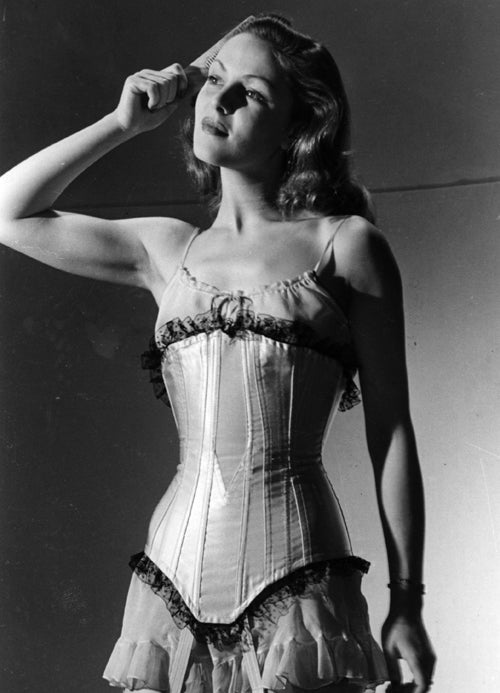
Pert and pretty, Hazel Court was a versatile actress who for several years was the epitome of the deceptively demure, often spunky, but very English heroine in British films of the Forties. Her engaging performances in such films as Dear Murderer and Holiday Camp have become largely forgotten, however, due to Court's emergence in the Fifties as the star of early Hammer horrors and the stylish Edgar Allan Poe adaptations made by Roger Corman with such horror icons as Vincent Price, Boris Karloff and Peter Lorre, which made her a cult favourite with fans of the genre and earned her the label "the Queen of Scream".
The daughter of a professional cricketer, G.W. Court, she was born in Birmingham in 1926 and set her sights on an acting career at an early age. Although her family moved to Sutton Coldfield when she was six months old, she gained her first stage experience with the Birmingham repertory company. When her enterprising sister sent Court's photograph to the director Anthony Asquith, he referred her to Ealing Studios for an interview, and she was given a small role in Champagne Charlie (1944), a salute to Edwardian musical halls starring Tommy Trinder and Stanley Holloway.
Court had one line – "I've never had champagne before" – but she had a better role as leading lady to the comedians Flanagan and Allen in Dreaming (1944), followed by another period musical, Gaiety George (1946). Her popularity grew when she played Sally Gray's crippled sister in Carnival (1946) and Phyllis Calvert's sister in The Root of All Evil (1947), and she had a telling part as a feisty secretary whose fiancé (Maxwell Reed) temporarily ditches her when he falls for the charms of a vamp (Greta Gynt) with a lethally jealous husband (Eric Portman) in Arthur Crabtree's serviceable adaptation of the hit play Dear Murderer.
She was given her first starring role teamed with the American actor William Eythe in Meet Me at Dawn (1947), Thornton Freeland's limp comedy about the escapades of a professional duellist, but she followed it with one of her most memorable performances when loaned to Gainsborough Films to play a leading role in Ken Annakin's Holiday Camp (1947). Annakin's first feature film after six years of making documentaries, the film captured the mood of its time with its economical and imaginative script and its effective use of location footage of a real holiday camp.
"Among a group of young actresses lent to us by Rank," wrote Annakin in his autobiography, "the most outstanding and beautiful was Hazel Court, who incidentally became a friend for life. She played the daughter of Jack Warner and Kathleen Harrison [in their first appearance as the Huggetts] and represented the millions of girls who had lost their men in the war, but were hanging in there."
Holiday Camp was a great success – "The Huggetts absolutely caught the spirit and feeling that existed after the war," said Annakin – and it stands up well today, but Court's subsequent starring roles were in weak movies – a portmanteau film about items being prepared for a wedding, Bond Street (1948), a laboured comedy despite a script by Terence Rattigan and Rodney Ackland, and My Sister and I (1948), an artificial murder mystery that did little for Court or Sally Ann Howes, who played her sister. Also in the cast was Dermot Walsh, who became Court's husband in 1949.
One of Court's better films was George King's Forbidden (1949), in which she gave a spirited portrayal of a fairground ice-cream vendor who falls in love with a married man (Douglas Montgomery) while fending off the advances of a shady spiv, Kenneth Griffith.
She starred with Walsh in two lively "B" thrillers, Ghost Ship (1952) and Counterspy (1953), then in 1954 she played in the first of her "cult" movies, the low-budget sci-fi tale Devil Girl from Mars, in which a leather-clad Martian (Patricia Laffan) comes to Earth to take men back to her female-dominated domain. Lack of funds for special effects resulted in moments like that in which a transformation shot of Laffan is achieved by a simple photographic effect of a rippling image, prompting one onlooker to comment, "Ooh, look, she's gone all wobbly." "That film haunts me!," said Court in a 1990 interview: "Everywhere I go people say, 'Oh, I saw you in Devil Girl from Mars!' I think it only took about two weeks to shoot and it was made on a shoestring. We got paid next to nothing."
After several more "B" movies and a television series, Dick and the Duchess (1957), in which she starred with Patrick O'Neal, Court's red hair and green eyes were seen in colour for the first time when she was cast in the role which would redefine her persona, Terence Fisher's The Curse of Frankenstein (1957), which not only changed the course of her career, but launched the Hammer horror cycle, stretched existing boundaries of gore, and teamed Peter Cushing and Christopher Lee for the first time. "I always thought Peter was living in the wrong century," said Court. "He should have been born in the 1880s. It seemed odd to think of him in the modern day because he gave the impression that he belonged in a costume."
Court's next Hammer movie was Fisher's The Man Who Could Cheat Death (1959). "I think a reason those films were so successful," said Court, "was that we all took them very seriously, and managed to convince the audience of our sincerity. There was no tongue-in-cheek attitude until we made The Raven, which was meant to be funny!"
Court was nurse to a mad doctor (Kieron Moore) in her next Hammer movie, Dr Blood's Coffin (1960), then in 1962 she made the first of three films in which she was directed by Roger Corman, The Premature Burial (1962), at the climax of which Ray Milland shovels dirt on her as she lies in a grave. "I was really in there doing my own stunt. The scene required me to hold my breath for a full minute, but they did use cork instead of actual dirt."
Court described Corman's The Raven (1963) as her favourite film "because everybody laughed and joked and it was fun to work with three such talented giants of horror films, Vincent Price, Boris Karloff and Peter Lorre. Karloff was a great charmer, and Peter had great sex appeal. When Peter talked to you, it was as if you were the only person in the world." In 1963 Court divorced Walsh, having established a home in the United States, where she worked frequently on television between movies, and in 1964 she married the actor-director Don Taylor, who had directed her in an episode of the TV series Alfred Hitchcock Presents. (As an actor, Taylor is best remembered as the young man who marries Elizabeth Taylor in Father of the Bride.)
Nineteen sixty-four was also the year of Court's last major film role, and the most admired of her Corman films, the gaudily exotic Masque of the Red Death, with Vincent Price. "Vincent would always have a twinkle in his eye on the set, laughing and joking, but when we would be shooting, he'd flip right back into character," she said. "We became very good friends. In fact it was Vincent who encouraged me with my painting, which eventually led to sculpting. He loved my work and even bought a number of them."
After retiring to bring up her family, she further developed her interest in sculpture, travelling to Italy every year to carve, and her work was exhibited in public galleries. After Taylor's death in 1998 she enjoyed attending movie conventions and corresponding with fans. She had recently completed her autobiography, due for publication next week, its title reflecting the genre for which she accepted that she was best known, Hazel Court: Horror Queen.
Tom Vallance
Hazel Court, actress: born Birmingham 10 February 1926; married 1949 Dermot Walsh (died 2002; one daughter; marriage dissolved 1963), 1964 Don Taylor (died 1998; one son, one daughter); died Los Angeles 15 April 2008.
Subscribe to Independent Premium to bookmark this article
Want to bookmark your favourite articles and stories to read or reference later? Start your Independent Premium subscription today.
Join our commenting forum
Join thought-provoking conversations, follow other Independent readers and see their replies