Howard Zinn: Historian whose criticisms of American social policy made him a hero of the Left
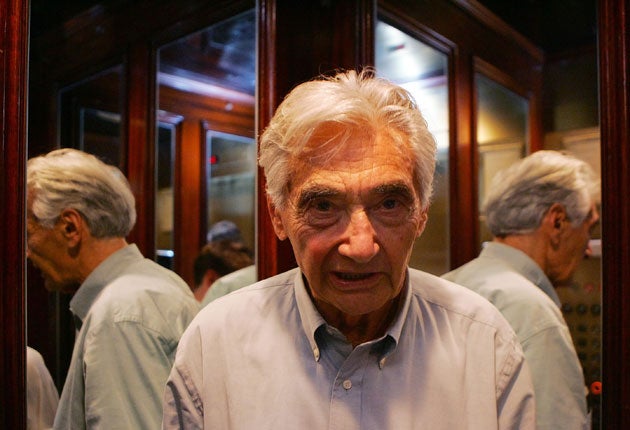
In 1980, the historian and activist Howard Zinn published The people's history of the United States, which turned inside out the traditional perspectives of American history. Zinn portrayed many of America's heroes as perfidious villains and transformed the triumphalist narrative of American progress into a litany of unfettered power-abusing and exploitation of the poor, people of colour, immigrants, workers, and all the disenfranchised who had lacked a voice in mainstream histories. Originally published with a print run of 5,000, the book became a staple of many history courses, and its spin-offs, including a young-people's version, a comic-book, and an abridged history of the 20th century, have gone on to sell 2 million copies.
Critics, and even some obituarists, accused Zinn of failing to show "balance", but Zinn insisted his book was one small counterweight to the overwhelming bias of mainstream history toward the political, economic, and social elites, and its implicit assumption of idealistic nationalism, capitalism, and imperialism. His refusal to credit the likes of Jefferson, Lincoln, or the Roosevelts with progressive achievements, while highlighting their shortcomings, infuriated mainstream "liberal" historians, while his steadfast opposition to wars saw right-wingers targeted him as an "appeaser".
But unlike many of his most virulent critics, Zinn had lived out the positions he argued. He opposed war as a decorated military flyer, championed labour as a former shipyard worker, and had risked jobs and jail protesting and working for civil rights and against the Vietnam war. Indeed, this willingness to ignore careerism appeared to infuriate many of his fellow academics as much as his insistence that meaningful change could only arise from the collective will of ordinary people, not heroic leaders. His views, and his passionate presentation of them, made him a favourite of successive younger generations; Zinn's History is the book Matt Damon extols in the movie Good Will Hunting.
Although a public figure in Boston, Zinn was born in Brooklyn to Jewish immigrant parents. His father ran candy stores, peddled off a push-cart, worked in factories, and moved the family through what Zinn called "every slum in Brooklyn" staying ahead of landlords. His parents introduced him to books via an edition of Dickens sold as a premium with the New York Post, and he studied writing in high school. After graduating he went to work in Brooklyn's navy yard, and at 17 he joined an anti-fascist rally organised by the Communist Party in Times Square, and got his first lessons in the uses of power when police attacked the peaceful demonstrators.
With the outbreak of war he could have stayed in his essential shipyard job but he joined the Army Air Corps, flying as a bombardier on B-17s from Britain. He dropped the first napalm attack, on retreating German soldiers at Royan, France, killing hundreds of civilians. He learned another indelible lesson; after the war he sealed his medals in an envelope marked "Never Again". Nine years later he returned to Royan, gathering documents and testimonies that proved that the official military history of the bombing, which minimised civilian casualties, was a lie.
After the war he married Roslyn Schecter, whom he had met at the Navy Yards, and after working as a labourer entered New York University on the GI Bill, receiving his BA in history in 1951. He took his MA and PhD at Columbia University; his masters' thesis examined the Colorado mining strikes that culminated in the infamous Ludlow Massacre, while his dissertation, on the radical Congressional career of New York mayor Fiorello LaGuardia, became a prize-winning book in 1959.
However, by the time his PhD was awarded in 1958 he was already head of the history department at Spelman, an historically black women's college in Atlanta, where his students included the future novelist Alice Walker. He became advisor to the Student Non-Violent Coordinating Committee (SNCC), then at the forefront of the civil rights movement, and his frequent clashes with Spelman's administration over its resistance to its students being involved in the civil rights struggle led to his being fired, despite being a tenured department head, in 1963. Meanwhile, he wrote two books, a study of segregation's background called The Southern Mystique (1964), and, in the same year, a study-cum-manifesto, SNCC: The New Abolitionists, whose call to rejection of authority and respectability echoed the course of Sixties radicalism and Zinn himself.
He began teaching at Boston University in 1964. Having studied East Asian politics as a visiting fellow at Harvard, he became deeply involved in the anti-war movement, publishing Vietnam: the logic of withdrawal in 1967. In 1968, Zinn travelled to Hanoi with Father Daniel Berrigan, and negotiated the release of three captured American pilots. And when Daniel Ellsberg leaked classified Defense department documents, known as the Pentagon Papers, to the press, he left a copy with the Zinns, and Howard edited, along with his friend Noam Chomsky, the Beacon Press edition. He also testified for nearly a full day at Ellsberg's trial, explaining to the jury the history of US involvement in South-east Asia.
Although his classes at Boston University were popular with students, Zinn inevitably clashed with the university's administration. He led faculty strikes and refused to cross picket lines of university workers, and on his final day of teaching, in 1988, he ended his last class early to join a picket line. Upon his retirement, Zinn's book output grew to match the demand created by the success of the People's History, and he kept busy with lecture tours and journalism, particularly in the left-wing weekly The Nation. He wrote his first play, Daughter of Venus, in 1984, and later updated it from the cold war to terrorism; two more plays, Marx in Soho (1999) and Emma (2002) about the anarchist Emma Goldman, followed. His memoir, You can't be neutral on a moving train (1994) was billed as a "personal journey".
The second Iraq war found Zinn's commentaries more in demand than ever. His textbooks and theories may have drawn sharp criticism, but his political stances had most often been proven right by history, and he became a lightning-rod around whom opponents of the Bush-Cheney invasion could rally and at whom defenders of the establishment could direct their opprobrium, something Zinn relished. But it was worrying that the leaders of anti-war activism were men who had been elder statesmen to a generation of protest four decades earlier.
Zinn was honoured many times for his activism, being given the Thomas Merton, Eugene Debs, and Upton Sinclair awards; he also received a Lannan literary prize. Roslyn's death in 2008 slowed him only slightly. He died on a lecture tour of a heart attack suffered while swimming.
Michael Carlson
Howard Zinn, historian and activist: born Brooklyn, New York 24 August 1922; married Roslyn Schecter (died 2008; one son, one daughter); died Santa Monica, California 27 January 2010.
Join our commenting forum
Join thought-provoking conversations, follow other Independent readers and see their replies
Comments