Inge Laird: Poet who was a guiding light of New Departures publications and the Poetry Olympics
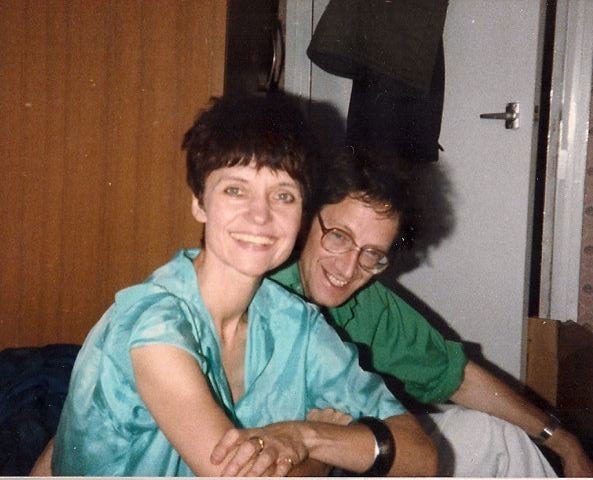
Inge Laird was a rara avis among artists and writers in the near ego-less purity of her aspirations and achievements. More piano and less ostentatious – but no less coherent – than Keats, Dylan Thomas or Philip Larkin, she celebrated even her own life's transience: "what little I have/drifts quietly towards/the open window".
Inge Elsa Laird was born in Düsseldorf in 1939, the younger child of Margarete and Robert Drenker. Her mother's parents sold trucks in Düsseldorf, and when Grete and Robert married they co-founded a heavy lorry transport company. Inge's father was conscripted soon after her birth and paid scant further attention to his family. After the war Grete was left in possession of one truck to run with its remaining driver, whom she later married. Inge and her brother Günther lived with their mother and stepfather in a small flat way out of town. It took the children more than an hour to walk to school and back every day, which nurtured Inge's lifelong love of nature and the countryside.
Notwithstanding her dark-shadowed origins, Inge also retained happier memories of her childhood – of being a dab hand at basketball and other sports, and evidently popular with high-spirited fellow students. She was equally joyful recalling after-school camaraderie, fun and first loves that gathered momentum around Düsseldorf's vibrant New Orleans Jazz Club. In 1962 she came to London, partly with a view to brushing up her English, and first earned her keep as a model for art classes at the Richmond Institute. Barbara Laird, mother of the professional brass musician Michael Laird, attended the class, and introduced Inge to her son in January 1963. They married early in 1964, and their only child, Nicola, was born that autumn. Inge was delighted when two grandchildren, Benita and Max Laird-Hopkins, emerged in 1992 and '95 and she instantly warmed to the role of devoted and much loved grandmother.
In the late 1960s she enjoyed working in the Richmond bookshop of a Holocaust survivor, Dr Houben, who expanded her already considerable literary and socio-historical awareness. After this she worked as a ticket agent for Lufthansa in Piccadilly, where she got on famously with staff and customers for 20 years (she particularly relished the amount of freeish air travel worldwide the job facilitated).
From the early 1980s on she wrote highly original and perceptive book reviews for the Jewish Chronicle, New Democrat and Financial Times, where some of her mind-stilling minimalist verse and lyrical prose also first appeared. "Time" is fairly typical of her earliest poetry: "Boiling eggs takes / 5 minutes / cutting bread takes less / putting butter and / salt on the table / still less / the coffee is ready / it is time / to sit / and as we listen / to the news / it becomes quite clear / we have no time / at all."
From 1982, when she and I first met, Inge co-edited various New Departures publications, including the POW! (Poetry Olympics Weekend) and POP! (Poetry Olympics Party) Anthologies, and co-organised many Poetry Olympics festivals and Jazz Poetry SuperJams, mainly at London venues ranging from Westminster Abbey and the Astoria, Ronnie Scott's and the 100 Club to the Stratford East, Young Vic and Queen's Theatres, the South Bank Centre and Royal Albert Hall. Her cosmopolitan fluency was instrumental in our gathering the likes of Kazuko Shiraishi, Miroslav Holub, Patti Smith and the blind multimedic bard Moondog, who gave his last performance at the age of 80 at our Poetry Olympics Marathon in 1996.
Laird's own compelling stage presence and intimately cadenced voicings gradually attracted a cult following for her performances in English and German across the UK and also in Germany, Italy, North America and Japan. In 2001 Maja Prausnitz's Elephant Press published an elegant booklet, Poems, and in the following year Laird released a CD recording of her renditions of the same selection (both still available via gretchen@blackspringpress.co.uk).
Her political engagement as both artist and activist was as effectiveas it was uncompromising. Unlikesome who only preach or publish, she made a point of wedding ideals toactions – frequently, for example, taking food, blankets and other supplies and back-up at expense she could ill afford to ailing, down-and-out and homeless citizens.
Despite increasingly unfair shares of health setbacks, Inge never lost her zest and talents for humorous takes on life's vicissitudes and ironies. During a walk round her home turf of Wimbledon Common, she gleefully pointed out how the wording on one of the benches donated by and embossed with the names of municipal dignitaries had been altered by a local wag. This bench's donor, called something like Brig-Gen Marmaduke Chumley-Tomkins, had chosen for epitaph the fact that he"... loved walking in this Common" – but the letter "l" of "walking" had been immaculately replaced by "n".
She also never lost her delicacy of phrase or her lilting continental accent. Her grace, charm, beauty and spontaneity attracted all manner of attentions, some more welcome than others. But she was more amused than affronted by spectacles such as the bate the famed Lothario Warren Beatty got into when, at a chance encounter in Hamburg, she proved amiably impervious to his blandishments.
She loved all the arts and embodied an extraordinarily rich spectrum of cultural appreciation and scholarship. When still a schoolgirl she completed a monograph on Leonardo, and later delivered papers and seminars on subjects including her beloved JS Bach, and the literature, arts and music of the Holocaust. Among those whose works she continually returned to were Blake, Hölderlin, Heine, Brecht and Weill, the Comedian Harmonists, Simone de Beauvoir, Paul Celan, Woody Allen, Sylvia Plath, Primo Levi, RB Kitaj, the West-Eastern Divan Orchestra, as well as the poet Frances Horovitz and film-maker Rainer Werner Fassbinder, both of whom she befriended.
Some of her last writings were imbued with sonorous, graphic, uncomplaining and fearless intimations of mortality: "... the feminine spirit / hears the blackbird / high above in love song / taming the wind /... the inconclusive skirmish ends /... the song will finally / take me away / like weaving rain / far and near".
Inge Elsa Drenker, writer, translator, interpreter, editor, teacher: born Düsseldorf 19 January 1939; married 1964 Michael Laird (one daughter); died London 3 January 2011.
Join our commenting forum
Join thought-provoking conversations, follow other Independent readers and see their replies
Comments