Jack Kemp: Politician who championed the cause of supply-side economics
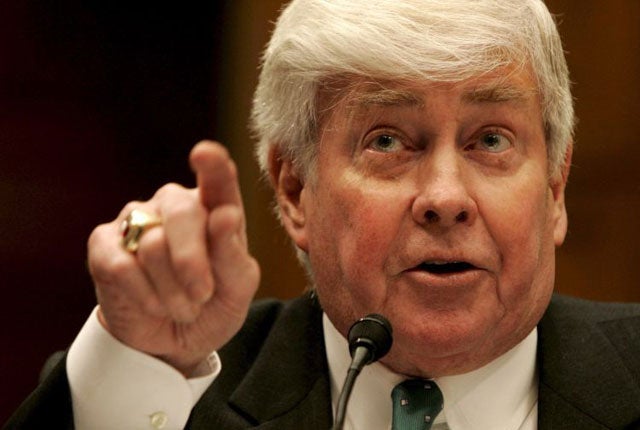
Jack Kemp was a bundle of contradictions. He was a top-flight American football player who became one of the country's most prominent politicians, serving on Capitol Hill, as a cabinet secretary under the first President Bush and, in 1996, as his party's vice-Presidential candidate. He was a staunch conservative, but also a powerful advocate for minorities and the poor. For many, he was never more than a simple jock. Arguably however, his most lasting political impact was intellectual: as champion of the supply-side theories that dominated Republican economic thinking for a generation.
Kemp first embraced the cause in the mid-1970s, a few years after he had given up playing for the Buffalo Bills to represent the city as a Congressman. By 1978, he and a fellow group of Republican enthusiasts were bringing tax-cutting bills to the floor. The Democratic majority of the day meant that none passed, but the issue gave decisive ammunition for Ronald Reagan in his triumphant 1980 White House campaign, and remained the cornerstone of Republican economic orthodoxy until the twilight of the younger President Bush.
No believer was more passionate than Kemp. Within months of Reagan's election, his first goal was met with the passage of a bill that Kemp co-authored, reducing taxes by almost a quarter for an initial three-year period. Tirelessly he pressed his agenda of economic growth, free markets and free trade. Deficits for supply-siders did not matter: faster growth and surging personal incomes and business profits would recoup almost all, if not all of the revenue initially lost.
By the late 1980s, Kemp was positioning himself as Reagan's spiritual heir and successor. But his presidential campaign of 1988 never really got off the ground. From the outset he trailed his two more moderate rivals, vice-President George H. W. Bush and Bob Dole, the then Senate minority leader (who eight years later would enlist Kemp as his own running-mate, despite the hearty dislike the two nursed for each other). After a dismal showing on "Super Tuesday" that March, he dropped out of the race. But he would remain a pivotal figure in Republican politics throughout the next decade.
Jack Kemp grew up in a heavily Jewish part of west Los Angeles, where his father ran a trucking company. From his earliest days he wanted to be a gridiron player, even though at 5ft 10in he was on the small side for the sport. After graduating from Occidental College (attended years later by Barack Obama) he was picked up and discarded by several teams before being signed by the Los Angeles Chargers of the newly founded American Football League in 1960. After the Chargers moved to San Diego the following year, Kemp led them to a 12-2 season, before injuring his shoulder. He was then acquired by Buffalo, winning two AFL championships with the Bills before retiring after the 1969 season, the AFL's last before it merged with the older established National Football League.
The switch to politics was less remarkable than it appeared. Kemp had served as president of the AFL players' association – in effect their trade union – and had campaigned for many leading Republican politicians of the era, including Barry Goldwater, Nelson Rockefeller and Richard Nixon. As a top-flight sports star, he not only was as well-known as most career politicians but had devoured the works of conservative thinkers like Goldwater, Ayn Rand and Friedrich von Hayek. As a former team-mate recalled to The New York Times, on long trips "he was reading these political books, while we were reading comic strips."
Football also fuelled Kemp's other great political cause, the improvement of life for poor people, especially blacks. The football huddle, it is said, is colour-blind – or as Kemp himself put it later, "I can't but care about the rights of people I used to shower with." African-Americans genuinely trusted and respected him. In 1992 Kemp, the self-described "bleeding heart conservative" would be about the only member of a Republican administration who could go to Los Angeles after the race riots without fearing for his personal safety.
In Congress he quickly made an impression. By 1974, Time magazine was hailing him as a potential national leader and when Reagan came to power in 1981, he was elected chairman of the Republican conference, the third- ranking party position in the House of Representatives. Had he won the presidency in 1988, Kemp would have been the first sitting Congressman to ascend to the White House since James Garfield, the 20th president, in 1881, but it was not to be. He switched his hopes to the vice-presidency, but that job too eluded him, going to the virtually unknown Dan Quayle.
Instead Kemp became Secretary of Housing and Urban Development. His tenure was not particularly happy. He threw himself into the job with his trademark energy, but clashed with colleagues, irritated by his pushiness and verbosity. As the elder Bush's presidency ran into trouble, Kemp manoeuvred to be put in charge of the administration's domestic policy, further infuriating his boss. He was also congenitally unable to hide disagreement with colleagues. "My body language," he used to acknowledge, "was as bad as it could be."
After Bush's defeat by Bill Clinton in 1992, Kemp took to the lecture circuit, in anticipation of what everyone expected would be a second White House run in 1996, as one of the obvious favourites for the Republican nomination. But in early 1995, he surprisingly took himself out of contention, insisting his brand of libertarian conservatism was out of step with current Republican thinking. But he remained a star in a party short of them, and it was not entirely a surprise when Dole, the eventual 1996 nominee, picked Kemp as his running-mate, despite their well-known antipathy.
Dole was a plodding and mediocre campaigner, and at 73 would have been the oldest man ever elected president. Kemp was thus a natural fit on the ticket – a dozen years younger and a compelling speaker who might appeal to the black and minority voters among whom Republicans traditionally fared poorly. But once again it was not to be. Bill Clinton easily won a second term, and Kemp left the national political spotlight again, this time for good.
Rupert Cornwell
Jack French Kemp, professional American Football player and politician: born Los Angeles 13 July 1935; starting quarterback with the Los Angeles, then San Diego Chargers 1960-62, Buffalo Bills 1962-1969; Member of Congress, 1971-1989; Secretary of Housing and Urban Development, 1989-1993; Republican party vice-Presidential nominee 1996; married 1958 Joanne Main (two sons, two daughters); died Bethesda, Maryland 2 May 2009.
Join our commenting forum
Join thought-provoking conversations, follow other Independent readers and see their replies
Comments