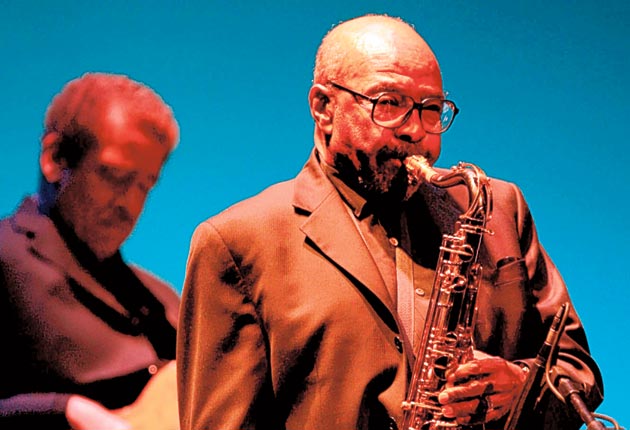
James Moody: Revered jazz saxophonist and flautist who formed a charismatic partnership with Dizzy Gillespie

For free real time breaking news alerts sent straight to your inbox sign up to our breaking news emails
Sign up to our free breaking news emails
Although he counts as a Bebop pioneer, James Moody's work had the elements of basic jazz at its root.
His role as Dizzy Gillespie's musical partner sometimes cast him in shadow, but he was a match for the trumpeter in every aspect of his playing. His powerful sense of humour also went to generate the charisma in which the two men bathed their audiences.
Few musicians swung harder than Moody and his mastery of the blues was part of his unique eloquence. Technique came easily to him and his fluency on the tenor and alto saxes and on the flute was unrivalled. He was born in Georgia, but grew up in Newark, New Jersey. "I think I was almost 17 when I was given an alto sax in the school orchestra," he told me. "At that time I didn't know my head from a hole in the ground, but when I was drafted into the US Air Force in 1943 I really got to be familiar with the instrument.
"My mother bought me a tenor just before I got drafted. I was stationed in Greensboro, North Carolina and Dizzy's big band came to play at the base. He told me that he was going to regroup the orchestra and since I was due for discharge in a month or so he suggested I should come to New York and try out for him. He didn't hear me play. I'd just told him I was in the camp band."
Moody became a member of Gillespie's second great big band, formed in 1946. They recorded a session for RCA Victor almost immediately and the half-dozen tracks remain classics, not least "Emanon" (spell it backwards), which included Moody's first solo on record. At that time "modern jazz" was still controversial, and sales didn't encourage RCA Victor to press on further.
"In those days with Dizzy I was making $17 a night and I always had money, so as far as I'm concerned that's the answer to the question of the band's success," Moody said. "People would look at us like we were crazy, especially on the tour down south. They just couldn't understand it. The band did a tour with Ella Fitzgerald and in a couple of places the people wanted to run us out of town! They thought it was just noise and they couldn't distinguish the music we were playing."
In 1947 Moody toured Europe with Gillespie and in 1948 made the first recordings under his own name for Blue Note. But his first huge success came when he returned to Europe as a soloist in 1949. He made an innocuous-looking recording of "I'm In The Mood For Love" with a small Swedish group, playing alto sax on record for the first time. When it was later issued in the US it became, in jazz terms, a huge hit, to the extent that it was forever known simply as "Moody's Mood For Love". Lyrics were written to Moody's improvisation and were later recorded by, among others, Van Morrison, Aretha Franklin and Amy Winehouse.
In our talks Moody was unrealistically modest. "Throughout my years with Dizzy I played tenor, and I didn't play alto at all professionally until I made 'Moody's Mood For Love'. As a matter of fact 'Moody's Mood' is the only reason I have a career. There are so many saxophone players who are fantastic musicians, and the only reason I'm known from them is because of that record."
Between 1949 and 1951 Moody spent most of his time in Europe, playing in the Miles Davis Quintet at the 1949 Paris Jazz Fair and deputising for Charlie Parker on one of Max Roach's recordings there. He worked with Kenny Clarke's band in Paris and Tunisia and backed Coleman Hawkins when Hawk toured Europe.
Although he recorded in Zurich he split most of his time between Paris and Stockholm until in 1951 he returned to New York, where for the next five years he led a septet featuring the singers Babs Gonzales and Eddie Jefferson. From 1958 he also played flute in his bands. But he tired of the responsibility of leading and, in 1962, worked in bands led by fellow tenors Gene Ammons and Sonny Stitt.
At the beginning of 1963 he was reunited with Gillespie in Dizzy's quintet and the two consolidated their brilliant partnership while also managing to cavort delightfully on stage throughout the next six years. Yet there was a more serious side. Moody had a strong philosophical sway on Gillespie, who became a much more responsible person under Moody's influence. While other musicians would be found at the bar, Gillespie and Moody would usually find a quiet spot where they could play chess. Gillespie's pianist, Kenny Barron, had a high opinion of Moody.
"He's just an amazing person for so many reasons. Number one is just his boundless energy. Number two is his humility. He's just a great musician and a really great guy. We spent four years together with Dizzy and what used to amaze me is that he would eat these chord changes up and then come back and say, 'Man, does that sound OK?' And I'd say, 'Come on, Moody, are you kidding?' He's like the eternal student of music, and he keeps on getting better. The other thing I can say about Moody is I want to be like him when I grow up. He's just a real open-minded cat, and he brings so much to the music. He's open to what the younger guys are doing, interested in what it is and how they're doing it."
In 1973 he left jazz and worked for six years in the anonymous backing bands of Las Vegas casinos, but playing at the 1979 Nice Jazz Festival, reignited his desires for jazz. He returned to New York and led a band at Sweet Basil and in 1980 rejoined Gillespie. But by now he was establish-ed as a leader, and played at festivals worldwide under his own name; in 1988 he was a founder member of Gillespie's United Nation Orchestra and next year played in Paris with Jay McShann's All Star Band.
In 1990, after recording with Milt Jackson, he made his debut on the soprano saxophone for his album Honey. He and Gillespie received a Grammy nomination in 1990 for their scat singing and Moody received innumerable awards, culminating in a Jazz Master Award from the National Endowment for the Arts in 1998. The book James Moody's Greatest Transcribed Flute Solos appeared in 1975.
Moody had a voracious musical appetite and he drank deeply at the wells of Lester Young and John Coltrane. He never drank alcohol and his humour came from deep within his bones. In later years he delighted audiences with his perfected jazz yodelling and he wasn't above trying his hand at Pavarotti on stage as well.
James Moody, saxophonist, flautist, bandleader: born Savannah, Georgia 26 March 1925; married (three sons, one daughter); died San Diego, 9 December 2010
Subscribe to Independent Premium to bookmark this article
Want to bookmark your favourite articles and stories to read or reference later? Start your Independent Premium subscription today.
Join our commenting forum
Join thought-provoking conversations, follow other Independent readers and see their replies