Janey Buchan: MEP who fought for artistic and political causes
Janey Buchan, who died at the weekend, was not a professional politician as we now know them but an old-fashioned political activist of the kind who always had a cause to fight and never allowed herself to be put off by the possibility of defeat or failure. Those who knew her learned not to be surprised to receive a telephone call out of the blue, which would last a good long time as she unburdened herself of whatever had excited or angered since the last call. Alternatively, it could be a hastily written letter, sometimes containing an unexpected gift such as a book that she thought deserved a bigger readership. She held strong opinions, but not easily predicted, of everyone she met. She was a Scot but had no time for the late John Smith; a left-winger who held a low opinion of Tony Benn; a lover of political folk music who thoroughly despised Bob Dylan.
Though she was a Glasgow councillor in the 1960s and represented Glasgow in the European Parliament for 15 years, high office did not really interest her. Fighting causes was what she lived for. The causes were many, but what seems to have interested her most was where politics and the arts intersected.
Janey Kent, as she then was, was four days old when the General Strike broke out, and lived through the 1930s Depression as a small child. Her family was luckier than many of the neighbours. Her father, Joseph Kent, was a shipyard worker who managed to find work as a tram driver when the yards were closed. Her mother, Chrissie Sinclair, was employed as an understairs maid.
They were also the only family in their tenement flat with a bathroom, though to fit everyone in their "room and kitchen" flat Janey's parents slept in the kitchen while she, her sister Alexandrina and their Irish granny slept in the other room. When her brother Enoch was young, he slept in the front room cupboard. Janey passed her 11-plus to get into grammar school, but had to leave at the age of 14 with one O-level, in Latin, to train as a shorthand typist.
Her parents met and married in Glasgow's Episcopal Cathedral, but were swept up in the radicalism of the times and joined the Communist Party, and at 14 Janey joined the Young Communist League, where she met Norman Buchan, who later sat as a Labour MP from 1964 until his death in October 1990. He was then a first-year student at Glasgow University, but went off for four years as a tank driver in North Africa and Italy. They married when the war ended, and their son Alasdair was born in 1947, when Janey was 20 and Norman was completing his interrupted university education.
Communist Party discipline required cadres to provide beds for speakers or organisers from out of town. In the Buchans' home, a party member from Trinidad stayed for three months before taking the hint that Alasdair wanted his bedroom back.
However, it was not the personal inconvenience that drove the Buchans out of the Communist Party and into the Labour Party, but the Soviet invasion of Hungary in 1956. For the rest of her life, when Janey referred to people she had known from "The Party", she meant the Communist Party.
She was one of a small group who organised the People's Festival, the first fringe events that ran alongside the newly created Edinburgh Festival between 1949 and 1953. This was the start of a lifelong involvement with theatre groups, folk singers and other performers who mixed politics and entertainment.
She and Norman established The Ballads Club, an after-hours folk song society, at Rutherglen Academy, and later the original Glasgow Folk Club. Instead of putting up communist agitators overnight they were now playing host to folk singers such as Ewan McColl, Woody Guthrie's sidekick Cisco Houston, and eventually Pete Seeger.
When Seeger went on a world tour after the US government had given him back his passport in 1961, Janey took the considerable risk of booking the 4,000-seater St Andrew's Hall in Glasgow; the concert was a sell-out success. She took none of the proceeds because she considered herself to be a volunteer; she still had a day job as a secretary.
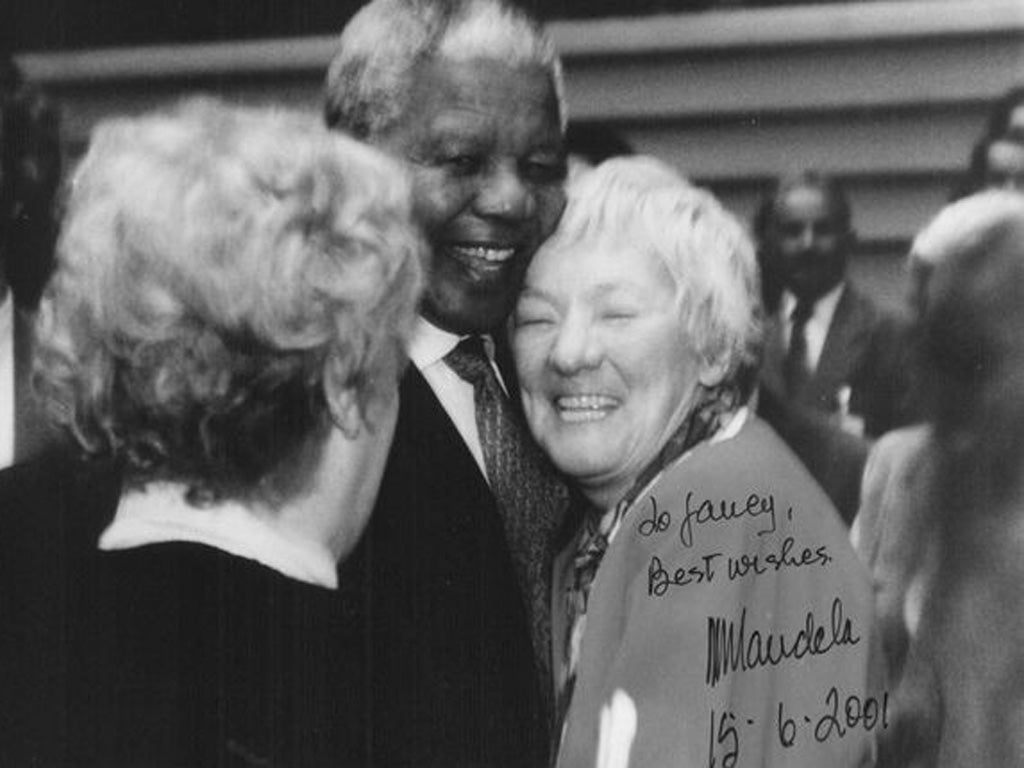
Other causes that benefited from her generosity included South Africa,and gay rights. She raised huge sums for anti-apartheid causes, and during the hysteria about Aids her outspoken views earned her the nickname of the gays' favourite Scottish straight grandmother.
She was also an avid regaler of anecdotes full of names of famous politicians or performers, which may have made her sound like a shameless name-dropper, except that she really did know these people. The excellent coffee supplied by her secretary in the European parliament attracted many neighbouring MEPs to her office each morning; which was how she came to be on first-name terms with Willi Brandt, Lionel Jospin and Otto Von Habsburg, the last heir to the throne of the Austro-Hungarian Empire. She is survived by her brother Enoch, son Alasdair, four grandchildren and one great-grandson.
Jane O'Neil Kent, politician: born Glasgow 30 April 1926; MEP for Glasgow 1979-94; married 1945 Norman Buchan (died 1990; one son); died Brighton 14 January 2012.
Join our commenting forum
Join thought-provoking conversations, follow other Independent readers and see their replies
Comments