Jim Brown: Director of Radio Free Europe during the Cold War
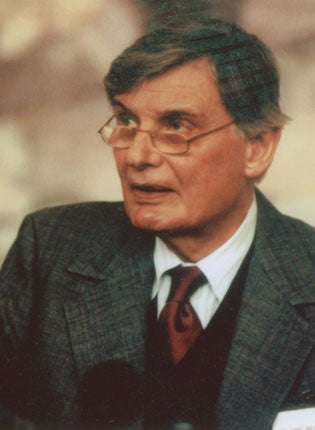
Jim Brown played an important role in the Cold War through a long career with Radio Free Europe (RFE), ending as Director from 1978 to 1984, when he resigned because of disagreements with the Reagan administration.
RFE was one of the good project on which the CIA spent its money. The funding remained covert (although many people knew or guessed) in the early 1970s, when Congress voted for open financing under a new Board for International Broadcasting. Based in Munich, RFE broadcast in local languages to Eastern Europe, acting as an exiled domestic radio station providing news and comment that was unavailable in the tightly censored media of the communist world. Audiences were huge, and included the regimes themselves, so the station became an important factor in East European politics, particularly in Poland, which after the Cold War awarded him the Knight’s Cross of the Order of Merit.
As Brown wrote in his unpublished memoir: “It broke the communist information monopoly and gave East Europeans the chance to think and judge for themselves... It tried to keep Eastern Europe’s societies together....
This was RFE’s basic task, and it was a worthy one. On a more individual, personal level it kept East Europeans company... levelling with its audience, not trying to lever it. Several East Europeans whom I met after 1989 stressed that it was this companionable, almost pastoral, function of RFE that helped keep their spirits up and for which they were the most grateful.”
In 1992 he was introduced to Vaclav Havel, who greeted him warmly with the words... “Jim! We were colleagues!” – a tribute to RFE’s important role in disseminating the writings of human rights movements in Eastern Europe. For Brown, “That made everything worthwhile”.
Brown was born in the United States of British parents. When his father (a miner who became a tram conductor in the US) died, he moved to Britain with his mother, went to school there, and graduated in History from Manchester University before doing an MA under Sir Lewis Namier.
In 1957, after National Service in the RAF, he joined RFE as an editor and then became a research analyst for Bulgaria and Romania. This was shortly after the major reassessment of RFE that followed the Hungarian uprising in 1956, which was crushed by Soviet tanks at the cost of thousands of Hungarian lives and the imprisonment or exile of many others.
In that period Washington had been indulging in rhetorical promises to roll back the Soviet empire in Eastern Europe, and RFE was widely accused of having fomented the uprising and fostered unrealistic hopes of Western help. A detailed investigation found that there had been no direct encouragement to revolt or promise of help, but the shrill, exhortatory tone and several very irresponsible broadcasts, including advice on military tactics, were strongly condemned and certainly did great damage. As a result, major changes were made in policies and personnel.
Brown was ideally suited to the new regime that was put in place, with its emphasis on accurate reporting and more carefully judged commentaries.
He rose to become Director of Research and Analysis in 1969, then Deputy Director of RFE in 1976, and finally Director in 1978. He brought his calm, friendly personality and deep knowledge of Eastern Europe to the task of managing the often passionate and divided exiles who made up most of the staff. At the same time he had to fend off political pressures from West Germany and Washington. In Germany many misguided socialists regarded the presence of RFE on German soil as incompatible with détente. In Washington Senator Fulbright surprisingly fell victim to the same error and fought stubbornly for two years to close the station.
In response to those campaigns, a special commission set up by President Nixon found that RFE contributed to détente because “peace is more secure in well-informed societies than in those that may be more easily manipulated”.
The State Department remained unhappy as its embassies in Eastern Europe were bombarded with complaints from the governments of the area. Brown’s response was that RFE’s main obligation was to the people of Eastern Europe, whereas the State Department’s was to relations with the states of Eastern Europe.
His main concern was always the station’s credibility, especially as this earned it influence in times of crisis. As he pointed out, his listeners lived in a system that bred suspicion of everyone and everything, so only accurate and judicious broadcasting could overcome these reservations and build a reputation for honesty and accuracy.
In a memorandum just before becoming Director he called for “more restraint, less harping, fewer generalisations, less driving home the obvious, more writing for the gratification of the listener rather than the writer”.
When Ronald Reagan entered the White House in 1981 Brown’s approach was not appreciated. The new regime dismissed détente with the Soviet Union as an illusion, whereas Brown saw it from a European perspective as an opportunity to promote peaceful change in Eastern Europe, a view that was largely vindicated by subsequent history. As he wrote later, “Détente always weakened, not strengthened, communism in Eastern Europe”. But the new regime wanted hard-hitting anti-communist commentaries that Brown saw as reverting to the disastrous policies of the early 1950s. They were as divisive in RFE as they were within the Western alliance. Many changes were made in the Board and other appointments. For Brown the breaking point came when a man he regarded as unqualified (and who was quickly sacked by a later director) was appointed director of the Czechoslovak service.
His career shifted to research and writing: St Antony’s College, Oxford; the RAND corporation; the University of California; back at RFE in 1991 as Scholar in Residence; the Aspen- Carnegie Commission on the Balkans in Berlin; and the American University in Bulgaria, where he had a very happy period teaching from 2000- 2002. He was as popular with students as he had been with most of the staff of RFE. He published many books and articles on Eastern Europe, and had a long and happy marriage, with two daughters and six grandchildren who adored him.
Richard Davy
James Franklin Brown, broadcaster, author, scholar: born New York 8 March 1928; married 1954 Margaret Wood (two daughters); died Oxford 16 November 2009.
Join our commenting forum
Join thought-provoking conversations, follow other Independent readers and see their replies
Comments