Joan Bright Astley: Secretary to Winston Churchill's War Cabinet
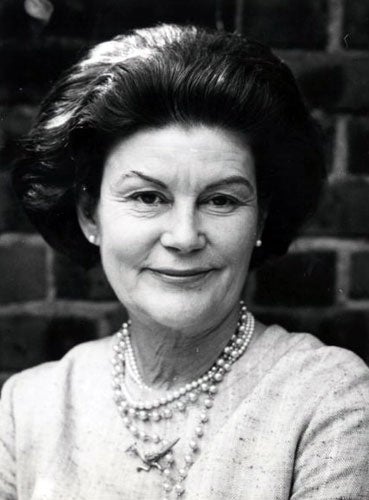
Joan Bright Astley was a member of that indispensable apparatus of administrators and secretaries who toiled in support of the great military, intelligence and political figures of the Second World War. Churchill and Eden were among her familiars, while she worked with senior generals such as Ismay, Wavell and Brooke. Her job was to set up a Special Information Centre (SIC) for Commanders-in-Chief, a section required by Churchill because, as Prime Minister, he could no longer give time to the regular meetings with top brass which had been his custom when he was First Lord of the Admiralty.
Although once described as a "difficult" teenager, she was one of those who kept the wheels of war turning. Her personal blend of capability and discretion meant she is suspected of being one of the models for James Bond's Miss Moneypenny. She certainly dated Ian Fleming, finding him "awfully attractive and fun".
Joan Bright was born in Argentina into a peripatetic family, headed by an English accountant and a Scottish governess, whose travels took them to Spain, Bedford, Bath and Bristol. She attended a variety of schools, learning shorthand and typing and working as a secretary at the British legation in Mexico. She had the chance, oddly enough, of working in Germany for Rudolf Hess, one of Hitler's senior associates, to teach his family English. She turned it down.
Instead, in 1939, she was inducted into Whitehall's secret world, when a friend told her surreptitiously that she might find some interesting workif she went to St James's Underground Station at 11am on a certain day, wearing a pink carnation. A lady appeared, who led Bright, after many changesof direction, to an office where she was met by a colonel. After he had got her to sign the Official Secrets Act heidentified through the window a citizen standing on the street corner. "When you leave here," he said, "don't let him see you. Turn left and keep going." That is how she came to join D/MI(R), a section of the War Office concerned, among other operations, with the disruption of Romanian oil supplies to the Germans.
She spent time working for J.C.F. Holland, one of whose roles was to organise commandos who would use guerrilla tactics to disrupt anyGerman invasion of England. Moving on to the Joint Planning Committee, she was given the task of running the Secret Intelligence Centre, a title which was rather more grandiosethan its reality since it consisted of a single underground office in the Cabinet War Rooms. It was, however, a vital cog, since there she held vital secret papers emanating from high-level military and intelligence bodies. Her job was to receive senior officers and allow them to read documents under controlled conditions.
Although this might be thought a recipe for an isolated existence, she by all accounts made the various commanders welcome with her brand of attractive informality. She showed easy expertise in navigating between the war's big personalities, who of course often had big egos, and she was often in demand.
She turned down an invitation to serve in India with General Wavell, and instead went on to become personal assistant to General Sir Hastings "Pug" Ismay, who was particularly close to Winston Churchill.
She admired many of the men of action she came across. For example she described one irregular warrior, Colin Gubbins, thus: "He had just enough of the buccaneer in him to make lesser men underrate his gifts of leadership, courage and integrity... He was a man-at-arms, a campaigner, the fires banked up inside him as glowing as those round which his Celtic ancestors had gathered between forays from glen and brae."
She became an administrative officer accompanying Churchill and the top brass to the summits with Stalin, Roosevelt and Truman which were aimed at deciding the course of the war and the fate of the post-war world.
Her travels took her to Washington, Moscow, Tehran, Yalta and Potsdam. During the Potsdam conference she explored the Chancellery building in Berlin, which had been reduced to rubble by British and American bombers and Russian artillery. She later recalled seeing discarded Iron Crosses on the floor, writing: "The smell of Berlin was quite definitely the smell of decayed death."
But her wartime career was not all hard work and destruction: "We had such fun," she recalled. "We had lots of boyfriends."
She wrote of her wartime experiences in a lively memoir entitled The Inner Circle: a view of war at the top (1971), as well as co-authoring, with Peter Wilkinson, a book on Sir Colin Gubbins: Gubbins and SOE (1993). She was was awarded the OBE in 1946.
In 1949 she married Colonel Philip Astley, who was involved in trench warfare in the First World War and political warfare in the Second,winning the Military Cross and being twice mentioned in despatches. In 1950, with their newly born son,she and Philip Astley set sail forEast Africa. But they never got there. Bad weather, a shipwreck off thecoast of Portugal and a heart attackfor Philip landed them in Spain, where they stayed until they returned tolive in England in 1952. Philip diedin 1958.
Joan Bright Astley was not Miss Moneypenny; but Samantha Weinberg, author of The Moneypenny Diaries (published under the name Kate Westbrook), reckons she is one of three or four women whose attributes were used by Ian Fleming to make up the character.
"I liked Ian," Bright Astley said in recent interviews. "I thought he was awfully attractive and fun, but elusive. I think he was a ruthless man – he would drop somebody if he didn't want them any more. That would be it."
She described Fleming, whom she "picked up with during the war," as "a very attractive person and very good-looking." But a few years ago she insisted, discreet to the last: "No torrid love affair. I've got nothing to tell you on that side."
David McKittrick
Penelope Joan McKerrow Bright, public servant and military historian: born Corrientes, Argentina 27 September 1910; staff, War Cabinet Offices (Special Information Centre) 1941-43; Administrative Officer, British Delegations to Summit and Tripartite conferences Washington, Quebec, Cairo, Tehran, Moscow, Yalta, Potsdam 1943-45; OBE 1946; married 1949 Philip Astley (died 1958, one son); died London 24 December 2008.
Join our commenting forum
Join thought-provoking conversations, follow other Independent readers and see their replies
Comments