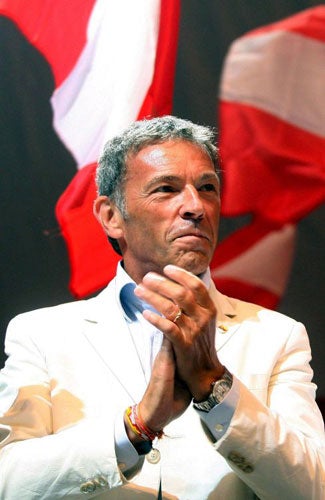
Jörg Haider: Charismatic right-wing politician whose controversial beliefs and policies led to isolation for Austria

For free real time breaking news alerts sent straight to your inbox sign up to our breaking news emails
Sign up to our free breaking news emails
Jörg Haider, the right-wing Austrian politician and governor of Carinthia, was killed in a car accident on Saturday. For years Haider had been a kind of bogeyman abroad, but he had a considerable following in his native land, and especially in Carinthia.
Jörg Haider was born in the Upper Austrian town of Bad Goisern in 1950. His father was a shoemaker, his mother a teacher. Both had been more than nominal members of the Nazi party – his father served as a lieutenant in the Wehrmacht in the Second World War. After attending secondary school in Bad Ischl, where he had first contacts with nationalist youth organisations, in 1968 he moved to the University of Vienna to study law. In 1973 he graduated and shortly after was called up for military service, volunteering for extra service on top of the mandatory nine months. In 1974 he started work at the University of Vienna in the department of constitutional law.
Haider had joined the youth wing of the Freiheitliche Partei Österreichs (FPO, or Austrian Freedom Party), founded in 1955 as a mixture of political currents opposed to the two main parties, the Catholic-orientated Österreichische Volkspartei (OVP, Austrian People's Party) and the Sozialistische Partei Österreichs (SPO, Socialist, later Social Democratic Party). These two had ruled Austria in coalition from 1945-66. With its roots in the Pan-German movement, the FPO included both nationalists and liberals.
In 1970 Haider became leader of the FPO youth movement, until 1974. He was party secretary of the Carinthian FPO from 1976 until 1983. In 1979, aged 29, he became the youngest MP of the 183 members of the federal parliament, serving until 1983. He served again in parliament from 1986 to 1989 and from 1992 to 1999.
From 1983 his policies became more aggressive, when he rose to party leader of the Carinthian FPO. He started to criticise the leaders of the FPO – which at that time was still a minor political movement, winning only about five per cent of the vote in 1983. The FPO entered into a controversial coalition as junior partner to the SPO in May 1983 and remained in power with that party until January 1987.
Good fortune came to Haider outside politics when, in 1983, he inherited the estate of his uncle Wilhelm Webhofer, who had owned a large estate in Carinthia known as Bärental ("bear valley"). Questions were raised because its ownership was based on a forced sale by an Italian Jew in 1941.
The decisive point of Haider's political career came in September 1986 when he defeated the Austrian Vice-Chancellor Norbert Steger in a vote for the FPO leadership at the party conference in Innsbruck: many delegates feared that Steger's liberal views and his coalition with the Social Democrats threatened the party's existence. Haider attempted to increase his party's standing by appealing to those opposed to the EU, those against immigration, and those who thought "the Third Reich was not all bad", including its work creation programmes, and who believed that its crimes were exaggerated.
Good-looking, he also struck a chord among the younger elements with his fashionable clothes, his skiing and his fast cars. There was also the boredom factor of younger people who were disillusioned with the old parties. In 1999, however, he distanced himself from his earlier remarks about Nazism. He would accept "keine braunen Schatten" (no brown shadows), and said he was an Austrian democrat.
Under Haider's leadership the FPO went from 4.98 per cent of the vote in 1986 to 26.9 per cent in 1999, putting it on a par with the OVP. The outgoing Social Democrats could not find a coalition partner and months of negotiations followed until in 2000 the OVP formed a coalition with Haider's FPO. This caused a sensation, both in Austria and across Europe; the heads of the governments of the other 14 EU members decided to cease co-operation with the Austrian government.
The coalition remained in office until 2007, although Haider stepped down as the FPO's chairman in 2000. Without him his party's vote seemed to evaporate: at the 2002 election it lost nearly two-thirds of its support.
None the less, Haider remained the FPO's major figure until 2005, when he founded the Bündnis Zukunft Österreich (BZO, or Alliance for the Future of Austria). He was expelled from the FPO but the BZO's increasing popularity won it 11 per cent of the vote in the September 2008 general election. Last week, Haider and Heinz-Christian Strache, the leader of the FPÖ, negotiated to put aside their differ-ences following their combined success at the polls. The results for their two parties came to 28.2 per cent of the ballot, as against 15 per cent in 2006. This placed them on a nearly equal footing with the "winning" Social Democrats.
Haider was killed near Klagenfurt, in Carinthia, in the early hours of Saturday after leaving a nightclub, on his way to a family gathering for his mother's 90th birthday. Police said the Volkswagen Phaeton that he was driving at speed went off the road.
It will be interesting to see whether his absence makes coalition politics easier or not.
David Childs
Jörg Haider, politician: born Bad Goisern, Austria 26 January 1950; married (two daughters); died Klagenfurt, 11 October 2008.
Subscribe to Independent Premium to bookmark this article
Want to bookmark your favourite articles and stories to read or reference later? Start your Independent Premium subscription today.
Join our commenting forum
Join thought-provoking conversations, follow other Independent readers and see their replies