Juan Almeida Bosque: Cuban vice-president who fought alongside Castro and Guevara

For free real time breaking news alerts sent straight to your inbox sign up to our breaking news emails
Sign up to our free breaking news emails
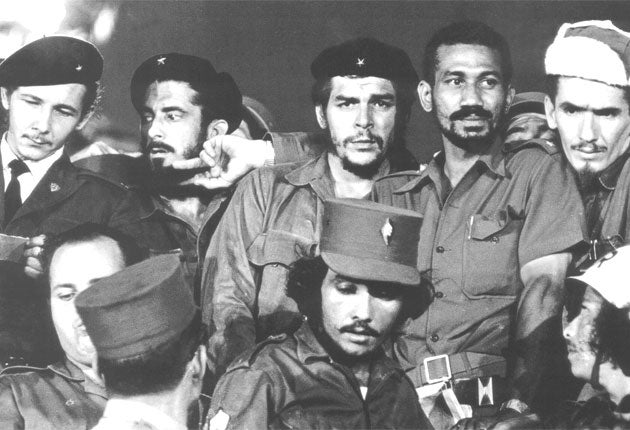
When Fidel Castro, Ché Guevara and a ragtag band of revolutionaries trundled victoriously into Havana on 8 January 1959, Juan Almeida's was the only black face at the head of their convoy. To the majority of the Cuban capital's residents – poor, black or mulatto (mixed race) – the sight of a black man in one of the leading jeeps was a comforting signal that the revolution would finally give them a voice.
Almeida was one of 80 revolutionaries who had sailed from Mexico to Cuba with Castro and Guevara in December 1956 on board a rickety motor boat, the Granma, to launch the revolution. He was one of only a dozen who survived the rough, week-long crossing and the initial battles with the forces of the dictator Fulgencio Batista. Soon after their landing, vastly outnumbered, a Batista officer shouted to them to give up. Almeida reportedly yelled "Aqui no se rinde nadie!" ["Nobody here surrenders!"], a slogan that became one of the most famous and lasting of the revolution and can be seen on posters around Havana to this day.
For his bravery, Almeida became the only black commander of the revolutionaries who forced Batista to flee the country on New Year's Day 1959, and who entered the capital a week later. Castro had put him in charge of the revolutionaries' Third Front, in the province of Oriente, as the revolutionaries pushed west across the Sierra Maestra mountains towards Havana.
When he died of a heart attack aged 82, he was one of several vice-presidents under Castro, a member of the communist party politburo and one of only three remaining men who held the honorary title "Commander of the Revolution" – second in rank to only El Jefe Maximo himself. Until he suffered from heart problems he was one of the most visible members of Cuba's ruling élite, often appearing alongside Castro or his brother Raúl at public events or diplomatic parties, and regularly representing Cuba at meetings abroad. He was something of a right-hand man to Fidel Castro and, latterly, to Raúl, who has been running the country since his brother's illness.
To younger Cubans, and in the Spanish-language music world, Almeida was best known as a composer of bolero songs – he wrote more than 300 of them – many of them love songs or ballads about his days as a guerrilla in the Sierra Maestra. Songs such as "Qué le pasa a esa mujer?" ["What's going on with that woman?"] or "La Lupe" (about a girl called Lupe) – can regularly be heard on radio stations throughout Latin America or in Spain.
A descendant of African slaves, Juan Almeida Bosque was born in a run-down neighbourhood of Havana on 17 February 1927. Although he wanted to be a lawyer he was forced to leave school at the age of 11 to work as a bricklayer's hod carrier to help feed his siblings. After studying privately, and already in his 20s, he won a place at the University of Havana, studying law, where he met another budding lawyer called Fidel Castro.
Castro, who, using the nom de guerre Alejandro, was plotting to overthrow Batista, took Almeida into his confidence and the two men led an ill-conceived attack on the Moncada army barracks outside the eastern city of Santiago on 26 July 1953. The guerrillas were routed – more than 60 were killed – and Castro and Almeida were jailed on the Isle of Pines for 15 and 10 years respectively before being amnestied in 1955. It was then that they gathered in Mexico City with the Argentinian Guevara and other sympathisers to plot their revolution before sailing from the Mexican port of Tuxpan, packed on board the Granma, bought from an American businessman who had named it in honour of his grandmother.
After the success of the revolution, Almeida was first put in charge of the rebel army's Motorised Units, later its Air Force and, for a short time, the entire Cuban revolutionary army. In 1968, Castro appointed him to the politburo of the communist party's Central Committee, where he was responsible for the island's construction sector. In 1998, he was given the rare honorary title "Hero of the Republic of Cuba."
In recent years, there were strong rumours among anti-Castro Cubans in the United States that Almeida had been involved in a CIA-financed plot to overthrow Fidel Castro. The Cuban leader apparently accepted his old friend's denial of the rumours; Almeida survived and was roundly praised by Castro after his death. "I was a privileged witness to his exemplary conduct for more than half a century of heroic and victorious resistance, in the struggle against the internationalist missions and the resistance to the imperialist blockade," Castro said.
Little was known as to Almeida's marital status or survivors but one son, Juan Juan Almeida, now 40, fled the Castro regime and became an outspoken critic of Castro and his own father, notably in his recent book Memoirs of an Unknown Cuban Guerrilla. "I ended up confused like millions of Cubans," he wrote, "so that we no longer know the exact difference between good and evil."
Phil Davison
Juan Almeida Bosque, revolutionary, vice-president of Cuba: born Havana 17 February 1927; died Havana 11 September 2009.
Subscribe to Independent Premium to bookmark this article
Want to bookmark your favourite articles and stories to read or reference later? Start your Independent Premium subscription today.
Join our commenting forum
Join thought-provoking conversations, follow other Independent readers and see their replies