Jyoti Basu: Marxist politician who combined realpolitik and revolutionary ideas
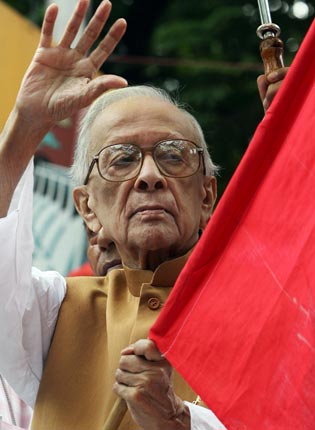
Jyoti Basu, who has died aged 95, was a staunch Marxist and a towering figure in Indian politics for six eventful decades. In 1997, he came close to becoming the county's first Communist Prime Minister. But the Communist Party of India (Marxist) Politburo decided against participating in the United Front government, a decision Basu later described as an "historic blunder". Others felt it was a manifestation of the insecurities of the Indian Left typical since the fall of the Soviet Union. In the end, H.D. Deve Gowda, of the Janta Dal party, became the premier.
Basu's name was a byword for intellectual, political and personal integrity, as well as for a straightforward but cool and imperturbable style. He was born into a middle-class Bengali family in Kolkata, then Calcutta, in July 1914. His father, Nisikanta, was a physician, his mother, Hemlata, a housewife. After attending St Xavier's Collegiate School and graduating in English from Presidency College in Calcutta, he travelled to London in 1935 to study law. While in England he was initiated to Marxism, coming into contact with Harry Pollitt, Ben Bradley, Rajani Palme Dutt and other leading lights of the Community Party of Great Britain. He joined the Indian League, London and the Federation of Indian Students in Great Britain and was elected as secretary of the London Majlis, an Islamic organisation, in 1937.
He returned to Calcutta as a barrister in 1940, joining the Communist Party of India (CPI) and marrying Basanti Ghosh, who died in 1942 (his second wife Kamala, who he married in 1948, died four years ago). In 1946 he was elected to Bengal's Legislative Assembly and was secretary of the West Bengal Provincial Committee of the CPI from 1952 to 1957. When the old CPI split in 1964, he was the kingpin of the new Communist Party of India (Marxist). He served as deputy chief minister of West Bengal in 1967 and 1969 in the United Front government; from June 1977 to November 2000 he was the chief minister for an unprecedented five terms for the Left Front government.
An astringent, unsmiling comrade, always clad in white "dhoti" and "kurta", he had many revolutionary ideas, many of which he realised when he was in power. He made a profound, long-term difference to the large, populous and strategically important state of West Bengal that was always his first priority. He implemented basic land reform, establishing India's first comprehensive system of democratic decentralisation and extended rural electrification and irrigation. Agricultural production came out of the slump in which it had been for decades before the Left Front came to power. In the 1980s and 1990s the state showed the highest rates of agricultural growth among the 17 most populous Indian states. As a consequence of the institutional changes and agricultural growth, nutrition levels improved and rural poverty declined noticeably.
On the national scene, Basu, a skilled practitioner of realpolitik, emerged as a compelling mediator and arbitrator. In moments of national crisis his was always the voice of sanity and common sense; he seldom, if ever, suffered from indecision.
Basu, whose first name means "light", had no political guru to speak of. Often described as a Fabian Socialist rather than an orthodox Communist, he was self-taught, though naturally influenced by Stalin and Lenin and having learnt much from his fellow Communists Muzaffar Ahmed and Saroj Mukhopadhyay. Disliking procrastination and inept administration, he worked as the sole co-ordinator between various ministries, every problem tending to cross his desk.
Basu's genius lay in negotiating the tricky interface between theory and polemic and the practical business of working with the masses and winning them over. He was helped by his early experiences as an influential trade union organiser, popular agitator and shrewd leader. He started out, as was typical for his generation, as a freedom fighter facing and overcoming the state-sponsored repression and intolerance in newly independent India.
In contrast to the Spartan lifestyle preferred by most of the CPI (M) leadership, Basu was known for his European sojourns during the oppressive Calcutta summers. He was a strong supporter of the abolition of English language education in primary schools but his son, Chandan Basu, and grandchildren were schooled at elite Anglophone institutions in Calcutta. It was also alleged that Chandan made the most of his father's political position to become a business tycoon. In 2006 the Supreme Court of India issued notices to Basu and others in connection with land allotments at Salt Lake city.
Unlike many Communist heads in other countries, Basu stepped down from office willingly and at the height of his popularity, after 24 years in power, in November 2000, succeeded by Buddhadeb Bhattacharya. The CPI (M) politburo wanted to use his services for "organisational expansion" in the country. But he preferred to spend much more time in his home town than in Delhi. However, the 18th congress of the CPI (M) in 2005 re-elected him to its Politburo. In 2006 he asked the CPI (M) to allow his retirement, but his wish was not granted. At the 19th Congress, in 2008, he was not included in the Politburo, though he remained on the Central Committee.
Haresh Pandya
Jyoti Basu, politician: born Kolkata, India 8 July 1914; married 1940 Basanti Ghosh (died 1942), 1948 Kamala (died 2006; one son); died Kolkata 17 January 2010.
Join our commenting forum
Join thought-provoking conversations, follow other Independent readers and see their replies
Comments
Bookmark popover
Removed from bookmarks