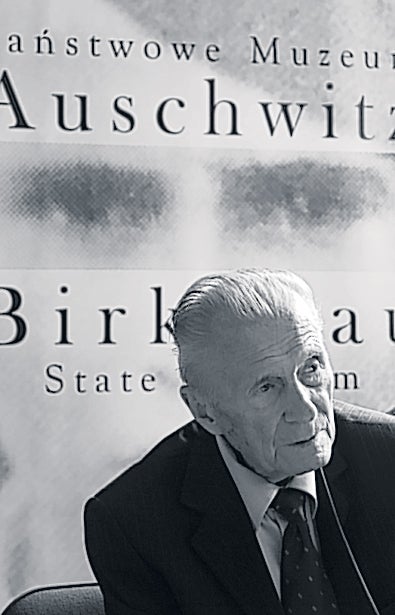
Kazimierz Smolen survived the concentration camps at Auschwitz and Mauthausen, and went on to co-found the State Museum at Auschwitz-Birkenau. He died on Holocaust Memorial day aged 91.
Smolen was born into a Catholic family in 1920 in Chorzow Stary, southern Poland. After the Nazi occupation in September 1939 he joined one of the first resistance groups. Arrested in April 1940 in Chorzow, he was sent to the former Austro-Hungarian cavalry barracks on the outskirts of the Polish town of Oswiecim, which had been annexed by the German Reich and was now known as Auschwitz.
The Nazis had converted the old barracks into a concentration camp for Poles, and Smolen was dispatched in one of the first prisoner transports and given the prisoner number 1327. He recalled that in the first few months, he and the other prisoners, mainly Poles, were held standing in a totally dark cell; many suffered strokes. Each morning and evening the SS conducted roll call outside. Weak, starving and barefoot, prisoners were often made to do "exercise" by turning around in circles with their arms raised above their heads, sometimes for several hours. When the inmates stopped or lowered their arms, the guards beat or shot them.
Later they were put to work building Birkenau, a new sub-camp, where the gas chambers were located. They worked from 5am until dark in muddy fields and marshes, their food consisting of a litre of herbal tea in the morning and 250 grams of bread in the evening, and sometimes soup. There were deaths each day from exhaustion. Fortunately for Smolen, when the Nazis discovered he could type he was transferred to office duties.
Smolen left Auschwitz on the last transport of around 10,000 prisoners on 18 January 1945, nine days before its liberation by Soviet troops. He survived the "death march" and was imprisoned in Ebensee, the sub-camp of Mauthausen concentration camp near Linz in Upper Austria. There he joined Russian, French, Dutch, Norwegian, German, Austrian, Spanish and other nationalities. The camp was an integral part of the Nazi armaments industry where the policy of Vernichtung durch Arbeit [extermination through work] was the order of the day.
As the curtain fell on the Reich most of the SS guards and their commander, Franz Ziereis, fled. Ziereis was later shot trying to escape from American troops. On 5 May 1945 the camp was approached by soldiers of the 41st Recon Squad of the US 11th Armored Division, who disarmed the auxiliary guards and left. The 30 or so remaining SS were killed by the prisoners.
After the war Smolen returned to Poland and graduated from the law faculty at the Catholic University of Lublin. He worked for the Main Commission for Investigation of Nazi Crimes and had the satisfaction of living to see the longest-serving commandant of Auschwitz, Rudolf Höss, tried and hanged. The last commandant, Richard Baer, died in custody. Smolen appeared as a witness and an expert in many war-criminal trials, including the Nuremberg trials in 1945 and '46, and the Frankfurt Auschwitz trials, which ran from December 1963 to August 1965. At Frankfurt six defendants were given life sentences and several others received the maximum prison sentences – though many others never faced trial.
Smolen was a co-founder and adirector, from 1955-90, of the StateMuseum Auschwitz-Birkenau. He was also a long-standing secretary-general and deputy chairman of the International Auschwitz Committee. Hisperiod in office saw many controversies: he not only had to rebut Holocaust deniers but he was often faced with disagreements within his committee with members from about 19 countries, which reflected the changes in Cold War alliances.
He and his wife lived within the camp in a flat above the main office. They remained there after his retirement. He explained his decision to return to the camp to manage it as a way of honouring those who were killed there. He attributed his survival to good health and extreme luck. He died in Oswiecim on the 67th anniversary of the camp's liberation, which in 2005 was designated as International Holocaust Remembrance Day by the United Nations.
Kazimierz Smolen, lawyer and museum director: born Chorzow Stary, Poland 19 April 1920; married; died Oswiecim, Poland 27 January 2012.
Join our commenting forum
Join thought-provoking conversations, follow other Independent readers and see their replies
Comments