Ken Annakin: Film director whose 50 films included 'The Longest Day' and 'The Battle of the Bulge'

For free real time breaking news alerts sent straight to your inbox sign up to our breaking news emails
Sign up to our free breaking news emails
Ken Annakin directed over 50 films, ranging from documentaries and popular British hits, such as Holiday Camp and Miranda, to epic international productions including The Longest Day, Those Magnificent Men in Their Flying Machines and The Battle of the Bulge.
The director Mike Leigh described him as "a cornucopia of surprises," though he himself stated that his films fell mainly into three categories – making people laugh, immortalising Second World War battles, or pure adventure.
"I never made art house films or movies with a message," he said, though admitting that his favourites – the Somerset Maugham tale, "The Colonel's Wife", in the anthology Quartet, and the adaptation of Graham Greene's short story, Across the Bridge, had "interesting character development and something to say about life." His early experience in documentary enabled him to capture perfectly the post-war feeling among the working classes in his first feature film, Holiday Camp, and he was able to marshal the extensive creative forces that enabled him to make his later epics.
The son of a government surveyor, he was born in 1914, and raised in the industrial town of Beverley in East Yorkshire, where he attended grammar school, leaving at 16 to work as a clerk in a tax office, finding respite in movies and attending an evening course in drama at Hull University (which later awarded him an honorary Doctor of Letters degree). Winning £100 on the Derby, he bought a ticket to Auckland and embarked on travels to New Zealand, Australia and the US, hitch-hiking or taking casual work as a car salesman, compere of a commercial road show and a journalist.
At the start of the Second World War he worked with the Auxiliary Fire Service before being drafted into the RAF as a mechanic. Injured in the Liverpool blitz, he was moved to the RAF Film Unit, where he worked as camera operator on propaganda films for the Ministry of Information and the British Council. We Serve (1942), a recruiting film for women, was directed by Carol Reed, who made Annakin his assistant director, after which Annakin directed several training films for Verity Films, a group led by Sidney Box, who was about to become head of Gainsborough Pictures. He advised Annakin to make a film that showed he could handle actors as well as he dealt with documentary.
"I was lucky," he recalled, "in that I got a picture called English Criminal Justice (1946), which really explained the British system of law and gave me a wonderful break. Sidney kept his promise and gave me Holiday Camp to direct. I was a typical documentary guy and Holiday Camp taught me a lot about movies – like the need for humour and good women's roles."
Annakin and the writer Godfrey Winn went to Butlin's holiday camp at Filey to research their subject and devise a story. "Sydney and Muriel Box decided we should add certain elements, like the Neville Heath-type serial murderer played by Dennis Price, that was news then." The film was an enormous hit ("perhaps because I had come from documentary, and British cinema at that time was very artificial"). Most memorably, the film introduced the Huggetts, played by Kathleen Harrison and Jack Warner.
"They absolutely caught the spirit and feeling that existed after the war. Troops had been lectured on equality, and how when they came home England would be the country where everybody had equal opportunities. People didn't want more fairy stories; they wanted something in which they could recognise themselves. Being of lower-middle-class origins myself, I felt at home with these people who were having a fine holiday in a very cheap place which provided wonderful entertainment. I think we caught the spirit of the camps, and we had a very warm natural cast."
Annakin's next film, Broken Journey (1947), which focused on a group of disparate characters on an aeroplane that crashes in the Alps, was a forerunner of the "disaster movies". It proved moderately successful, but his third film, Miranda (1948) was another of Gainsborough's biggest hits. A farcical comedy in which a holidaying doctor reels in a mermaid on his fishing line and takes her to London, pretending that she is a wheel-chair bound invalid, with only an eccentric nurse (Margaret Rutherford) knowing the truth. When Miranda is first revealed to her, she exclaims, "A mermaid! I've always believed in them!" "Maggie was wonderful," said Annakin. "She was a complete original with no technique at all that she admitted to. I recall telling her to do that funny little flutter of her lips as she came into close-up, and she said, 'I don't do any fluttering of my lips!'"
In his autobiography, Annakin confesses that he fell in love with Glynis Johns, who was married to Tony Forward, but when she told him, "Tony's gone gay!" and tried to seduce him, he resisted because, "If I played her game and made love to her, I would never again be the boss in the studio."
For Quartet (1948), a collection of four stories by Somerset Maugham, Annakin contributed "The Colonel's Lady", in which a country squire (Cecil Parker) is perturbed when his wife (Nora Swinburne) writes a book of erotic poetry about a "secret love", unaware that it is his younger self. Annakin described it as "one of the best pictures I ever made, touching though not sentimental." He also made three more films about the Huggetts, and contributed two enjoyable segments to another Maugham anthology, Trio (1950).
Hotel Sahara (1951) was the witty tale of a hotel in the desert in 1942 which changes its appearance and attitudes for every group of visitors – British, Italian, Free French, German or Arabic. It starred Peter Ustinov and had great success in Germany "because it was the first to show that many Germans were human beings serving just like other soldiers."
Claudette Colbert and Jack Hawkins starred in The Planter's Wife (1952), a melodramatic account of Malaysian plantation owners battling terrorists, after which Annakin made the first of four films he was to direct for Walt Disney, The Story of Robin Hood and his Merrie Men (1952), starring Richard Todd, a roistering account to which Annakin brought appropriate brio. He followed it with The Sword and the Rose (1953), with Todd as the lover of Mary Tudor (Glynis Johns) in a lively romp entertainingly enough to excuse its disregard for historical accuracy.
Later films made for Disney were Third Man on the Mountain (1959) starring James MacArthur as a Matterhorn climber, and the more successful Swiss Family Robinson (1960), a delightful adaptation of the classic tale of a shipwrecked family who build an island paradise, with John Mills and Dorothy McGuire as the parents. It was made on location in Tobago in a studio built of corrugated iron sheets. "We had terrible sound because torrential storms battered on the tin roof, so I had to spend 28 days at Pinewood post-synching the entire film."
Annakin made his favourite film, Across The Bridge, in 1957, starring Rod Steiger as a criminal on the run but safe as long as he stays on the Mexican side of the border. "The movie is really half a Graham Greene story (the part from where he has crossed the bridge) and Guy Elmes 'manufactured' the story that leads to the bridge. It worked beautifully."
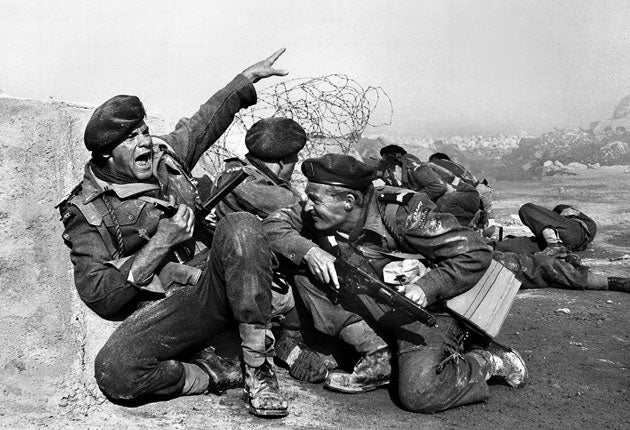
Received with acclaim in the UK, it was given only limited release in the US, but Annakin had huge international success when he was asked by Darryl F. Zanuck to direct the British section of the war epic The Longest Day (1962) based on Cornelius Ryan's best-selling account of the D-Day landings, seen from the American, British, French and German points of view. Richard Todd, Sean Connery, Peter Lawford and Kenneth More were among the actors whose sequences were directed by Annakin, who also filmed the memorable scene in which Richard Burton is an RAF pilot lying wounded and full of morphine, pointing out to a young soldier, "I'm crippled, he's dead, you're lost. I suppose it's always like that in war."
Annakin was sole director on his next big-budget movie, a boisterous comedy about the early days of aviation and a London to Paris aeroplane race, Those Magnificent Men in Their Flying Machines (1964), which had a fine cast of comics, including Red Skelton, Tony Hancock, Terry-Thomas and Benny Hill, plus jaunty music by Ron Goodwin that Annakin described as "the most perfect theme tune I have ever been given in any of my movies." Annakin and Jack Davies wrote the original screenplay, which won them an Oscar nomination, and the often hilarious, if over-long movie proved to be one of Annakin's most successful.
He followed it with another blockbuster, the epic Battle of the Bulge (1965), which was praised for its look at the dirtier aspects of war, though its historical accuracy was called into question. It was Annakin's last film of true importance. The Long Duel (1967), which he also produced, was an ambitious but bland project in which Yul Brynner led a peasant revolt in 1920s India, and Monte Carlo or Bust (1969) was a patchy attempt to duplicate the success of his earlier aviation comedy, this time with vintage cars in a chaotic race. Films like Call of the Wild (1972) starring Charlton Heston, Paper Tiger (1975) and The Pirate Movie (1982), an adaptation of The Pirates of Penzance, were muddled flops. In the mid-Eighties, he moved with his wife and daughter to the United States, where his final film was The New Adventures of Pippi Longstocking (1988).
Kenneth Cooper Annakin, film director: born Beverly, East Yorkshire 10 August 1914; married 1959 (two daughters, one deceased); OBE, 2002; died Beverly Hills, California 22 April 2009.
Subscribe to Independent Premium to bookmark this article
Want to bookmark your favourite articles and stories to read or reference later? Start your Independent Premium subscription today.
Join our commenting forum
Join thought-provoking conversations, follow other Independent readers and see their replies