Leon Febres Cordero: Confrontational President of Ecuador
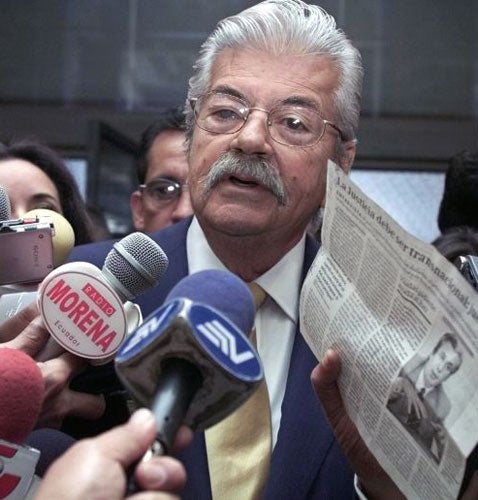
León Febres Cordero, who was President of Ecuador from 1984 to 1988, was the arch-representative of his country's political and economic ancien régime, which was swept aside by the electoral victory of the left-wing nationalist Rafael Correa in 2006.
He made the international headlines when he was kidnapped by Ecuadorean air force commandos during an official visit to the Taura air base, on the Pacific coast, in January 1987. Although he was released after 11 hours, the incident, in which five presidential bodyguards were killed, was symptomatic both of Ecuador's unstable politics – the kidnappers were demanding the release of a general who had been arrested for mutiny – and the confrontational character of a man who seemed to attract conflict like a magnet.
Febres Cordero was an old-fashioned political caudillo, with an overbearing personality, who dominated the right-wing Social Christian party (PSC) for almost four decades. The party's stronghold was in the coastal city of Guayaquil, Ecuador's major Pacific port and economic powerhouse, where he had extensive business interests. The PSC acted as an often baleful influence on Ecuadorean politics, hamstringing the legislature with its large block of seats, and wielding behind-the-scenes influence through the control of judicial appointments, but rarely wishing to take responsibility for forming a government. The one exception was when Febres Cordero ran successfully for President in 1984.
It was not a happy experience. Apart from being kidnapped, he presided over a period of economic crisis, when the price of oil, Ecuador's main export, was at rock-bottom, and also of political confrontation, during which left-wing guerrillas appeared briefly in what had been a relatively peaceful country, by Latin American standards. He dealt with the insurgency in a characteristically heavy-handed manner, giving rise to complaints of serious human rights abuses by security forces which are being investigated by a Truth Commission set up by President Correa.
Febres Cordero was unapologetic about his political methods. "My best friends are my cigarettes and my pistols," he once said. "They never ask for anything and are always ready. I always carry a gun, because I've been under fire all my life."
Leó*Febres Cordero Ribadeneyra was born in 1931 into a prominent Guayaquil family. He studied mechanical engineering in the United States, and entered national politics in 1966, as deputy for his native Guayas province. He also served briefly as senator and made a successful business career, running – among other activities – the Noboa family's vast agricultural export empire.
His period as mayor of Guayaquil, between 1992 and 2000, was an altogether more fruitful time than his occupation of the presidential palace. He was credited with rescuing the bustling but dilapidated tropical port from the clutches of the Bucaram family, populist demagogues who had built up a mass following among the inhabitants of the sprawling shanty towns that had sprung up around the city as rural migrants arrived in search of work and a better life. Febres Cordero turned around Guayaquil's chaotic administration and finances, carried out an impressive public works programme and built a sold base for his successor, Jaime Nebot, also of the PSC, who, as President Correa's main rival, remains a force to be reckoned with in Ecuadorean politics.
Febres Cordero was elected deputy once again in 2002, but within a few years ill-health – he was suffering from lung cancer, after regularly smoking up to 80 cigarettes a day – had forced him to withdraw from active politics. His influence lingered on, however, until the Ecuadorean electorate's patience with the PSC finally ran out. In November 2006 the party's presidential candidate was an also-ran in the elections that brought Rafael Correa to power, with a commitment to abolish the old way of doing politics represented by Febres Cordero.
Colin Harding
León Febres Cordero Ribadeneyra, politician and businessman: born Guayaquil, Ecuador 9 March 1931; President of Ecuador 1984-88; Mayor of Guayaquil 1992-2000; married first María Eugenia Cordovez Pontón (four daughters; marriage dissolved); second Cruz María Massuh; died 15 December 2008.
Join our commenting forum
Join thought-provoking conversations, follow other Independent readers and see their replies
Comments