Louis Handschuh: French resistance operative who survived one of the most daring escapes of the Second World War

For free real time breaking news alerts sent straight to your inbox sign up to our breaking news emails
Sign up to our free breaking news emails
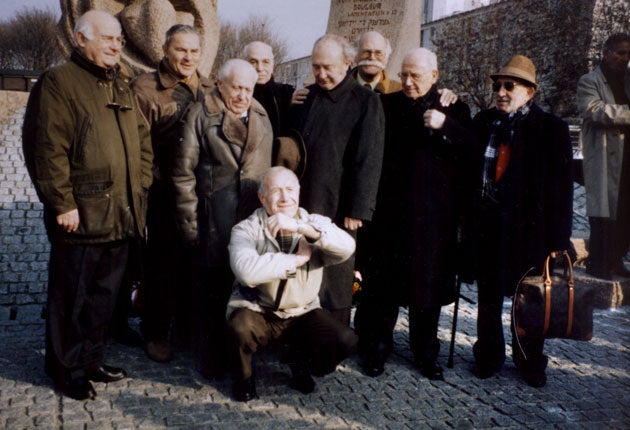
Louis Handschuh, who has died in Paris aged 89, was one of the last survivors of one of the most remarkable escapes of the Second World War.
Initially housing Spanish refugees, then, briefly, British prisoners of war, the concentration camp at Drancy began receiving Jews arrested in Paris in August 1941. A half-finished housing estate in a suburb just north of the city, Drancy became the most important reception centre for Jews from all over France, and between the summer of 1942 and July 1944 nearly 63,000 people passed through it on their way to gas chambers in Poland.
Under Marshall Pétain, Jews in France were subject to an almost total loss of civil rights, and until July 1943 Drancy was administered by the French. Gross overcrowding and little sanitation or edible food resulted in widespread malnutrition. At one point 800 starving inmates were sent home to be fed, only to be rearrested afterwards. Though they wore their own clothes and occasionally received parcels from outside, inmates had no hot water, nowhere to sit and nothing to do, nor any idea of how long they would remain or what would become of them.
When the SS captain Alois Brunner, a protegé of Adolph Eichmann, took over the camp, brutality and blackmail were added to near-starvation and disease. Brunner wanted no deaths within the camp but suicide was commonplace. Who stayed and who received the green slip denoting deportation, just as who was – and wasn't – considered a Jew, depended on his whim. The camp, which often held more than 3,000 people (the housing estate was designed for only a few hundred) was run by just six SS officers, many daily duties being perfomed by a Jewish security service whose members were not safe from deportation. Without some kind of job in the camp almost no one stayed more than a fortnight. Louis and his younger brother Eugene worked in the camp kitchen producing watery turnip soup.
Deportees had no idea what lay in store for them. Many inmates had fought and been decorated in the war and regarded themselves as French citizens first and Jews second. The Nazis, moreover, went to inordinate lengths to conceal the death camps, publishing newspaper articles about attractive, purpose-built settlements in the east, faking postcards from Auschwitz and continually reminding inmates to take receipts with them to be cashed into Polish currency on arrival. When two escaped Auschwitz inmates returned to France in 1942 and recounted to the Jewish authorities what they had witnessed they were not believed.
In September 1943, after the American invasion of North Africa and the German take-over of the Unoccupied Zone, Brunner was ordered to Nice to round up Jews. While he was away 40 inmates, led by a pharmacist Claude Aron, decided to dig a tunnel large enough to evacuate the whole camp population.
In November, just a metre and a half from completion, the tunnel was discovered. A laundry mark on an item of clothing identified one of the diggers, and under torture he gave up 13 names. Trains were scarce and Brunner obsessed with filling any available space, and along with hundreds of others the 14 were deported, in railway wagons marked 40 men, eight horses. Assuming they would be going to Germany as forced labour, knowing there was only one track running east and that near Lerouville in the Meuse Department the gradient would force the train to slow down, they resolved to jump off. Although thin and undernourished, most were young, some of them renowned sportsmen. With only a screwdriver and saw blade for tools the iron bars were finally prised free and the wooden boards kicked out. Of those who jumped only Aron was later recaptured, doing resistance work near Lyon. Alone and in chains he was taken to Auschwitz, where he was immediately hanged. (This little-known story has been well told by Janet Thorpe in her book Nous n'irons pas a Pitchipoï, published in France by Editions de Fallois but never in its original English, and is the subject of a forthcoming feature film).
Louis Handschuh, who was then 23, was among the escapees with his father Oscar and his brother Eugene. Born in Budapest, in 1930 he had emigrated with his family to France, where Oscar worked as a tailor. Active in the Resistance, after their arrest father and sons were taken to the notorious Cherche Midi prison in Paris where Dreyfus had been held, then to Compiègne, where they met many of their fellow tunnellers, and from there to Drancy. Louis's fiancée and his mother had by then been deported and killed at Sobibor, though it was only in the 1970s that the Handschuhs learned what had happened to them.
Oscar was injured jumping from the train and for over a week was cared for by locals; but within 24 hours Eugene and Louis (with the help of a 50 franc banknote sewn into his jacket) were back with the Resistance in Paris and fought for the city's liberation. After the war the Handschuhs owned a successful clothing business.
Handsome and charismatic, Louis never saw himself or the other escapees as heroes or tried to exploit his wartime experiences, but was concerned to counter the myth that Jews had behaved like sheep or were in some way complicit in their fate: the Jewish uprising in the Warsaw ghetto in 1943 was, at the time, the largest revolt against the Nazis anywhere in occupied Europe.
Alois Brunner, the Nazi Simon Wiesenthal had most wanted to find, escaped to Syria in the 1950s, from where his death has yet to be reported. If alive, he would now be 97. Drancy, left unfinished in 1935, was, due to a housing shortage, finally completed in 1947, and is presently occupied by 500-odd people from 40 countries. As the first example of large-scale public housing, rather than as the site of one of the most shameful episodes in French history, it has the status of Monument Historique.
After the war, Handschuh married Line Kaczka, a much decorated heroine of the Resistance who, at the age of 18, had been arrested in Paris carrying a gun and deported to Ravensbruck. They had two sons. She, their children, and his brother Eugene survive him, as does Serge Bouder who, with Eugene, removed the bars on the train.
Michael Estorick
Louis Handschuh, war hero: born Budapest 17 May 1920; married Line Kaczka (two sons); died Paris 15 November 2009.
Subscribe to Independent Premium to bookmark this article
Want to bookmark your favourite articles and stories to read or reference later? Start your Independent Premium subscription today.
Join our commenting forum
Join thought-provoking conversations, follow other Independent readers and see their replies