Maurice Jarre: Composer who won three Oscars for his work with David Lean

For free real time breaking news alerts sent straight to your inbox sign up to our breaking news emails
Sign up to our free breaking news emails
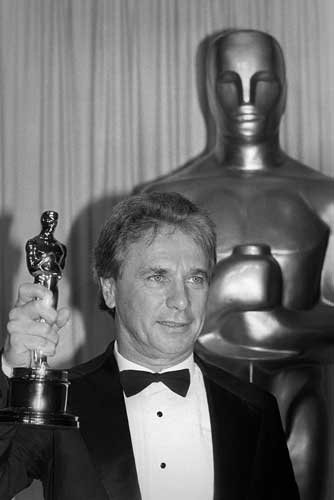
Maurice Jarre, who won three Oscars – all for films by David Lean – was one of the last of the "silver-age" film composers, perhaps best known for scoring large-scale films but equally at home with more intimate fare.
Jarre began by studying engineering at the Sorbonne but despite the late start ("when I was 15 I knew nothing of music") decided to change subjects. Against his father's will he enrolled at the Conservatoire de Paris and, alongside composition and harmony, made the unusual choice of percussion as his major instrument. The decision would reverberate throughout his career.
He learned the ondes martenot under the instrument's inventor Joseph Martenot and played it and percussion in the theatre, eventually spending 12 years as music director at the Théâtre National Populaire ("the best time of my life, the most difficult, the most interesting, the most exciting.") It gave him a marvellous feeling for drama that would serve him well in the cinema.
In 1952 he struck up a working relationship with the director Georges Franju, scoring Hôtel des Invalides (1952) a documentary that upset the authorities by its concentration on the tragedy rather than the glory of the "invalides de guerre". After documentaries and shorts by directors including Franju, Resnais and Demy, his first feature was Franju's La tête contre les murs (1959, UK title The Keepers), about an escape attempt from a mental asylum. But their best collaboration was the ghoulish yet heartbreaking Les yeux sans visage (Eyes without a Face, 1960). Jarre's marionette-ish waltz with its brittle harpsichord set the scene for the story of a plastic surgeon's desperate attempts to atone for a car accident that left his daughter hideously disfigured.
It was in 1962 that Jarre's international career took off. Though he scored the D-Day epic The Longest Day (1962) what really helped was, in fact, being second choice for another film. Malcolm Arnold had won an Oscar for David Lean's The Bridge on the River Kwai (1957) and was expected to score Lawrence of Arabia (1962). Stories differ as to how the two fell out but, without Arnold, the film's producer Sam Spiegel considered using more than one composer. However, after hearing Jarre's main theme, he offered him the whole film, giving him six weeks to score it. To complete the assignment, Jarre alternated four hours' work with 10 minutes sleep and picked up his first Oscar for the thrilling score that sets driving, exotic percussion and Rósza-like brass against a soaring theme on the strings that evokes the burning desert sun.
Lean was to make only three more films, and Jarre scored them all. In 1965 he picked up his second Oscar for Doctor Zhivago (one of the film's five). Jarre having failed to satisfy the director with his first few attempts at a main theme, Lean advised him to take a weekend in the mountains with his girlfriend, forget about the film and take his inspiration from that. He came back with "Lara's Theme", later a hit as "Somewhere My Love".
For Ryan's Daughter (1970) Jarre got a Grammy rather than an Oscar, but after the film's critical mauling Lean retired hurt, before returning in 1984 with A Passage to India, which was criticised for fatally misunderstanding Forster's novel. Jarre included some enjoyable "tea-dance" music in the otherwise serious score and won his third Oscar, as well as a Golden Globe. Lean also intended to have Jarre score Nostromo but he died before it went into production.
With Lawrence as a springboard Jarre's international career took off. For Is Paris Burning? (1965), set during the city's liberation from the Nazis, he wrote a jaunty French-inflected waltz featuring the accordion. The following year's Grand Prix featured a prominent percussion section to ramp up the tension but (sounding at some points like a modernised Lawrence), the score could not turn the Formula 1-and-romance project into a convincing epic. More successful was John Huston's Kipling adaptation The Man Who Would Be King (1975), with its stately, melancholic fanfare.
Jarre was also one of the composers who followed on from Bernard Herrmann after the composer's split with Hitchcock, but the director's third-last production, Topaz (1969), an international espionage story, was hamstrung by a directionless production process and Jarre's music could do little to save it.
Jarre had used the ondes mortenot in Lawrence and other scores but in the 1980s he began more fully to combine orchestral and electronic elements, leading to a period of experimentation. Parts of Fatal Attraction (1987) are weighed down by an almost unbearably suffocating feeling of dread as the music disintegrates into a hoarse texture pierced by fragments of melody.
On the other hand, his work on Peter Weir's 1980s films tends to the generously melodic. The Year of Living Dangerously (1982) captures an Australian reporter in Sukarno's Indonesia with the ondes and evocations of the didgeridoo, while Dead Poet's Society (1989) includes a pipe band. But their finest collaboration is Witness (1985), in which Harrison Ford protects a child witness to murder in the Amish community. The barn-building scene, accompanied by a stately chaconne, was the film's highlight. Jarre denied that adding electronics to the orchestra for the score was expediency, saying that it would have been easier and cheaper to omit them.
But at the same time he was taking on a range of other projects. He may (unfairly) have had something of a reputation for epics, so 1984's spy spoof Top Secret was a rare comedy. But the following year he played to his strengths in Mad Max: Beyond Thunderdome whose exhilaratingly over-the-top score features full orchestra, choir, a battery of percussion, four pianos and three ondes.
For the shockingly bleak Jacob's Ladder (1990) Jarre's rising and falling theme, led by the piano, gives a feeling of the ebb and flow of hope and hopelessness. But in the same year he also scored the romantic thriller Ghost (1990). It may be best remembered for the much-parodied ghostly pot-throwing scene, accompanied by Alex North's "Unchained Melody'"but Jarre also wrote a big-hearted theme – though it is perhaps a bit too old-fashioned for the film's youthful protagonists.
As well as percussion, Jarre had a penchant for other unusual instruments, sometimes inspired by the story and sometimes not. Unsurprisingly, "Lara's Theme" from Doctor Zhivago emerges from a haze of 22 balalaikas, and Villa Rides (1968) has an enjoyably Mexican-tinged score, again finding a place for a decent-sized percussion section. But The Tin Drum (1979) includes among its militaristic percussion, a fujara (a Slovakian flute) and steel drums. For the Irish-set Ryan's Daughter Lean specifically asked him to avoid traditional music and he had another hit song with "It Was a Good Time".
As well as his film scores, Jarre wrote some concert works including the Concerto for E.V.I. (electronic valve instrument), an instrument invented and played by Nyle Steiner. The third of its four movements is a protest against noise pollution, including rap and church bells. It was written in San Moritz and dedicated to his fourth wife. His son Jean-Michel also found fame as a composer, while another son, Kevin, is a screenwriter, and his daughter Stephanie is a set decorator and production designer. His last film was Uprising (2001) a Holocaust-story TV movie.
John Riley
Maurice-Alexis Jarre, composer: born Lyon 13 September 1924; married firstly Francette Pejot (one son); 1965 Dany Saval (marriage dissolved, one daughter); 1967 Laura Devon (marriage dissolved, one son), 1984 Fong F. Khong; died 29 March 2009.
Subscribe to Independent Premium to bookmark this article
Want to bookmark your favourite articles and stories to read or reference later? Start your Independent Premium subscription today.
Join our commenting forum
Join thought-provoking conversations, follow other Independent readers and see their replies