Maurice Wilkes: Visionary and pioneering doyen of British computing

For free real time breaking news alerts sent straight to your inbox sign up to our breaking news emails
Sign up to our free breaking news emails
In 1946 Maurice Wilkes was a junior academic and acting director of the Cambridge University Mathematical Laboratory – a tiny outfit with a handful of pre-war calculating machines. One day in May he received a visit from LJ Comrie, an authority on mechanical computing, who was advising Wilkes on re-equipping the Laboratory. Comrie brought with him a mimeographed document he had received from the University of Pennsylvania titled A First Draft of a Report on the EDVAC. The report described the design for a new kind of computing machine based on electronics. Wilkes instantly realised the report's significance and stayed up all night reading it before Comrie took it away the next day – there were no photocopiers in those days. The EDVAC Report was the foundation on which the modern computer industry was built – it determined the direction of Wilkes' life and that of countless thousands of others who were to be caught up in the computer revolution.
Maurice Vincent Wilkes was born in 1913 in Dudley, Staffordshire. His father was the cashier for the estate of the Earl of Dudley, his mother a housewife. He was educated at King Edward VI Grammar School, Stourbridge. In his teens he read Wireless World and built crystal sets – useful experience when it came to computers. He entered St John's College, Cambridge, in 1931 to read the Mathematics Tripos. He sat in on physics lectures and obtained a radio amateur's licence.
In October 1935 he became a research student at the Cavendish Laboratory under the physicist JR Ratcliffe, working on the propagation of long radio waves. The following spring Wilkes attended a lecture given by Douglas Hartree, a computing expert and professor of mathematical physics at Manchester University, and was immediately drawn to computing. In early 1937, when John Lennard-Jones, professor of theoretical chemistry, set up a Mathematical Laboratory at Cambridge to provide computing and calculating facilities, Wilkes became an early and enthusiastic user. Lennard-Jones offered him the position of University Demonstrator in charge of the Laboratory from October 1937.
On the outbreak of war, the Mathematical Laboratory was taken over by the Ministry of Supply and Wilkes and many of his colleagues were enlisted in the war effort. He was posted to the Air Defence Experimental Establishment at Christchurch, Dorset, where he worked on radar and mathematical research. In autumn 1943 he was transferred to the Telecommunications Research Establishment, Malvern, where he worked on the Oboe bomb-aiming system. There, Wilkes built up a network of contacts that would prove invaluable.
At the end of the war he returned to Cambridge as acting director of the Mathematical Laboratory. In summer 1946, a few weeks after he had read the EDVAC Report, he was invited to a summer school organised by the Moore School of Electrical Engineering at the University of Pennsylvania. The School had just completed the ENIAC, the first electronic computer for defence calculations, and the EDVAC Report described the design for a follow-up machine. Because of difficulties getting a berth, Wilkes did not arrive on the course until mid-August, by which time he had missed more than half. Rarely short on confidence, he decided he had not missed much of consequence. Sailing home on the Queen Mary he began the design of a machine he called the Electronic Delay Storage Automatic Calculator – EDSAC for short, in tribute to the EDVAC.
Wilkes was appointed permanent director of the Mathematical Laboratory and work started on the EDSAC in early 1947. Almost everything had to be done from first principles – memory technology, electronic arithmetic and logic, and control circuits. Wilkes made good use of his wartime contacts to find out about new techniques and locate scarce components. Cambridge was at the centre of UK computing, and he established fortnightly colloquia attended by members of almost every computer project in the country.
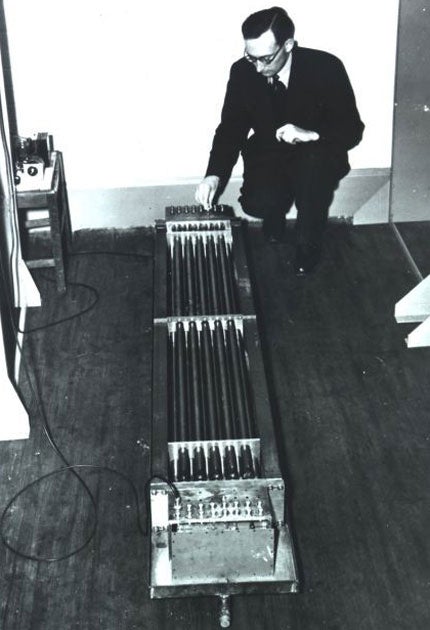
The EDSAC sprang into life on 6 May 1949, the world's first practical electronic computer. (Manchester University had got there first in June 1948 with an experimental machine, but the EDSAC was the first capable of running realistic programs.) By the new year the Laboratory was offering a regular service; Wilkes decided it would specialise in writing programs rather than building computers. He was perhaps the first person to recognise the importance of software (a term not used until about 1960).
He assigned the design of the EDSAC programming system to a research student, David Wheeler (later professor of computer science at Cambridge). The system Wheeler created was a tour de force admired worldwide. In 1951 Wilkes described the techniques in the first textbook on programming, The Preparation of Programs for an Electronic Digital Computer, although the book was known as "Wilkes, Wheeler and Gill". The third author, Stanley Gill, was a young researcher who later became professor of computing science at Imperial College.
The Laboratory took on a steady rhythm of teaching, computing services and research. In 1951 the Laboratory organised its first summer school in programming, where a sizableproportion of the British computer profession got its entrée into computing. Next came a postgraduate diploma in computing, and eventually undergraduate courses. Heavy use of the facilities was made by Cambridge's researchers, including luminaries such as John Kendrew, Fred Hoyle and Martin Ryle. Kendrew's calculations for determining the molecular structure of myoglobin, for which he received the Nobel Prize in 1962, were largely done on the EDSAC.
EDSAC was soon loaded to capacity, and plans were laid for EDSAC 2. Wilkes came up with a new design principle, microprogramming, that greatly simplified the logical design of the new computer. Microprogramming was Wilkes' most important scientific contribution to computing. In the early 1960s IBM based its world-beating System/360 computers around the idea, and it remains a cornerstone of computer architecture.
Cambridge's prominence and Wilkes' confident manner led to constant invitations to give lectures and participate on committees. He was elected to the Royal Society in 1956 and became inaugural president of the British Computer Society in 1957.
He was appointed Professor of Computer Technology at Cambridge in 1965, a title chosen to distance himself from the theoretically-minded professors of computing science by then being appointed in many universities. Wilkes was inclined to underrate theoretical viewpoints. For example, in 1947 he pointedly did not attend the famous series of lectures on computing machines given by Alan Turing, now acknowledged as Britain's computer genius without peer.
Wilkes remained director of the Computer Laboratory (renamed from the Mathematical Laboratory in 1970) until he reached the statuary retirement age of 67 in 1980. His tenure had seen computers evolve from scientific instruments to information processing machines that were the basis of a worldwide industry. The Laboratory was constantly at the forefront of research, leaping on to the time-sharing bandwagon in the 1960s and computer networking in the '70s. Wilkes was good at keeping up with technology trends, preventing either himself or the Laboratory from getting locked into dying research fashions.
He was also deeply interested in the history of his subject. His writings in the 1950s are almost unique for the historical context in which he placed contemporary developments. In 1971 he gave an important lecture on Charles Babbage, the Victorian computer pioneer. In preparation, he made a study of Babbage's manuscripts in the Science Museum Library, London, the first modern scholar to do so. Later he became a good friend of I Bernard Cohen, professor of the history of science at Harvard University.
Wilkes loved America and Americans. Following retirement from Cambridge he became a consulting engineer with the Digital Equipment Corporation in Massachusetts. Whereas at Cambridge Wilkes' position had made him appear a little authoritarian, in the US he loosened up, though he could still be waspish. Freed from running the Computer Laboratory, he was fully able to enjoy his numerous honorary doctorates and awards.
Incapable of retiring, in 1986 he returned to Cambridge, becoming a board member of Olivetti-AT&T Research Laboratories. He continued to make technical contributions and publish articles about Babbage and his milieu. In 1992 he was the first recipient of the Kyoto Prize, computer science's most prestigious and richest award.
Maurice Vincent Wilkes, computer technologist: born Dudley, Staffordshire 26 June 1913; Director, Computing Laboratory, Cambridge University 1946-198,; Professor of Computer Technology, 1965-80, then Emeritus; senior consulting engineer, Digital Equipment Corp, Maynard, Mass 1980-86; KBE 2000; married 1947 Nina Twyman (one son, two daughters); died Cambridge 29 November 2010.
Subscribe to Independent Premium to bookmark this article
Want to bookmark your favourite articles and stories to read or reference later? Start your Independent Premium subscription today.
Join our commenting forum
Join thought-provoking conversations, follow other Independent readers and see their replies