
For free real time breaking news alerts sent straight to your inbox sign up to our breaking news emails
Sign up to our free breaking news emails
Over an infamous 56-day period during the southern winter of 1981, New Zealand was starkly divided over a tour by South Africa's national rugby team, the Springboks. To show their opposition to the apartheid system, which these sportsmen were effectively ambassadors for, campaigners mobilised throughout the country to stop the matches – with some success. These bitter protests saw unprecedented civil disobedience, sometimes sparking violent clashes with police and rugby fans, as well as mass arrests.
Two years later, Merata Mita's gritty documentary Patu! recalled the turmoil, since recognised as a landmark in the country's approach to race relations (both abroad and at home), and in reshaping attitudes towards the "national sport" and its links with politics.
Like the Springbok tour, Patu! was the subject of heated debate, and while mainstream cinemas shunned it, the film received a standing ovation after its premiere at the 1983 Wellington Film Festival, as well as international acclaim. It was the first feature-length documentary ever made by a female director in New Zealand, and Mita's best-known work in a career that included roles as a reporter, presenter, director, editor, narrator, actor and soundtrack designer over nearly three and a half decades.
Whether working in historical and contemporary documentary or fiction, she chose her subjects in an uncompromising effort "to reflect a Maori point of view of our changing society. To see as a Maori sees it, to write visually as a Maori would write it."
In her chapter for the book New Zealand Filmmakers (Ian Conrich and Stuart Murray, eds, 2007), Geraldene Peters defines Mita's inherently political, collaborative films as being about communities, often characterised by a strong focus on women as leaders and activists, and the use of layered cultural references, echoing the Maori oral tradition of whakapapa (geneology).
Of Ngati Pikiao and Ngai te Rangi Iwi descent, Mita had a traditional Maori upbringing, as the third oldest of nine children in the picturesque coastal village of Maketu. One of her salient early memories was of seeing films projected onto the walls of the local wharenui (a Maori community meeting house). During eight formative years' teaching at Kawerau College, she began to understand the power of images through using film and video in her lessons with local youths – many of them also Maori.
In 1977 she began working in the film industry as an assistant on a documentary, but soon became dissatisfied with the way Maori were represented on film, and the subordinate roles they found themselves performing for Pakeha (non-Maori) film-makers.
Within two years she had made her own debut, as director, co-producer and co-editor (with her partner Gerd Pohlman) on Karanga Hokianga Ki O Tamariki (1979), a documentary about a papal delegation visiting a rural community in Northland. She took on the same roles for Bastion Point: Day 507 (1980), a documentary about a dispute over land between its traditional Maori owners and the Crown, and in 1982 completed The Bridge: A Story of Men in Dispute – another documentary, focusing on industrial action.
During this period, she also worked as a researcher and presenter for TVNZ on the current affairs/magazine programme Koha. While there, she began what was to be a 25-minute documentary about the campaign against the Springbok tour. When this was deemed to be too political, she left TVNZ and completed the film independently.
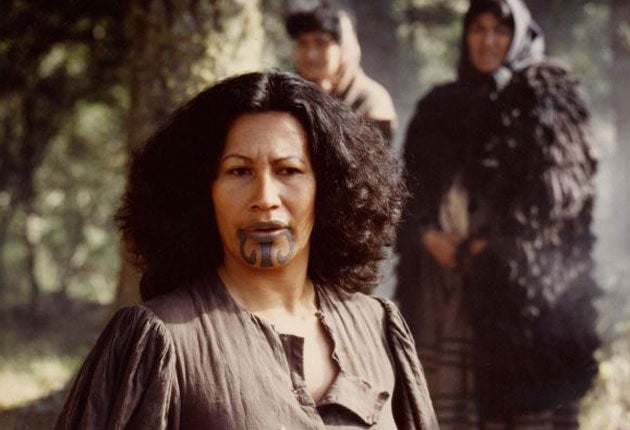
Just before its release, she took part as an actor and casting director in the historical feature film Utu, which led to a lengthy relationship with its director, Geoff Murphy. It was not until 1988 that she directed, wrote and produced her own fiction feature film, Mauri, which won a prize at Italy's Rimini Film Festival.
In 1990, she completed Mana Waka, another key work, based on restored archive footage from an unfinished 1940 film about the carving of ceremonial canoes, and the vision of cultural and spiritual leader Princess Te Puea Herangi. From this time onwards she was based in the US, where she often worked alongside Murphy, and later taught film production at the University of Hawaii. She returned to New Zealand for projects such as Hotere (2001), a profile of the artist Ralph Hotere.
She was most recently in the spotlight again when she received an Order of Merit in New Zealand's 2010 New Year Honours List, and for her role on the production team of the hit feature film Boy (2010). She died suddenly after collapsing outside the studios of Maori Television in Auckland.
Merata Mita, film-maker and activist: born Maketu, New Zealand 19 June 1942; six children; died Auckland, New Zealand 31 May 2010.
Subscribe to Independent Premium to bookmark this article
Want to bookmark your favourite articles and stories to read or reference later? Start your Independent Premium subscription today.
Join our commenting forum
Join thought-provoking conversations, follow other Independent readers and see their replies