Mirko Tremaglia: Fiercely nationalist Italian politician
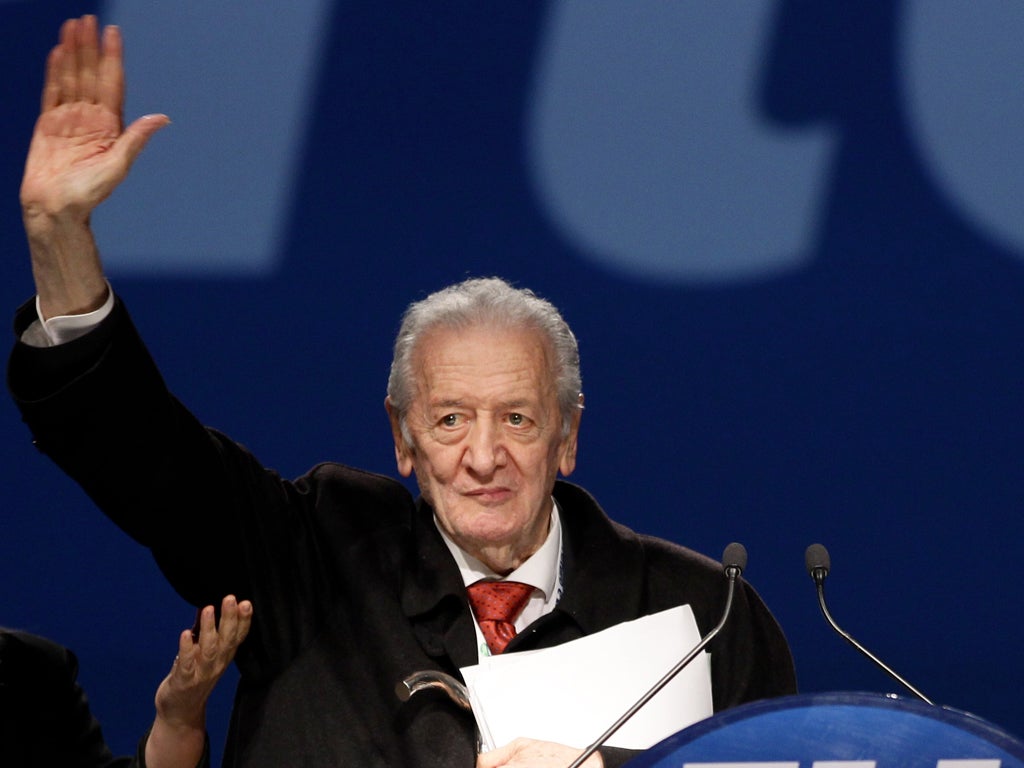
Mirko Tremaglia was the last remaining human link between Italy's present-day political world and the Fascist regime of Benito Mussolini.
Born in the prosperous and robustly independent northern industrial city of Bergamo, Tremaglia volunteered to fight for Mussolini in 1943, when the man who had ruled Italy for 20 years began the last act of his career, as dictator of the pocket Republic of Salò, the Nazis' puppet statelet on the shores of Lake Garda that was responsible for dispatching thousands of Italian Jews to the death camps.
Tremaglia, who was only 17 at the time and who signed up with his two brothers, must have realised fairly fast that he had landed on a sinking ship. But he stuck with it to the end, fighting the American liberators before being captured and interned in a POW camp near Pisa.
Nor did the theoretical outlawing of Fascism and neo-Fascist parties in Italy's post-war constitution cause Tremaglia any belated qualms of conscience: he had made his commitment, for reasons of sentimental nationalism more than anything more sinister, and rigid loyalty to the Fascist ideal was to be his moral compass for the rest of his life. The paradoxical consequence was that, by the end of his nearly 40-year political career, he stood out in an increasingly disreputable parliament as a man of real principle. President Giorgio Napolitano, his near-contemporary and for decades a pillar of the Italian communist party, Fascism's deadly wartime enemy, acknowledged his improbable stature in a generous – though carefully worded – tribute.
To be an unrepentant Fascist in post-war Italy took a certain perverse courage. Released from internment, the young Tremaglia was barred from studying at one prestigious university but graduated in law from another and became a practising lawyer. He joined the Movimento Sociale Italiano (MSI), successor party to the Partita Fascista, in 1948, and became right-hand man of its leader, Giorgio Almirante. He was first elected to parliament in 1972 and passed more than 20 years as a parliamentary leper: no other party wished to sully itself by an alliance with the MSI. The situation was transformed when Almirante's young successor, Gianfranco Fini, led the party in from the wilderness, changing its name to Alleanza Nazionale, visiting Israel, condemning anti-Semitism and joining Silvio Berlusconi's first coalition government. When Fini went on to describe Fascism as "an absolute evil", Tremaglia refused to endorse the sentiment, but despite that disagreement they remained colleagues to the end.
His political career peaked in 2001 when Berlusconi, elected to power for the second time, gave him the new post of Minister for Italians in the World, and Tremaglia became the first and only formerly card-carrying Fascist to serve as a post-war minister. During his spell in power he achieved his long-cherished goal of giving Italian expatriates the right to vote in domestic elections. The move was backed by Berlusconi as a cunning device to prevent the centre-left beating him at the next election, so when it had the opposite effect, bringing Romano Prodi back into power in 2006, Tremaglia found himself not only out of office but terminally out of favour with the media mogul. The law which bears his name has since been praised by the centre-left as the first significant extension of the Italian franchise since the granting of votes to women and the lowering of the voting age to 18.
The Italian nationalism which was his driving political sentiment led him to some surprising conclusions. In 2009 he condemned an attempt by Berlusconi's government to make illegal immigration a crime, arguing that illegal immigrants should be brought within the law through an amnesty. "We are duty-bound not just politically but morally to safeguard [for immigrants to Italy] the same rights that our own emigrants obtained with many sacrifices," he said. It was this fierce adherence to his beliefs that led parliamentary adversaries to describe him after his death as "a good man" and "a man with a backbone." President Napolitano spoke of "sincere reciprocal esteem on the human level and in the performance of our tasks, with a sense of responsibility to the nation."
He is survived by his wife. His only child, Marzio, who was also a politician, died in 2000.
Mirko Tremaglia, politician: born Bergamo 17 November 1926; married (one son, deceased); died Bergamo 30 December 2011.
Join our commenting forum
Join thought-provoking conversations, follow other Independent readers and see their replies
Comments