Paul Arden: Saatchi & Saatchi creative director behind many of the firm's best-known advertising campaigns
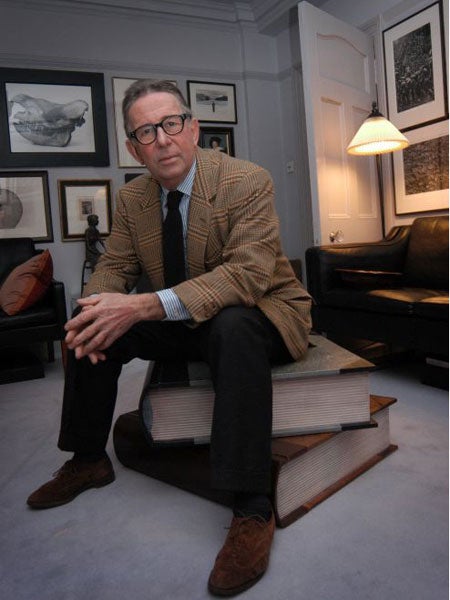
Paul Arden was a legend in the largely anonymous world of advertising. He followed Jeremy Sinclair as the chief creative in Saatchi & Saatchi through the firm's most glamorous and best-known period in the 1980s.
Arden was the ringmaster behind the whole creative circus that saw British Airways become "The World's Favourite Airline", The Independent become the new intelligentsia's favourite newspaper, Margaret Thatcher the nation's favourite leader and Silk Cut their favourite fag. He was aided in this by the patronage of Charles Saatchi, co-owner of Saatchi & Saatchi, the difficult, obstreperous and visually brilliant copywriter whom the difficult, obstreperous and visually brilliant Arden both idolised and feared.
He was actually directly involved with Charles Saatchi on only one campaign, for Silk Cut, in 1983. Saatchi owned paintings by the Italian artist Lucio Fontana. These were basically sewn-up slashes. Saatchi came into our office and said, "Here is the next campaign for Silk Cut. Photograph it." When we pointed out that silk being cut was a concrete idiom, a visual pun that would not work in any other language but English, Saatchi would have none of it.
So in the typical excess of the 1980s, the next three months saw five world-renowned still-life photographers, under Arden's direction, fiddling around, cutting up bits of silk to get the right effect. On Saatchi's mandate, the pictures were then blown up to full 48-sheet poster size and posted outside Charlie's office window on a special hoarding on the roof of our Charlotte Street headquarters, so that he and Arden could select the one that worked the best.
The final poster campaign became the basis of one of the simplest and most graphically clever English advertising campaigns ever, one that was surreally funny, and sometimes gargantuanly misguided – like Arden's attempt to "do a Christo" by stretching a mile of purple silk across an American canyon and slashing it from a huge crane for a cinema commercial.
This blend of financial devil-may-care, artistic sensibility and sheer bloody-mindedness was Paul Arden in a nutshell. The artistic sensibility he inherited from his father, Les, a shy, sensitive painter from Leicester, whose bucolic watercolours were exhibited at the Royal Academy, a hobby which suited his gentle temperament far better than his job as a visualiser in advertising. Paul, on the other hand, though not as accomplished a painter, was an indomitable perfectionist in the quick-witted, cut-throat advertising world. And though Arden frequently had his throat cut – he was fired six times – phoenix-like he rose to better jobs and greater acclaim.
Arden went into advertising after leaving Beckenham Art College, and worked at several agencies, including Doyle Dane Bernbach, Lintas and Colman & Partners before joining Saatchi & Saatchi in 1979, as executive creative director. He stayed until 1992, when he left to set up the film production company Arden Sutherland-Dodd.
At Saatchi's, Arden and I led the team that created the campaign for the launch of The Independent for Andreas Whittam Smith in 1986. For a media business like advertising, launching the first quality newspaper in 112 years was an absolutely plum job. Accordingly we assembled a crack team – a great new copywriter, Peter Russell, the brilliant art directors Digby Atkinson and Chris Gregory, and the best young account man in Saatchi's, Robert Saville (who turned copywriter on this campaign and later founded Mother, the unsurpassed postmodern advertising agency).
We gave the art directors the line, "The Independent. It is. Are you?" and Arden, Atkinson and Gregory added the Saatchi hallmark of elegant surrealism: the poster of two peas in two pods and the commercial of sheep dutifully following each other into a butcher's lorry, employing fine art direction to nail our strategy of independent thinking. Arden and I stood at Baker Street station on launch day, bought 20 copies each and watched as the public demolished the rest of the huge pile. It is the only time I saw Paul cry.
In the 1970s, many advertising people like Paul Arden, Dave Trott, Robin Wight and myself got involved in EST (Erhard Seminars Training), a rather vicious Californian self-realisation course. It had a profound effect on Trott and I. We both got divorced. But not Paul; he stuck loyally with Toni, his long-suffering Danish wife, who was always the one point of certainty in his often tumultuous life. None the less EST's brand of eclectic philosophy, populist psychology and quasi-religious enthusiasm got under Arden's skin and erupted magnificently 20 years later in his bestselling first book, It's Not How Good You Are, It's How Good You Want To Be (2003).
I never fully bought into Arden's Dadaist talks where he spoke while a naked man stood next to him, or the string quartet who played as he stood silent for another "speech". Part of his eccentricity was as cleverly contrived and deliberate as Dali or Duchamp.
But the unique and almost childlike simplicity of his books, which are clever, funny and fiendishly wise (he published Whatever You Think, Think The Opposite in 2006, and God Explained in a Taxi Ride, 2007), remind me so much of Werner Erhard, the sage former car dealer who founded EST. Erhard's masterly aphorisms, like "Always ride the horse in the direction it is going", are frequently matched and even bettered by Arden's epithets: "Have you noticed that the cleverest people at school are often not the ones who succeed in life?" Even the clever conceit in the subhead for the first book, "The world's best-selling book by Paul Arden", is a brilliant piece of commercial double-talk that I'm sure helped him sell over a million copies.
He often seemed to speak in riddles or even faintly autistically to blurt out the most inappropriate and unkind things. Once when proudly shown a photograph of an account woman's newborn, he responded enthusiastically, "I love ugly children." I believe there was no malice, but watching a team's faces turn from beaming smiles to horror as critiquing their work he screamed "Yes. Yes. Yes", then suddenly mid-sentence and mid-thought, starting to stamp and shout "No. No. No." and then rip up the storyboard, you might wonder. Certainly it's not a tactic recommended by many management manuals.
With Arden you either bought his full-steam-ahead directness or you didn't and but for Toni's calm and regal marshalling of her difficult charge I don't think there would have been many long-term buyers. Toni and Paul shared everything, especially his love of art, particularly photography, of which they amassed a large and refined collection, which finally emerged in their gallery in Petworth, Sussex.
Sometimes his fabled bumbling went beyond the bounds of tolerance, for example when as the best man at my wedding Paul committed the ultimate cliché and lost the ring. Like many of his self-centred gaffes, it was more funny in the retelling than the reality. In the end, though, Paul Arden's innate kindness would poke through. As an indefatigable champion of the underdog, probably fired by his humble beginnings in a council house in Sidcup, he was the mentor of scores of misunderstood, overlooked or underrated creatives like Graham Fink, Alex Taylor and Mark Reddy who have gone on to sparkling careers in advertising.
Tim Mellors
Paul Howard Arden, advertising executive and writer: born Sidcup, Kent 7 April 1940; executive creative director, Saatchi & Saatchi 1979-92; married (one son, one daughter); died Petworth, West Sussex 2 April 2008.
Join our commenting forum
Join thought-provoking conversations, follow other Independent readers and see their replies
Comments