Penny Tweedie: Photographer whose work encompassed war zones, people with Aids and Australian aboriginals

For free real time breaking news alerts sent straight to your inbox sign up to our breaking news emails
Sign up to our free breaking news emails
Throughout a 50-year career covering not only wars but also the social conditions that people lived in, Penny Tweedie brought a meticulous, caring and sensitive approach to her coverage of events, which ranged from dramatic news stories to showing the everyday lives and culture of people such as the Australian aborigines.
She worked in all areas of photography: news, portraits, still life; and for all media outlets: newspapers, magazines, books and television, and for campaigns and corporate outlets. Some of her corporate work was taken on to supplement work done for charities and often to fund her trips to cover news stories.
Penny was born in Hawksmoor, Kent to a farming family. She was determined, despite family opposition to be a photographer and entered Guildford Art School to study the subject. On leaving she joined the staff of Go Magazine, one of the precursors to the Sunday supplements, and started her life of travelling. She left there after two years to go freelance, and she was to remain a freelance for the rest of her life. A potential job offer by the Daily Express was withdrawn after its journalists voted against her employment on the grounds that a woman might faint if sent to cover a train crash.
Her work quickly brought her to the attention of other picture editors, and she built up a portfolio which included coverage of life in the slums of the Gorbals in Glasgow for the charity Shelter. Her work for charities was to continue throughout her life. The spirit of patients receiving palliative HIV/Aids care in Uganda had a particular impact on her: “It was the most humbling experience of my life,” she wrote. “Here are these people dying who were actually thanking us for coming along to take their picture and tell their story. I just hoped that my pictures could do them justice.”
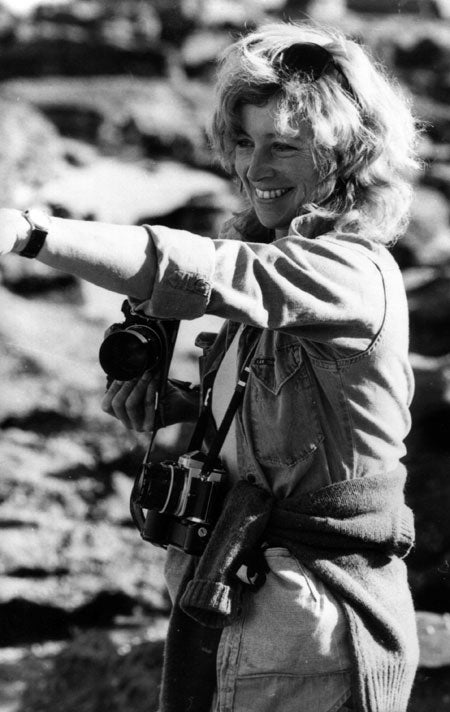
Penny was to cover some of the bloodiest conflicts through the latter part of the century; she never fainted and she never compromised her principles. An energetic attractive figure, cameras draped around her neck, she became a familiar sight in the most difficult locations. She was shot at by planes as she sheltered under a tank in a minefield on the Golan Heights during the Yom Kippur war; she was thrown out of Uganda during the mass expulsions of Asians, and she photographed the invasion of East Timor by Indonesia, a conflict which led to the murder of several Australian journalist colleagues a few days later.
It was her coverage of the war in Bangladesh that would be a defining point in the way she saw her obligations as a photojournalist. Taken with other journalists to see victory celebrations in a stadium and seeing five prisoners being prodded by bayonets, she lowered her camera and refused to take photographs. She realised that this was being staged for the media. Describing the scene, she was to write: “Instinctively I thought that if they were about to torture and they weren’t pushing us away then this could be deliberately being done for the media.” She and two others left having tried unsuccessfully to persuade others to join their boycott. She returned to find the bodies of four of the men. “I felt,” she wrote, “that Siddiqui, [the Bangladeshi leader] must have wanted the media to record this, and so I felt we were complicit in their deaths.”
Invited in 1975 to Alice Springs in Australia to cover the shooting of a BBC film about the explorers Burke and Willis, Tweedie became fascinated by the lives and work of the Aboriginal people. She was to take up dual citizenship, living for some years in Canberra and the Northern Territory. It was her interest in the culture of the aborigine people that led to her being subsequently invited to Arnhem Land to record the lives of aborigine artists and their families. She repeatedly returned to see them, living among them and learning to survive in the bush. She was given the “skin name” Bulandjan, and was to produce work that ranged from a major article in National Geographic to a book, This, My Country, A View of Arnhem Land, and in 2001, Spirit of Arnhem Land, widely regarded as a classic. In 1999 she won the prestigious Australian Walkley Award for photojournalism. Another exhibition and book, Standing Strong, was to follow in 2001, based on photographs and interviews with young indigenous people.
She made frequent visits back to the UK, where she had kept a house, accompanied by her adored son Ben, who she had brought up on her own and was a regular companion on her assignments. In Britain she continued working free for various charities and campaigns such as Oxfam, Help the Aged and the Save The Children Fund, for whom she also travelled to South America and Timor. She continued to travel, with her work for NGOs covering among others the sufferings of landmine victims in Cambodia and orphans of the genocide in Rwanda.
At the same time she built up a large portfolio of portraits which included John Lennon, Princess Diana and General Gaddafi. Many of her subjects were to become friends, one, Alistair Cooke, described her as “cute as a dimple”. Her work appeared in most of the leading publications in the UK and throughout the world, including Newsweek, Time and Paris Match. She also contributed a chapter to a book on war correspondents and photojournalists.
She returned from Australia to Hawksmoor to look after her ailing mother, still taking photographs. In 2004, describing her work, she wrote: “This is my life, my passion: this is what makes me tick. I’ve been privileged to work with so many different and amazing people. I thrive on the challenge to convey their stories. This is what I do - it’s my life.”
She left a large body of work which is expected to go to the National Library of Australia, where it will be preserved for future generations.
Penelope Tweedie, photographer: born Hawksmoor, Kent 30 April 1940; one son; died Hawksmoor 14 January 2011.
Subscribe to Independent Premium to bookmark this article
Want to bookmark your favourite articles and stories to read or reference later? Start your Independent Premium subscription today.
Join our commenting forum
Join thought-provoking conversations, follow other Independent readers and see their replies