Phillip Tobias: Anthropologist who discovered Homo habilis and fought against apartheid
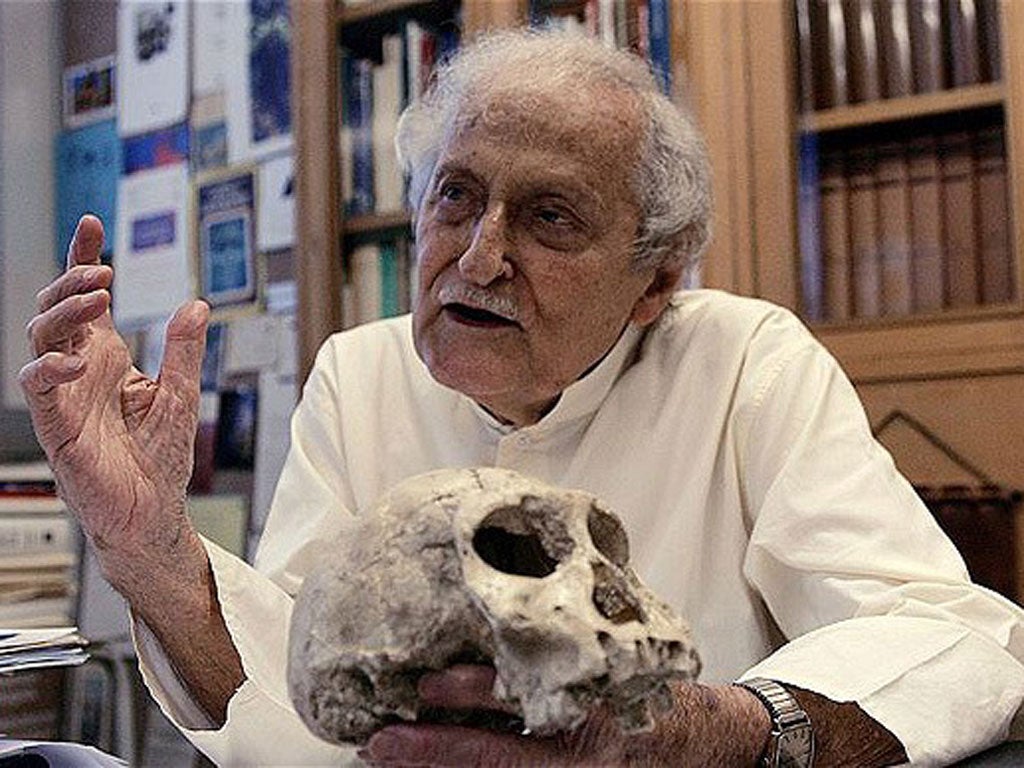
Phillip Tobias was a palaeoanthropologist who broadened and deepened our knowledge of the earliest history of the human-like species that came before our own. Working together with Mary and Louis Leakey he discovered and documented Homo habilis, a two million-year-old possible ancestor and one of the earliest users of tools. More recently he collaborated with Professor Ron Clarke in describing a new Australopithecus species, from a fossil skeleton dubbed Little Foot, which dates back some three million years or more.
He was born in Durban, South Africa in 1925, the son of Joseph and Fanny (*ée Rosendorff) Tobias. When Tobias was 16 his sister Val died, aged 21, as a result of inherited diabetes. Tobias later said that it was this event that resolved him to study genetics, to which he added archaeology and zoology. He arrived in Johannesburg in 1943 and enrolled as a medical student at the University of the Witwatersrand (Wits).
In May 1948 the National Party came to power, with Daniel-François Malan as Prime Minister, promoting racial segregation policies. Two months later Tobias was elected as the president of the National Union of South African Students. Within a year he had launched an anti-apartheid movement. He explained "In the beginning, it was a campaign to fight against the threat that apartheid be imposed on the universities. Over the years, it expanded its remit so as to oppose all other moves to impose segregation and grand apartheid on every sector of society."
Tobias obtained his medical degree in 1950 but never practised medicine. Instead he went on to complete his PhD at Wits. His thesis was published as the book Chromosomes, Sex-Cells and Evolution in the Gerbil (1956), the first of more than 1,000 publications during his long academic career.
In the same year he received a Rockefeller Travelling Fellowship, which took him to the United States, to the universities of Chicago and Michigan. On return to South Africa he once again became involved in the struggle against apartheid, following the announcement of government plans for segregation within the academic environment.
In 1957 he was one of 2,000 people who marched from Wits to Johannesburg's City Hall. During an awards ceremony in 2007 Tobias recalled: "As we marched down Jan Smuts Avenue, I remember being struck by an egg thrown by a hooligan standing on the side of the road. I later met a man at the airport who confessed to the deed and he apologised and said he was now a changed man." This was to be one of the last protests of its kind before the imposition of severe restrictions by the apartheid regime.
Two years later he succeeded Raymond Dart as head of anatomy at Wits and started work with Louis and Mary Leakey and John Napier at the Sterkfontein Caves. The cave complex had been excavated by Dart since 1936 and contains fossils of the Australopithecus species of ape-man, the most ancient skeleton yet discovered. At Olduvai Gorge, Tanzania, fossil bones were found in the 1960s of a human ancestor who was making and using tools. Dart called him Homo habilis, a name which Tobias anglicised as "the handyman". This new link between the earlier Australopithecus species and modern humans was at first disputed but has subsequently become widely accepted.
In 1987 Tobias again faced up to the apartheid system, this time under the regime of PW Botha. When the education minister, FW de Klerk, threatened to cut funding for universities which did not inform on anti-apartheid activists, Tobias responded at a public meeting: "We shall not subjugate ourselves to these savage conditions... We shall not prostitute our calling as academics to become a spying and policing agency. This university will not become a tool of repression."
Reflecting on this period, his former student and colleague Professor Lyn Wadley said, "The thing that I really admired so much is that during the darkest ages of South Africa, when he could have got a job anywhere in the world, he chose to stay here, because this was his country, where he could make a difference."
During the 1990s Tobias initiated a campaign to bring back the "Hottentot Venus" from France to South Africa. These were the remains of Saartjie Baartman, a member of the Khoisan tribe taken to London in 1810 by Dr William Dunlop, who exhibited her in shows to paying audiences. Baartman was subsequently taken to Paris where she died and was dissected and embalmed. She was finally laid to rest on Women's Day, 9 August 2002, in the Gamtoos River Valley, South Africa.
Tobias was the recipient of numerous awards, including Fellow of the Royal Society (elected 1996) and Order of the Southern Cross, presented by Nelson Mandela in 1999. During that same year the Sterkfontein Caves became a Unesco world heritage site, thanks to Tobias's work in promoting the cause. His autobiography, Into the Past, was published in 2005.
Tobias expressed regret at not having had children of his own but said: "I have taught over 10,000 students, and all of those are, in some small way, like my children... I like to believe that I have given something valuable to every one of them, and I can tell you quite honestly that almost every one of them has given something very valuable to me, and I remember them as my own family."
Marcus Williamson
Phillip Vallentine Tobias, anthropologist and anti-apartheid campaigner: born Durban, South Africa 14 October 1925; died Johannesburg 7 June 2012.
Join our commenting forum
Join thought-provoking conversations, follow other Independent readers and see their replies
Comments