Professor Edward Lorenz: Meteorologist whose work on weather prediction led to the discovery of chaos and the 'butterfly effect'
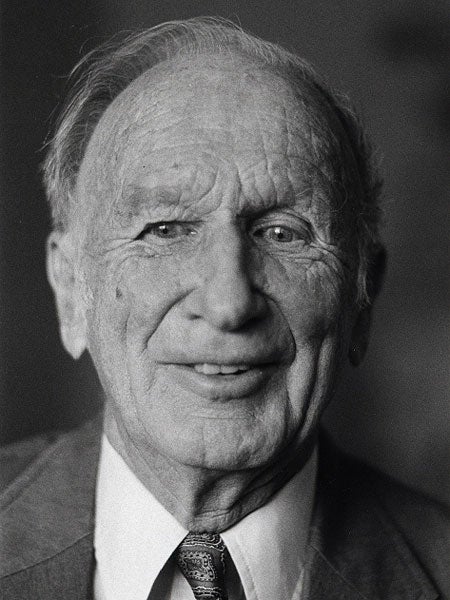
Edward Lorenz was a meteorologist at the Massachusetts Institute of Technology (MIT) whose investigations into predictability of the atmosphere led to the discovery of chaos and "strange attractors", while also changing the way operational forecasts are made. Known for his passion for science, his kindness, and his gift for writing, Lorenz produced papers of clarity and beauty, illustrated with understanding and gentle humour.
He was fascinated by forecasting, and studying the various ways our ignorance can lead to wildly misleading predictions of the future. The idea that a small event can produce large changes in the atmosphere dates back at least to Edgar Allan Poe, who discussed the growing impact a wave of the hand would have on the future. In the 1920s the British astronomer Sir Arthur Eddington focused on a match idly thrown from the window of a train, and in the early 1960s Lorenz considered the flap of a seagull's wings.
The origin of the now popular phrase "butterfly effect" is unclear; the contenders include a 1952 story by Ray Bradbury in which the death of a prehistoric butterfly leads to a very different modern world, as well as the butterfly-like shape of the strange attractor – an odd mathematical object which reveals more and more structure when examined closely – now known as the "Lorenz attractor". For Lorenz himself, the move from seagull to butterfly came about when his friend Philip Meriless, unable to reach him as a meeting deadline passed, submitted the title "Predictability: does the flap of a butterfly's wings in Brazil set off a tornado in Texas?" for a talk Lorenz was to give in 1972.
For more than half a century, Lorenz was a master computer modeller. He did not construct his models to be realistic, but rather to provide a compelling example by capturing the relevant mathematics, if not the relevant physics, of a situation. He had a knack for constructing nonlinear models that were more than fit for this purpose, providing new mathematical insights as well as hitting the targets they were designed to exemplify or contradict. He believed strongly that such stories allowed those with little or no training in mathematics to understand the essence of chaos, and without question his examples proved of great value in clarifying the vision of many who did have such training.
Asked why we could not make better weather forecasts, he wondered why we could make forecasts at all, and developed a clear understanding of the difference between the predictability of a physical system itself, the limits imposed by our lack of precise observations and those imposed by our not knowing exactly which equations to use. In constructing simple mathematical models to illustrate the lessons of predictability, the ways and means by which weather and climate forecasts go wrong, Lorenz developed insights applicable far beyond the earth sciences.
Edward Norton Lorenz was born in 1917 in West Hartford, Connecticut. While an undergraduate in mathematics at Dartmouth College, New Hampshire, in the Thirties, Lorenz took an interest in simple pinball machines which appeared in the local drug stores, and in the arguments that followed as to whether they were illegal games of chance or acceptable games of skill. He obtained a masters degree in mathematics at Harvard, before taking a graduate degree in meteorology from MIT.
After serving in the US Army Air Forces as a weather forecaster during the Second World War he returned to MIT, receiving his doctorate in meteorology in 1948 and joining the MIT faculty, to which he belonged for the rest of his career. His description of chaos in a simple model of convection in the early Sixties sometimes overshadows his wide-ranging contributions to atmospheric science, forecasting and the use of computers in scientific research.
Although trained to work with the equations that "governed" the evolution of the atmosphere, in 1955 he was appointed to lead a project in statistical weather forecasting. He immediately challenged the popular claim that the then recent results by Norman Wiener on linear methods provided an optimal approach to weather forecasting, leading some of his colleagues to view him not as a statistician, but as an infiltrator from the numerical weather prediction camp. The challenge took on a form that Lorenz used throughout his career: he developed a counter-example within the context of a simple nonlinear model. This approach did not question Wiener's mathematical results, but only their application, and proved much simpler than establishing the details of whatever mistake had been made in their application.
Lorenz first developed a simple nonlinear model of the atmosphere that considered only 12 variables and tuned it to display nonperiodic behaviour. He then showed that the linear method did not yield perfect predictions of this behaviour and since perfect predictions could be made by forecasting with the exact equations, he had demonstrated that the linear method could be beaten.
Attempting to examine a particular solution more closely, he famously went to get a cup of coffee after typing in a starting point from the original printout and restarting the computer, returning to find that the computer had generated a very different result from what he had expected. Initially suspecting a hardware fault in the computer, he found instead that the "error" had developed slowly due to the amplification of a slight difference in the starting point: he had typed in numbers as the computer had printed them out, and those values differed slightly from the internal values that the computer had used in the original run, hence he had introduced a small difference between the original run and the second.
He soon recognised the implications this held for weather forecasting: small unavoidable uncertainties in the observations could quickly lead to the loss of predictability, even if the weather model was perfect. He often drew an analogy with the pinball games he had witnessed in Dartmouth, where the placement of a winning pinball required super-human skill, an analogy strengthened by the habit of meteorologists to place small wagers even on their real-time forecasts of the 12 variable model, and then watching as the computer printer slowly revealed the results.
In the late Fifties, Lorenz did not wish the issue of sensitivity to small uncertainties to distract from his main message, which was the inferiority of linear forecasting methods. So he delayed detailed discussion of the effect he had witnessed while looking for a simpler model "in the hopes of being able to demonstrate exactly what was happening". This hope was realised with a model consisting of only three variables, which Lorenz introduced in a 1963 paper, "Deterministic Non-periodic Flow". This remains one of the clearest introductions to chaos and includes a description of how strange attractors are formed and why they are fractal.
In a less widely known paper in 1964, "The problem of deducing the climate from the governing equations", Lorenz moved from uncertainty in observations to uncertainty in model parameters, and showed how uncertain parameters pose significant challenges to determining the statistics which define the Earth's climate. Using an even simpler model, now called the Logistic Map, Lorenz demonstrated how its behaviour – the "climate" of the Logistic Map – changed, sometimes drastically, as model parameters were varied.
He even identified the so-called "period three window" which, a decade later, the mathematicians T.Y. Li and J.A. Yorke would discuss when introducing "chaos" as a technical term. Lorenz stressed that in mathematics, a computer could suggest propositions to be proven, propositions whose very existence was unknown until one saw numerical simulations. Indeed, simulations were to play this role years later in the work of Mitchell Feigenbaum and others.
Lorenz also argued that climate forecasting need not be impossible, even if detailed weather forecasts proved impossible due to chaos. His original paper on chaos is often cited by climate-change nay-sayers, who fail to note that in a paper published in the 1970s, "Climate Predictability", he stressed that chaos "does not indicate the rate of decay of climate predictability". In the same paper, Lorenz touched on a theme he was still developing last year: just how long might we need to run a realistic climate model if we want to be fairly sure we know what its climatological distribution really is?
Operational forecasters have the advantage of seeing their forecasts go wrong, day after day. After day. Observing how various forecasts went wrong, Lorenz used simple models to clarify problems and test potential solutions. As computers got faster, his simple models got a bit more complex, but the goal remained to illustrate and motivate methods rather than to simulate the actual weather.
He also worked with those who ran operational weather models, and often visited the European Centre for Medium-Range Weather Forecasts in Reading. Since 1992, the first line of defence against chaos deployed by operational weather forecasters has been to run not just one simulation per day, but an "ensemble" consisting of a few dozen simulations each initiated from a slightly different starting point, in order to determine how sensitive today's forecast is – Lorenz had pioneered the approach used to select an effective ensemble in the late Sixties.
In the Nineties Lorenz advanced the question of how to best improve a forecast if one was allowed to make one more observation of the atmosphere – how would you determine what to observe? Today, when satellites can produce more data than one has time to consider, these ideas can help determine which data to analyse in real time.
A member of the US National Academy of Sciences, Lorenz was also elected a foreign member of both the Royal Society and the Soviet Union's Academy of Sciences, and received numerous awards, including the Crafoord Prize, awarded jointly with Henry Stommel in 1983, and the Kyoto prize in 1991. Accepting the Kyoto prize, he stressed that a scientist "must be willing to question any commonly accepted explanation that is not logically and clearly stated, rejecting it and seeking a new explanation if it cannot be acceptably restated".
When questioned as to whether the Earth's atmosphere was chaotic, Lorenz would note the difference between what we can know regarding our models, and what we can know regarding the real world. He would often suggest that if our best models of a system were chaotic, then it seemed reasonable to call the system being modelled chaotic, while realising that the best model of tomorrow might prove rather different from those we have today. From the early Sixties onwards, he took the position that, even if the jury is still out when it comes to the Earth's atmosphere, "the most recent evidence seems to favour the seagulls".
Leonard A. Smith
Edward Norton Lorenz, meteorologist: born West Hartford, Connecticut 23 May 1917; staff, Department of Meteorology, Massachusetts Institute of Technology 1948-55, Assistant Professor of Meteorology 1955-62, Professor 1962-87 (Emeritus), Head of Department 1977-81; married 1948 Jane Logan (died 2001; one son, two daughters); died Cambridge, Massachusetts 16 April 2008.
Join our commenting forum
Join thought-provoking conversations, follow other Independent readers and see their replies
Comments