Professor Graham Stanton: Biblical scholar who helped guide New Testament studies at Cambridge into the 21st century
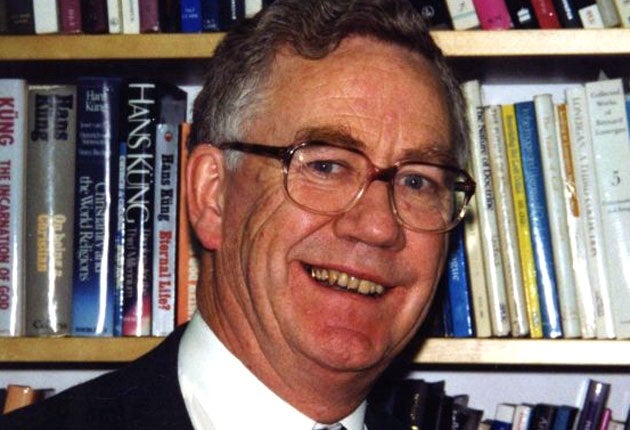
Graham Stanton was Lady Margaret's Professor of Divinity in the 500th year of the oldest chair at Cambridge University; and he played a major role in securing its re-endowment by the Kirby Laing Foundation just before he retired in 2007.
His nine-year tenure of the chair was relatively brief by comparison with that of his two immediate predecessors, Professors Charlie Moule (his former supervisor) and Morna Hooker, whose combined tenure was 47 years; but it was nevertheless decisive in bringing New Testament studies in Cambridge into the 21st century well-equipped for the future. The majority of his career was spent at King's College, London, where he went after the completion of his doctoral studies in Cambridge. There, first as Lecturer and then as Professor, he was a mainstay of the Department, securing a reputation as a skilled doctoral supervisor himself.
Born and brought up in New Zealand, Graham Stanton studied History and Theology at Otago University before coming to Cambridge to do a PhD. Although raised in the Salvation Army, he was licensed by the Presbyterian Church of New Zealand - the preliminary stage before ordination - just before he came to Westminster College, Cambridge on a Lewis and Gibson Scholarship.
Stanton began with an interest in the ways in which the message of Jesus was preached in the Church in the first two centuries, which led to his first book, Jesus of Nazareth in New Testament Preaching (1974). His primary work was on the Gospels, particularly that of Matthew, for the rest of his life. Stanton's best known book was probably The Gospels and Jesus (1989, with a second edition in 2002), which, as well as being an extremely lucid account of the primary issues, reaffirmed his belief that the present form of the Gospels had to be tackled before the issues concerning the historical Jesus, which had preoccupied 19th-century writers. So the dating of the Gospels, on which much ink had been spilt in the previous two centuries, was subordinated to a consideration of their final form.
His collection of essays on Matthew's Gospel, A Gospel for a New People (1992) used the full range of modern critical techniques to illuminate the community behind the text - a reminder that the Gospels, as much as the Epistles, were originally written in a particular context. He was prepared, where necessary, to draw on "the disciplined imagination of the historian"; and for him discipline was as important as imagination.
Stanton was also concerned to communicate with a wider general readership. Gospel Truth? New Light on Jesus and the Gospels (1995, translated into French, Dutch, Spanish and Italian) was a popular presentation of many of his scholarly themes. More recently Jesus and Gospel (2004) examined the development of the term "gospel" and the four canonical Gospels. His life's work is well summed up by some words in one of his most recent essays: "an ongoing dialogue between close attention to the biblical text, the effects of the text (for good or ill) through the centuries, and contemporary theological reflection". The recognition of that broad remit for New Testament scholarship - the text, its history and its continuing relevance - is still not universal, particularly the acknowledgement that there may have been bad effects as well as good.
Stanton served as President of the Society for New Testament Studies in 1996-97, and for nine years he edited New Testament Studies and the associated monograph series. He was a General Editor of the International Critical Commentaries, the leading set of commentaries in English on the Bible for more than a century. King's College, London elected him to a Fellowship of the College in 1996, and the University of Otago awarded him an honorary DD in 2000. In 2006 the British Academy awarded him the Burkitt Medal for his contribution to Biblical Studies.
At Cambridge he served as Chairman of the Faculty Board of Divinity and was Vice-Chancellor's Deputy as chairman of the Select Preachers' Syndicate. In Fitzwilliam College he took his share in College Committees and was a loyal supporter of College occasions, appearing in College for a special dinner in honour of a former London colleague less than a month before his death. He was active in fund-raising for both the University and College.
Stanton's academic career meant that he was never ordained, but he was active in his local churches in Orpington and Cambridge, served on the Doctrine, Prayer and Worship Committee of the United Reformed Church in the 1990s and led Bible Study at two General Assemblies. As a scholar he was meticulous, candid without being identified with conservative or radical positions, and always attentive to other people's points of view.
As a New Zealander he always supported the All Blacks, and was greeted with a haka from his former research students on the occasion of the presentation of a Festschrift on his 65th birthday. The characteristic wave in his hair, which never disappeared during his cancer treatment, matched his ready smile and friendly attitude to long-standing colleagues and first-year students alike. As a Head of Department he took great care to make newcomers feel at home. He was wise and generous in his treatment of others: "I never heard a bad word said about him," remarked one colleague.
As a loyal friend and an encourager of all young researchers he will be greatly missed. His courage in facing his illness was an inspiration to all who knew him, and the embodiment of his Christian faith.
David M. Thompson
Graham Norman Stanton, New Testament scholar: born Christchurch, New Zealand 9 July 1940; Temporary Lecturer, Princeton Theological Seminary, New Jersey, 1969; Naden Post-Doctoral Research Student, St John's College, Cambridge 1969-70; Lecturer in New Testament Studies, King's College, London 1970-77, Professor 1977-98; Lady Margaret's Professor of Divinity and Fellow of Fitzwilliam College, University of Cambridge, 1998-2007; MA, BD (Otago), PhD (Cambridge), Hon DD (Otago), FKC (London); married 1965 Valerie Esther Douglas (two sons, one daughter); died Cambridge 18 July 2009.
Join our commenting forum
Join thought-provoking conversations, follow other Independent readers and see their replies
Comments