Professor Richard Greenfield: Historian
Historian of the Horn of Africa whose 1965 'Ethiopia: a new political history' has never been bettered
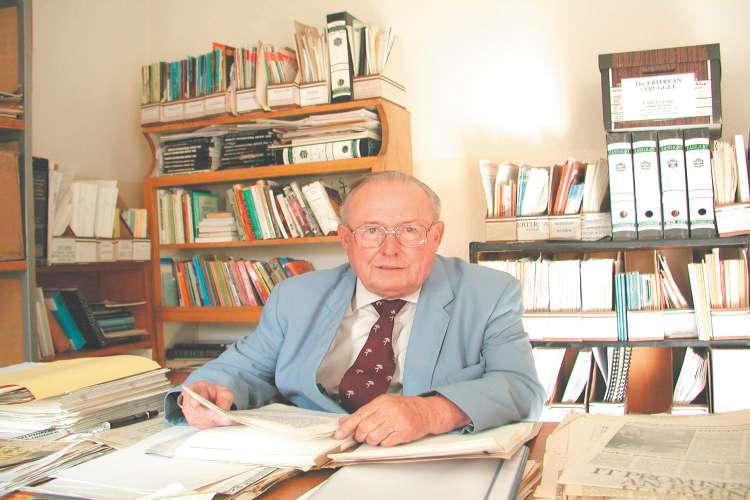
Richard Greenfield had an unparalleled grasp of the history and politics of the countries of the Horn of Africa, and will perhaps be best remembered for his 1965 book Ethiopia: a new political history.
From 1999 until 2007 he was Professor of History at the University of Asmara in Eritrea, supervising with painstaking thoroughness many history, law and political science students' research theses. When he joined the university, he also became senior consultant for the Eritrean Research and Documentation Centre in the city, and there deposited his comprehensive personal library and extraordinarily rich archives, now known as the Greenfield Collection. Among his treasures were first editions of James Bruce's Travels to Discover the Source of the Nile (1790) and James Theodore Bent's The Sacred City of the Ethiopians: being a record of travel and research in Abyssinia in 1893. He proved an inspiration to the young archivists and worked closely with the director of the documentation centre, Dr Azeb Tewolde.
Greenfield had first visited Eritrea in 1958 shortly after he had joined the staff of the University of Addis Ababa. A supposedly autonomous state, Eritrea was already on the way to an illegal annexation by Ethiopia. Later Greenfield was appointed dean of students and was in Addis during the attempted coup against Emperor Haile Selassie in 1960. He sheltered a number of student activists from the military when the coup was repressed and thus saved their lives. He stayed in Ethiopia until 1962 although subject to periods of harassment and house arrest.
Later he wrote Ethiopia: a new political history, which is still hailed as a remarkable synthesis of Ethiopia's long and complicated history as well as a critique of the outdated and corrupt ancien régime. The Ethiopian government attempted to suppress the publication of the work in the United States, then an important ally of Haile Selassie, and it was banned unsuccessfully in Ethiopia. For years the book circulated underground among the younger generation in xeroxed copies as the only true account of the country's recent history. It has never been bettered, even though it was greeted with virulent disapproval by Ethiophiles.
Throughout his adult life Greenfield championed the liberation of Africa and Asia from colonial rule and post-colonial manipulation. Born in London in 1931, he grew up in Grimsby, Lincolnshire. His national service was spent as a Second Lieutenant in Penang (Malaysia) during the Emergency and he thoroughly immersed himself in history and political affairs. After reading geography at Selwyn College, Cambridge, he served for three years in the Colonial Education Service in Tanganyika. Here he met and befriended Julius Nyerere, the first of many African associates to rise to a position of supreme power.
This post was an initial stimulus to him to serve most of his professional career in Africa, teaching at the University College in Nairobi, University of Ghana, the University of Benin (Nigeria), the University of Khartoum, and the University of Asmara. He also taught at the State University of New York and Northwestern University, and from 1977 to 1981 he was a Senior Academic Member at St Antony's College, Oxford and at Queen Elizabeth House, the Department of International Development at Oxford University. He was invited to be chairman of the Africa Centre in London during the mid 1990s and helped it weather a stormy period.
On occasions Greenfield also served as a political foreign affairs adviser to a number of senior African politicians and helped to ameliorate the effects of activities inimical to human rights. Having himself been thrown unjustly into jail in Nigeria in 1976 he was especially sympathetic to prisoners. His time in Somalia discreetly at the side of President Siad Barre (until 1986) and General Mohamed Aidid was especially fruitful.
Like another great Africanist, Colin Legum, Greenfield never attempted to influence matters of internal politics and for this reason was respected by all shades of opinion. But from his base in Oxford, he worked tirelessly on behalf of African refugees, personally intervening with Western authorities wherever possible, and always maintaining a keen personal interest in their individual lives. He had a wide circle of Eritrean, Ethiopian, Sudanese, Somali, Zimbabwean and West African friends and was a generous, compassionate host. Even in retirement he continued to receive calls from stranded and desperate Africans, particularly those from eastern Africa, who recognised his name and knew he would help them as much as he could.
Greenfield was a fine and fair critic of other people's writing and did some invaluable reviewing for the University of Indiana Press. He commented at length on much of my own work over the years and one of my recent books, Blood, Land and Sex: legal and political pluralism in Eritrea, owes much to his unrivalled editorial skills. He was an excellent teacher with a fine sense of humour and very popular with my students when he was a visiting lecturer at UCLA (the University of California, Los Angeles) in the early 1990s. While he was in the United States, his advice was often sought by the State Department and Congress.
Over the years Greenfield took a particular interest in Eritrea, especially as its citizens revolted successfully against the rule of the Ethiopians. He was active in raising money for the liberation movement and spoke out constantly on the right of Eritreans for self-determination and freedom. From 1992 he was invited each year to Asmara as an honoured guest for the May celebrations on the anniversary of liberation. He wrote numerous articles in journals and newspapers putting the Eritrean side of the debate. He was a paid-up member of the National Union of Journalists and a crusader for press freedom. He was also a very sympathetic supporter of the Oromo struggle for rights.
He returned to Eritrea in 1999 and made a home in Asmara. He admired greatly the spirit of the Eritreans and the sacrifices they made in their long battle for independence; on their side Eritreans from all walks of life respected and admired him. He loved exploring the many parts of the country, often taking visitors on trips to Massawa or Keren, and wrote enthusiastically about what he saw when he visited the Dahlak Islands. He was an excellent photographer. He had even hoped to write a history of Eritrea and a history of archeology for secondary students as well as his autobiography but alas time did not permit it.
He enjoyed life immensely even as he twice battled cancer, cataracts and hip replacement. On my many visits to Asmara over the past seven years, few days went by without commiserations over our favourite football teams (his being Grimsby Town) languishing in the lower reaches of the Football League. He regretted that his own days as a referee were long over.
His other much-loved country was Kenya and on his last visit in 2007 he had undertaken the painful task of tidying up the estate of yet another old friend who had died there. He would often reminisce about the theatre in Kenya and also about the Africa Dance Ensemble of Ghana to whom he acted as impresario on their tour of the United States in the late 1960s and early 1970s.
He was devotedly cared for and looked after for many years by Teferi Zewede in Oxford and more recently by Yonas Hagos Sihil in Asmara, two of several young Africans for whom he had a paternal relationship.
Roy Pateman
Richard David Greenfield, historian: born London 10 January 1931; Professor of History, University of Asmara, Eritrea 1999-2007 (Emeritus); Senior Consultant, Eritrean Research and Documentation Centre 1999-2008; died Oxford 1 June 2008.
Join our commenting forum
Join thought-provoking conversations, follow other Independent readers and see their replies
Comments