Professor Tom Singleton: Pioneer of the industrial applications of ergonomics
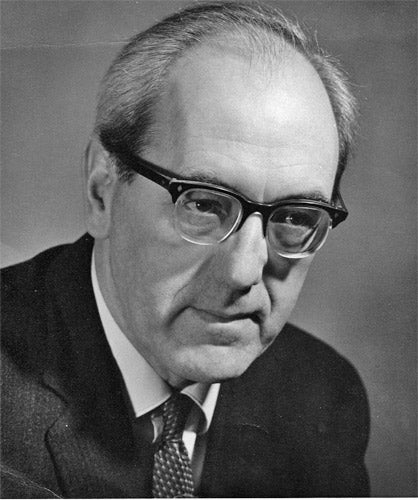
Professor William Thomas Singleton, known always at "Tom", was Emeritus Professor of Applied Psychology at Aston University. As an applied psychologist, he had devoted the majority of his long academic career to ergonomics, the technological discipline of designing equipment, systems, and working environments in accordance with human capabilities and limitations.
Ergonomics developed during the Second World War, when there was an urgent need to adapt new technologies, such as radar and avionics, to the characteristics of military users. After the war Singleton was among the pioneers who worked on the transition of ergonomics to industrial contexts. Nowadays, the areas of application include computers, process control, transport, and communications – any system involving transactions with human users. (The terms "ergonomics" and "human factors" are used interchangeably, and the UK professional organisation is "The Institute of Ergonomics and Human Factors".)
Singleton was Lancashire-born, to James Singleton, a spinning master, and Alice Ann, a weaver. He served in the wartime RAF, and then graduated from St Catharine's College, Cambridge in 1949, and began research work in the Nuffield Unit on Ageing. In 1953, he went on to the Shoe and Allied Trades Research Association (Satra) where he was concerned with the human aspects of footwear production, with particular reference to productivity, an urgent post-war issue.
He visited the US as part of OECD investigations of industrial productivity, and met the dominant US practitioners. In 1961 he took up a lectureship at the College of Aeronautics (now the postgraduate Cranfield University). There, he launched the Ergonomics and Systems Design Laboratory, which promoted research in the ergonomics of design and in human skills, along with postgraduate teaching. In 1965, he was appointed to the chair at Aston, one of the new wave of technological universities. The Applied Psychology Department was soon acknowledged as a repository of research and teaching in many fields, but particularly ergonomics.
Singleton had a lifelong enthusiasm for the study of human skill, fascinated by its adaptability, resilience, and elegance. As an advocate for naturalistic studies of skill rather than mere laboratory reproductions, he edited four volumes (The Study of Real Skills), surveying and integrating analyses of skills by experts in a variety of specialised fields. This focus on skilled behaviour led also to his signal development in the philosophy and practice of ergonomics – the "systems approach".
Whereas the early focus of ergonomics had been on individual elements of equipment, such as a particular information display or type of manual control, Singleton developed an analytical approach to the interaction of the human operators with the system as a whole. Thus, the unique human skills of the operators and other participants were delineated and promoted in the design of the system, along with comprehensive attention to their support by means of information aids, selection, training and job design. This more comprehensive approach now underpins ergonomics applications across the breadth of technology.
More recently, Singleton contributed to the analysis of human error, particularly in high-hazard and safety-critical systems. Industrial accidents, such as at the US Three Mile Island nuclear-power plant, and in the Flixborough chemical plant, showed the need for the prediction of potential human errors, and their amelioration, in future designs. He acted as an expert adviser to UK Nuclear Electric in the development of the Sizewell "B" power station.
He had many international commitments, including advisory posts for the World Health Organisation and the International Labour Organisation, as well as visiting professorships at the Universities of Leuven and Geneva. At home, he had diverse public appointments, and was influential in the drafting of the 1974 Health and Safety at Work Act, with its emphasis on employers' and employees' responsibilities to approach safety pro-actively. In 1968, he was awarded the Vernon Medal of the National Institute of Industrial Psychology. His books include ergonomics textbooks and more general studies of human skill. He retired from Aston in 1982, but continued his academic interests with characteristic vigour.
David Whitfield
Professor William Thomas Singleton, ergonomist: born 3 March 1924; Professor of Applied Psychology, Aston University 1965-1982; married (four daughters, one son); died 11 May 2010.
Join our commenting forum
Join thought-provoking conversations, follow other Independent readers and see their replies
Comments