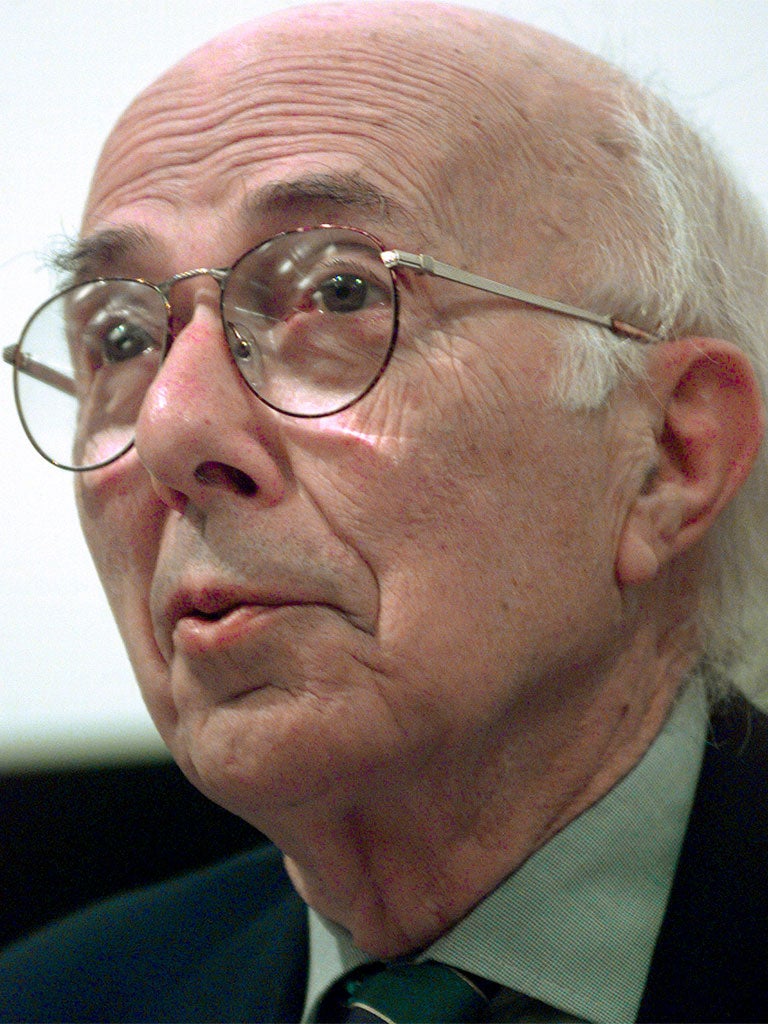
Renato Dulbecco was a former member of the Italian resistance who went on to receive the 1975 Nobel Prize for his work on viruses and cancer. He shared the Nobel Prize for physiology or medicine with two of his former students, Howard Temin and David Baltimore, for demonstrating how certain types of viruses invade mammalian cells to cause cancer. In the late 1950s Dulbecco illustrated that certain viruses can insert their own genes into infected cells and trigger uncontrolled cell growth, a trademark of cancer. This was achieved before it was possible to sequence DNA.
The discovery provided the first solid evidence that cancer was caused by genetic mutations, and changed the way scientists thought about the effects of carcinogens. Believing his research had broad implications for cancer prevention, at his Nobel address Dulbecco called for increased restrictions on tobacco and urged governments to limit dangerous chemicals. "While we spend our life asking questions about the nature of cancer and ways to prevent or cure it," he said, "society merrily produces oncogenic substances and permeates the environment with them."
He was also one of the first advocates of the human genome project: in 1986 he recommended cataloguing all human genes to gain insights into cancer, providing the intellectual impetus for the Human Genome Project, which was completed in 2003. Many thought this would be expensive and useless, but it has proved invaluable.
Renato Dulbecco was born in Catanzaro in southern Italy in 1914, moving shortly after with his family to the north. After the First World War his father, a civil engineer, was sent to Imperia, near the French frontier, where the young Dulbecco spent much time at a small meteorological observatory and developed an interest in physics. He built a working electronic seismograph, probably one of the first of its kind.
He attended Turin University, initially to study chemistry and physics, but he changed to medicine after consulting his uncle, a surgeon, graduating in 1936. In the Second World War he served in France and Russia, where he was injured in 1942. After recuperation, he went AWOL and returned to Italy, hiding in a village near Turin before joining the partisans as a medical officer. After the war, Dulbecco became a member of the Committee for National Liberation in Turin and joined the city council. However, political life did not suit him and he returned to Turin University to study physics and conduct biological research.
In 1947, a former fellow student, Salvador Luria, recruited Dulbecco to Indiana University, where he shared a laboratory with James Watson, co-discoverer of the structure of DNA. Dulbecco studied bacteriophages, viruses that infect bacteria. He showed that bacteriophages disabled by exposure to ultraviolet light could be reactivated by bursts of white light. His work caught the attention of Max Delbrück, who offered him a post at California Institute of Technology (Caltech) in 1949.
Collaborating with Marguerite Vogt, Dulbecco developed a method for measuring the quantity of virus in animal cells in tissue culture, paving the way for the development of the Sabin polio vaccine. He then turned to the connection between viruses and cancer; he was intrigued by the work of his student, Howard Temin, who wrote his thesis on the topic. Dulbecco experimented with viruses known to cause tumours in animals; at the time, no viruses had been linked to human cancers. Since then, a handful have been shown to cause cancer in humans, including the human papillomavirus, responsible for most cervical cancers.
In later years, Dulbecco studied breast cancer and concluded that breast cancer stem cells gone awry might be responsible for certain types of breast tumours. In 2000, he announced his discovery of the gene responsible for malignant osteopetrosis, a fatal hereditary disease that affects newborns.
Given US citizenship in 1953, Dulbecco was a faculty member and Professor at Caltech from 1949-62 before moving to The Salk Institute for Biological Studies in San Diego, where he worked until 1972. He then moved to London to serve as a director of the Imperial Cancer Fund. He returned to Salk in 1977, serving as president from 1988-92. In his free time, Dulbecco, a classically trained pianist, enjoyed giving recitals.
Martin Childs
Renato Dulbecco, virologist: born Catanzaro, Italy 22 February 1914; married firstly Giuseppina Salvo (marriage dissolved; one daughter, and one son deceased), 1963 Maureen Muir (marriage dissolved; one daughter); died La Jolla, California 19 February 2012.
Join our commenting forum
Join thought-provoking conversations, follow other Independent readers and see their replies
Comments