Robert Tear: Tenor celebrated for his interpretations of Handel, Mozart and Britten

For free real time breaking news alerts sent straight to your inbox sign up to our breaking news emails
Sign up to our free breaking news emails
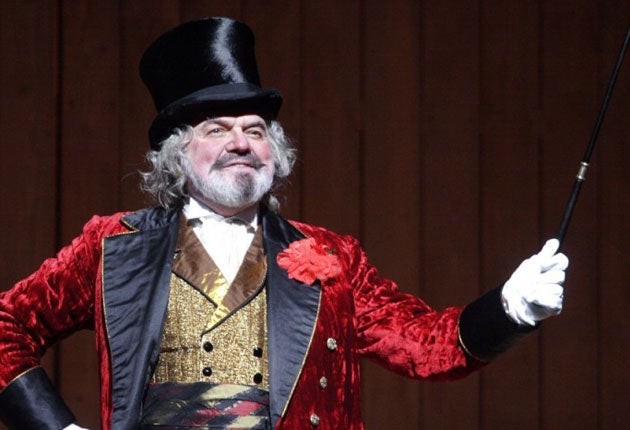
Robert Tear's very successful operatic career lasted for over 40 years. Renowned for his Handel and Mozart, the Welsh tenor was also particularly admired for his roles in operas by Britten and several other 20th century composers. Though mainstream Italian opera figured rarely in his repertory, Russian and German works offered him many opportunities to display his vocal and dramatic skills.
Tear was born in Barry in the Vale of Glamorgan in 1939. He studied at Cambridge University and made his debut in 1963 with the English Opera Group as the Male Chorus in Britten's The Rape of Lucretia. With the EOG he contributed to the premieres of two of Britten's Parables, as Misail in The Burning Fiery Furnace (1966) and as the Younger Son in The Prodigal Son (1968). He also sang Peter Quint in Britten's The Turn of the Screw and created the title role of Gordon Crosse's The Grace of Todd (1969).
After singing Jaquino in Beethoven's Fidelio and the Simpleton in Musorgsky's Boris Godunov for Welsh National Opera, as well as Alfredo in Verdi's La Traviata and Belmonte in Mozart's Die Entführung aus dem Serail for Scottish Opera, in 1970 Tear joined the Royal Opera and continued to sing at Covent Garden for the next 30 years. He made his debut as Dov in the premiere of Tippett's The Knot Garden (1970), one of his finest performances to date. He also sang the Deserter in the first performance of Henze's We Come to the River and Rimbaud in the premiere of Tavener's Thérèse (both 1976).
During the 1970s and 1980s Tear's roles at Covent Garden included Lensky in Tchaikovsky's Eugene Onegin, Prince Vasily Golitsin in Mussorgsky's Khovanshchina and Prince Shuisky in Boris Godunov, which became one of his outstanding characterisations, slimy yet chillingly powerful. Among his modern roles were Paris in Tippett's King Priam, Jack in the same composer's Midsummer Marriage, Tom Rakewell in Stravinsky's The Rake's Progress – another of his best performances – as well as two more by Britten, Captain Vere in Billy Budd and the title role of Peter Grimes.
His Grimes was was considered well sung but not dramatically strong enough. However, his Vere was extremely successful and he continued to sing it throughout his career.
Tear's German repertory was headed by two Wagner roles, Loge in Das Rheingold, which became very popular, and David in Die Meistersinger; it also included roles by Richard Strauss: Herod in Salome, Matteo in Arabella and Valzacchi in Der Rosenkavalier, as well as Monostatos in Die Zauberflöte. He sang Admetus in Gluck's Semele, Jupiter in Handel's Semele and the title role of the latter composer's Samson. In 1989 he took part in the British premiere of Berio's Un re in ascolto. Ten years previously, in Paris, he had sung Painter/Negro in the first performance of the three-act version of Berg's Lulu.
Tear made his Salzburg debut in 1985 as Eumaetus in Monteverdi's Il ritorno d'Ulisse in patria, He sang Aschenbach in Britten's last opera, Death in Venice, for Glyndebourne Touring Opera in 1989 and for the Festival in 1992. This was another great success for the tenor, who seemed to find it a particularly rewarding role. At a later Glyndebourne appearance he was appropriately crazy as Count Hauk-Sendorf in Janàcek's The Makropoulos Case, while in Munich he took part in the first performance of Penderecki's Ubu Rex (1991) and was much admired in the title role of Janàcek's The Excursions of Mr Broucek.
At Covent Garden, Tear sang Wolfgang Capito in Hindemith's Mathis der Maler (1995), the Bishop of Bujoya in Pfitzner's Palestrina (1997), which he repeated the following year at the Metropolitan, New York, followed by King Arthur in Birtwistle's Gawain (2000) and Dr Caius in Verdi's Falstaff (2003). He gave performances of Captain Vere in Billy Budd, with Australian Opera in Sydney (1999) and in Los Angeles (2000); and two performances of Herod in Salome, in Toronto and for Welsh National Opera (2001).
The same year he returned to Salzburg for the Emperor Altoum in Puccini's Turandot, while in 2004 he played M Triquet, the old tutor, in Eugene Onegin for WNO at Sadler's Wells Theare in London and M Taupe the prompter in Strauss' Capriccio at the Palais Garnier in Paris.
Robert Tear, concert and operatic tenor: born Barry 8 March 1939; Professor of International Singing, Royal Academy of Music from 1985; CBE 1984; married 1961 Hilary Thomas (two daughters); died 29 March 2011.
Subscribe to Independent Premium to bookmark this article
Want to bookmark your favourite articles and stories to read or reference later? Start your Independent Premium subscription today.
Join our commenting forum
Join thought-provoking conversations, follow other Independent readers and see their replies