Roy Disney: Film executive who became the conscience of Walt Disney and revived the company's fortunes
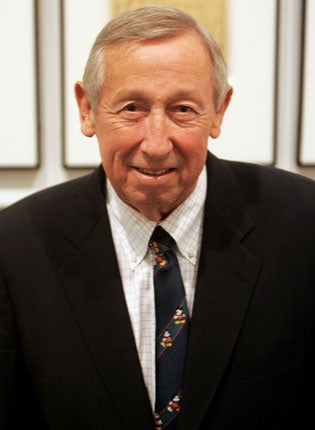
The nephew of the late Walt Disney, the most famous name associated with animated films, Roy Disney made a notable impact on the direction Disney's film empire took in recent years. He was a fierce protector of the Disney tradition, his courageous usurping of powerful board members, Ronald W. Miller (a former professional football player who was Walt Disney's son-in-law) and later the formidable Michael Eisner, who he felt were betraying the company's heritage, earning him the reputation of being a real-life version of Pinocchio's conscience, Jiminy Cricket.
In the 1980s, the studio was in decline its famed animation department had been allowed to disintegrate, and Roy was responsible for promoting a renaissance that resulted in such critical and commercial hits as The Little Mermaid (1989) and Beauty and the Beast (1991), the latter the first animated feature to win an Oscar nomination as Best Picture. (Roy Disney's installation of a computerised post-production facility made possible the revolving ballroom scene in the film.)
His father, Roy Oliver Disney, had co-founded the Disney Cartoon Studio with his brother Walt in 1923 (it was later renamed The Walt Disney Studio). "My father and Walt had a definite agreement that Dad was the business end and Walt the creative end, and only occasionally did one question the other." Though a tough negotiator, Roy was also an avuncular figure who looked like his celebrated uncle. Shy, polite and likeable, he was popular with staff. "He was happy to sit in a room with a beer and a hot dog and talk about story ideas," recalled animation producer Don Hahn. "He would walk through the halls, unannounced, and drop by and say hello. That kind of involvement was not only empowering but encouraging to us."
The only child of Roy O. and Edna Disney, Roy was born in Los Angeles in 1930. He was coming up to his eighth birthday when Snow White and the Seven Dwarfs had its premiere, and he told me his most vivid memory of the occasion was seeing one of the chief animators, Ward Kimball, looking around near the end of the film when the dwarfs are kneeling round the bier of Snow White. Seeing most of the audience wiping their eyes, he said, "My God, it's just a bunch of drawings!"
Roy had a childhood many would envy. He was allowed to play around the studio, where animators would try their work out on him to see if he thought it funny. "Walt wanted everybody's opinion and reaction. He was a pretty good listener until he made up his mind, then you could forget it."
Roy also liked to tell of the time when he had chickenpox, and Walt sat by his bed and read him the story of Pinocchio, which he was planning to make as a film. "When the movie came out," said Roy, "It was a big let-down for me. It was nowhere near as good as Walt's version."
Despite the agreement on responsibilities between Roy's father and his uncle, their relationship was often stormy, and there was a long period when they communicated only through memos. "My uncle was not an easy person to work for. He was just relentless in looking for quality, and made everybody's life difficult. I once said to Bill Peet, a brilliant story man who worked for the studio from Pinocchio on and who got sole story credit on 101 Dalmations, 'What really kept you working there?', and he said, 'Poverty, Roy. There really was no place for artists to go to find a good job in the Thirties and Forties. But Walt wanted the absolute best you could do and then a little bit more.'"
Walt Disney was also a ruthless editor, prepared to delete sequences that had taken months to perfect if he thought it was for the good of the final product, and Roy, after graduating from Pomona College, got his own start in the industry as an assistant editor on the television series, Dragnet. He joined Disney in 1953, working on the studio's acclaimed "true life adventure" series. "They were entirely the product of the editing rooms. I'd watched the first one, Seal Island (1949) being made up of some three or four hours of film that had been shot of seals on this island up in the Bering Sea. The only way you could make it into a story was in the editing room. It was a great lesson in film-making because it made me understand the power that film has to do things that aren't necessarily real."
Roy worked on nature films for over 20 years, including the Oscar-winning documentaries The Living Desert (1953) and The Vanishing Prairie (1954), and the Oscar-nominated short subject, Mysteries of the Deep (1959). After the deaths of Walt in 1966 and his father in 1971, Roy found his attempts to take a larger role in the company were being blocked, and in 1977 he left the studio, though he remained on its board as a director. Teaming up with lawyer Stanley Gold, he became a prosperous financier as chairman of the company Shamrock Holdings (named after one of Roy's racing sloops), which flourished as canny investor and corporate raider, noted for mounting hostile take-over bids.
Meanwhile he became increasingly concerned at the Disney corporation's neglect of its feature animation department, likening the company to "a real estate company that happens to be in the movie business." Gold later related, "I told him, 'You need to get all the way in or all the way out. Either sell your shares in Disney and go independent, or put up a fight and get rid of the managers and find real managers for this business.'"
Roy resigned from the board in 1984 and mounted a successful bid to oust two of the company's chief executives (not easy since one of them was Walt Disney's son-in-law) and revive its animation department. Forming an alliance with the billionaire Bass family of Texas, Disney returned to the board and forced out management, installing Michael Eisner as chief executive. Roy gave Eisner the mandate to revive the animation department, which was enduring some of its worst-ever reviews for its latest product, The Black Cauldron (1985), and he persuaded the studio to invest around $10m in a digital ink and paint system developed by Pixar, the firm that pioneered computer-generated animation.
John Lasseter, chief creative officer for Walt Disney and Pixar Animation Studios, said, "I really credit Roy Disney completely with the renaissance of Disney animation, beginning with The Little Mermaid, all the way through that great amazing series of classic Disney films." The other animated features included Aladdin (1992) and The Lion King (1994). In 2000 Roy realised a long ambition to made a sequel to Fantasia, the 1940 collection of classical music items given visual presentation. Walt Disney's original plan had been to reissue the film every few years with new sections added and others removed, and Roy did that with Fantasia 2000, though, like the original, it was not a commercial success.
I first met Roy when he was promoting the film in London, and we met again the following year when the newly-remastered Snow White was being issued on DVD for the first time. He was, I later learned, feuding with Eisner, and was becoming increasingly marginalised. When I mentioned to him how disturbed I was that the recent DVD releases of the vintage Disney films Saludos Amigos, Melody Time and Make Mine Music, had all been cut for perceived political correctness, he was totally sympathetic with my concern, and replied, "I was really angry. Nobody asked me, and I would not have let them do that. We're having meetings now to fix this problem because this is history. One suggestion is that we issue the films in two versions. If you want your kids to see Pecos Bill without a cigarette in his mouth (give me a break!) you can have it both ways. But we need to preserve historic works in their original form."
In 2003, when he discovered that his name had been left off the roll for election as director at the next annual meeting, he made a statement that Eisner's leadership had created a studio perceived as "rapacious, soulless and always looking for the 'quick buck' rather than long-term value." He helped establish a website, SaveDisney.com, then called on share-holders to cast a vote of no confidence in Eisner, prompting a remarkable 45 per cent. In response, directors removed Eisner as board chairman, and Eisner later announced that he would retire when his contract ended in 2006.
"People always underestimated Roy," said the former president of Walt Disney Feature Animation, Peter Schneider. "You underestimate Roy at your peril, as many people have learned." In 2005, Disney and Gold issued a lawsuit challenging the procedures that had allowed Eisner to hand-pick his successor, Robert A. Iger, but the suit was withdrawn when Iger offered Disney an office at the Burbank studio, a consultancy and the title "director emeritus".
An active philanthropist, Disney supported the California Institute of the Arts in Valencia, sustaining the dream of his father and Walt to create a top arts college in Southern California, and in 2005 he pledged $10m to establish the Roy and Patricia Disney Cancer Centre in Burbank, California.
Disney married Patty Dailey, the sister of a boyhood friend, in 1955, and they had four children. They divorced in 2007, and the following year he married Leslie DeMeuse, who had made documentaries about Disney's passion, sailing. The couple had made a sailing film together in 2000. In 1999 Roy fulfilled a lifelong dream by winning the Transpacific Yacht Race from Los Angeles to Honolulu (2,225 miles), setting a new course record.
He had a castle in Ireland as a holiday home, plus two homes in California (Los Angeles and Newport Beach), and at the time of his death he owned 16 million shares in The Walt Disney company. He was the last of the Disney family to be associated with the studio.
Tom Vallance
Roy Edward Disney, film executive: born Los Angeles 10 January 1930; married 1955 Patricia Ann Dailey (divorced 2007; two sons, two daughters), 2008 Leslie De-Meuse; died Newport Beach, California 16 December 2009.
Join our commenting forum
Join thought-provoking conversations, follow other Independent readers and see their replies
Comments