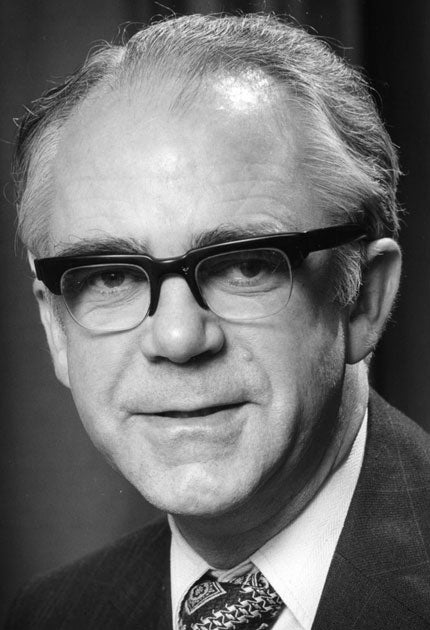
Sir Kenneth Clucas: Valued senior civil servant who later championed the cause of Citizens’ Advice Bureaux

For free real time breaking news alerts sent straight to your inbox sign up to our breaking news emails
Sign up to our free breaking news emails
Kenneth Clucas was one of the triumvirate of Permanent Secretaries appointed in the spring of 1974 when the incoming Labour Government broke up the old Department of Trade and Industry and created three departments out of it – Trade, Industry and Prices and Consumer Protection. Clucas got DPCP, not least due to a bit of wangling by Shirley Williams, the then-new Secretary of State. In her recent autobiography Climbing the Bookshelves she concludes "And that was how I came to get one of the best Permanent Secretaries in Whitehall".
After the demise of DPCP, with the arrival in office of Mrs Thatcher, Clucas became Permanent Secretary of the Department of Trade with John Nott as his Secretary of State. In his memoirs Here Today, Gone Tomorrow Nott describes Clucas as "a quite outstanding Permanent Secretary".
Kenneth Henry Clucas was born in November 1921, the son of a Methodist Minister, the Revd JH Clucas and his wife Ethel Sim. His schooling was at Kingwood (established by John Wesley for the sons of itinerant preachers). It was a severe and strict religious upbringing and Clucas later wrote, "In my mid-20s I became increasingly unhappy with religion, with the way people did not practice what they preached, and the supremacy that was given to dogma. So I gave it up and have never regretted it". His Thanksgiving Service will be Humanist.
After Kingswood Clucas went up to Emmanuel College, Cambridge but soon after, in 1940, was called up for the Army and selected for that Corps of the intelligentsia, the Signals. He was commissioned and attached to a Guards Regiment ("fish out of water," he wrote). Later he moved to HQ 21st Army Group and served with distinction (mentioned in despatches) in Normandy, Brussels and Bad Oeynhausen.
When Clucas was demobbed he went back to Cambridge and at the same time applied for the Administrative Class of the Home Civil Service; he was successful and appointed to the Ministry of Labour. Within two years, in 1950, he was posted to Cairo as labour attache to the Embassy.
He found the Egyptians broad-minded and much interested in what was going on in Britain, such as the 1944 Education Act, the Beveridge Report and its aftermath and the creation of the National Health Service. From Cairo he moved to Nicosia, where the Cypriots wanted advice about a social security system – which was sadly postponed for many years due to the Eoka rebellion.
Returning to England, Clucas rejoined the Ministry of Labour and was involved in the setting-up of Industrial Training Boards (short-lived) and Industrial Tribunals (long-lived). He did his stint as Private Secretary to the Minister of Labour, then John Hare, later Viscount Blakenham. In 1968 he succeeded Sir Alex Jarrett as Secretary of the National Board for Prices and Incomes. Aubrey Jones was the chairman and Clucas got along well with him; altogether he signed off 120 reports in three years.
With the abolition of the NBPI by the incoming Heath administration, Clucas was appointed First Civil Service Commissioner, responsible for the recruitment of most civil servants and for the management of the recruitment system. From there he went to the Department of Prices and Consumer Protection and the Department of Trade. He was knighted in 1976.
After retiring from the Civil Service in 1982 Clucas was much in demand. He disdained the company-director route travelled by so many ex-Permanent Secretaries, preferring to work in the public or semi-public domain. He became a member of the Council of Tribunals, of the Advisory Panel on the Freedom of Information Campaign and of the RIPA working group on Politics and the Civil Service.
He was chairman of the Committee of Inquiry into Advertising Controls, of the Monitoring Committee of the Association of British Insurers' Code of Practice and of Fimbra, the Financial Intermediaries, Managers' and Brokers' Regulatory Association – one of the forerunners of the Financial Services Authority. He was also chairman of the Nuffield Inquiry into the pharmacy profession, Chairman of the Lloyd's Working Committee on consumer guarantees and Ombudsman for Lloyd's Members.
But above all, as Permanent Secretary of the DPCP Clucas had long had an interest in the Citizens' Advice Bureaux movement. He took over as chairman of his local CAB in Godalming in 1982, then the Surrey and West Sussex Area Committee, and finally the National Association itself from 1984-89. There he established a successful partnership with Elizabeth Filkin, then its chief executive. Together they fought off the Thatcher government proposals for reducing the CAB grant and, indeed, turned to great effect the Lovelock Inquiry recommendations for the future of CABx.
Filkin maintains that she learnt more about government administration and tactics in those five years than from anyone else. Clucas took over the chairmanship of the Friends of CABx and the partnership with Filkin continued for years, with walks in Surrey and Sussex, routes (and pub lunches) carefully researched by him, starting at 10-12 miles and, as he got older, reducing to five miles or less.
In his private life Clucas was hugely happy, married to Barbara Hunter, 14 years younger and the daughter of an American Admiral, with whom he shared no love of golf or his politics but got on with famously. Clucas remarked rather acidly that it was probably because the Admiral so disliked his other sons-in-law.
But in 1993 tragedy struck: Barbara died of cancer aged only 53. Clucas had the support of his two girls, Jill and Susie, the former married to a Czech, Radek Uzel, whom Clucas took to immediately. They cared for him in his house at Godalming as he deteriorated with Parkinson's Disease. But Clucas was not to be got down. As he became unfit for walking he developed a love for cruising and so established a great friendship with Delia Keir, a widow from Edinburgh. But finally the wretched disease progressed and his final years were spent in a local nursing home.
Clucas was very much the all-round man – a great reader, a lover of the theatre and opera, a keen bridge player and setter of puzzles, and an adept ballroom dancer. Above all a good man, a good husband, father and grandfather. A man of unswerving principle, wise, meticulous and absolutely reliable. And good to work for.
Kenneth Henry Clucas, civil servant: born 18 November 1921; Permanent Secretary, Department of Trade 1979–82; Chairman, Nuffield Foundation Committee of Inquiry into Pharmacy 1983–86; Chairman, National Association of Citizens' Advice Bureaux 1984–89; CB 1969, KCB 1976; married 1960 Barbara Hunter (died 1993; two daughters); died 27 August 2010.
Subscribe to Independent Premium to bookmark this article
Want to bookmark your favourite articles and stories to read or reference later? Start your Independent Premium subscription today.
Join our commenting forum
Join thought-provoking conversations, follow other Independent readers and see their replies