Stanley Mitchell: Scholar whose greatest work was his translation of 'Eugene Onegin'
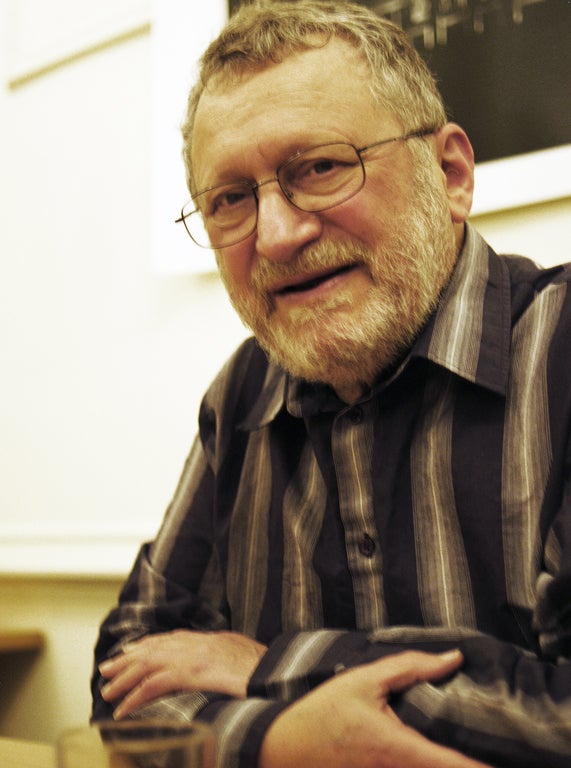
The translator and Russian scholar Stanley Mitchell will be remembered for his translation of Pushkin's verse novel Eugene Onegin.
Almost all Russians look on Pushkin as their greatest writer and on Eugene Onegin as Pushkin's greatest work. Mitchell made it possible for an English reader to understand why.
Stanley Mitchell was born into a Jewish family in Clapton in London's East End. His father had been born in Ukraine, his mother's parents in what is now Belarus. Stanley's devotion to his mother's father, who spoke only Yiddish, left him with a lifelong love of the language. After attending Christ College School in North London, he began teaching himself Russian while doing his national service. He then studied French, German and Russian at Oxford. There he met Hannah Brandstein, who had been born in Austria and come to England with her family, as refugees, in the late 1930s. Stanley and Hannah married in 1957.
Mitchell was deeply involved with left-wing politics and began publishing in New Left Review in his late 20s. He began his teaching career at the University of Birmingham and published a translation of Georg Lukacs's The Historical Novel in 1962. In 1965 he became the first lecturer in Russian literature at the new University of Essex.
Professor Angela Livingstone, his colleague there, writes, "I saw how constantly he encouraged students to appreciate beauty, and to think, inquire, judge. These 45 years later I phoned, out of the blue, someone who had been a student of ours in 1967, Mervyn Barker (now a retired English literature teacher), and asked what he remembered of Stanley. Mervyn recalled presenting a seminar paper, to which Stanley had responded by actually clapping his hands in delight at its provocative argument; from that response the young student had gained a self-confidence which lasted throughout his career."
As a young man, Mitchell had seemed destined for a prestigious academic career. He left Essex in 1975 and went on to teach literature, art history and cultural studies at universities and colleges from Camberwell School of Art to the University of California at San Diego and Dar es Salaam Tanzania.
Mitchell's ambition to translate Eugene Onegin probably goes back to his student days. In 1966, he, Angela Livingstone, Donald Davie and others began a series of seminars about the verse novel: it was hoped that this would lead to a collaborative translation. This did not come about, but Mitchell did not abandon the idea. In the mid-1980s, while spending six months in rural Tuscany recovering from a severe depression, he completed a draft of the first chapter. He revised this over at least seven years. A commission from Penguin Classics encouraged him to continue, and in 2008 his complete translation – one of the finest of all verse translations into English – was finally published. As Livingstone has written, "Thus Stanley Mitchell fulfilled the ambition born in the first years of the life of Essex University."
His translation reproduces every facet of the original: the precise meaning, the wit, the lyricism. Not once is there a false note. How this was achieved is best described in his own words: "I had never worked so hard at anythingbefore. [...] Every stanza was a struggle. [...] The process of translating eachstanza resembled a Sisyphean labour except that I was always able in the end to topple the boulder over to the other side. [...] Before translating Onegin I had regarded my life as a failurebecause of the bipolar disorder which nearly ruined me. [...] Since completing the translation, I know that I shall never have to feel a failure again.Repeating Pushkin's self-congratulation on finishing another piece ofwork, I said of mine: 'Well done, you son of a bitch!'"
The last time I heard Stanley read in public was in October 2008, at Pushkin House in Bloomsbury. I was hoping he would read the last stanzas – and he did. Twice he broke down, in tears. It was, I imagine, as hard for him to say goodbye to the poem as it had been for Pushkin himself:
But of those friends who, meeting, listened
To those first strophes that I wrote...
Some are no more now, some are distant,
As Sadi once said in a note.
They've missed the fully-fledged Onegin,
And she, from whom the model's taken
For dear Tatiana, she is gone...
Oh, much by fate has been undone!
Blest who betimes has left life's revel,
Whose wine-filled glass he has not drained,
Who does not read right to the end
Life's still, as yet, unfinished novel,
But lets it go, as I do my
Onegin, and bid him goodbye.
One cannot read the last two lines aloud without faltering and slowing down; the rhythm mimes the difficulty of saying goodbye. Tone, rhythm and meaning are perfectly fused. Mitchell's Onegin is the fruit not only of scholarship and uncommon devotion but also of considerable musical ability – he was an accomplished pianist.
Stanley is survived by his close friend Barbara Rosenbaum, without whose support it is unlikely he would have completed his Onegin.
Stanley Mitchell, scholar and translator: born 12 March 1932; married 1957 Hannah Brandstein (died 1994; one daughter, one son); died London 16 October 2011.
Join our commenting forum
Join thought-provoking conversations, follow other Independent readers and see their replies
Comments
Bookmark popover
Removed from bookmarks