Tajudeen Abdul-Raheem: Thinker, writer and prodigious orator who campaigned for the peaceful unification of Africa
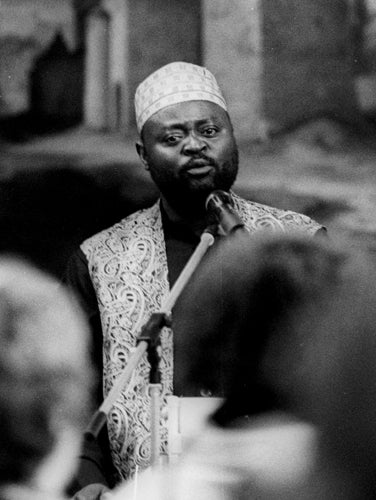
Tajudeen Abdul Raheem, who has died in a car crash in Nairobi, dedicated his life to the Pan-African vision and the peaceful unification of Africa. He leaves a wife, Mounira Chaieb, and two daughters, Aisha and Aida. A thinker and writer but above all a mighty talker, he inspired and influenced a whole generation of Africans and Africanists with his mixture of passion and humour. It is ironic that he died on 25 May – Africa Day.
I first met "Taj" in Kampala as Secretary General of the Pan-African movement, and I confess, I expected to be lectured by the high priest of Afrikan political correctness. I met someone quite different. Stocky, bearded and dressed as if for battle in the bush, he looked fierce and frightening. But his brilliant, ebullient eyes lit up and a huge gap-toothed grin cracked open his face. And then he started talking, body swaying, arms flailing, his flowing speech rising to crescendos that broke into great cackles of laughter.
I saw him make speeches on several occasions but I never saw him use a note. It just flowed out of him, direct, passionate, only diverting to pursue a witty paradox or a ridiculous contradiction. He could not resist them. His Marxism was dressed in stupendous African colours and laced with jokes and laughter. If imperialism and capitalism could have been overthrown by hilarity, Taj would have been master of the universe.
He once addressed a meeting at Parliament for African diaspora leaders to meet MPs. Dressed in African robes, he stunned his audience by praising the City of London: "the richest square mile on the planet" full of wealth, banks and trading houses. But, he said, with a wonderful role of those eyes, "at night you leave, and WE move in and take over". A frisson passed through the gathering. He went on, "We guard it for you, clean it for you, ready for your return in the morning." The point was brilliantly, gently made; Africans are here, please acknowledge us, and respect us.
While he used humour and charm to win over those who were usually the targets of revolutionaries, he reserved his rage for the rulers of Africa and their corruption, greed and incompetence. As he wrote last week, this ruling class "only looks at the welfare of the minority rich and powerful, at the expense of the impoverished and powerless underclass."
Born in Funtua, Nigeria, Tajudeen attended a madrassah but also a Catholic school. After university in Nigeria, he won a Rhodes scholarship to Oxford, where he impressed his teachers with his knowledge and ability to debate – though less so with his inability to deliver essays.
In London, he helped found a number of radical think tanks and Africa organisations such as the Africa Research Information Bureau, where he edited its journal, Africa World Review. He was also the founding chairman of the Centre for Democracy and Development and helped found Justice Africa. His position as Secretary General of the Pan-African movement gave him international status and access to African leaders, but little protection from the rulers in his own country. Back in Nigeria, Taj campaigned against the generals who had seized power and ruled and robbed the country for most of his life. In 2002 he was arrested as he was trying to return to London and had his passport confiscated. More recently, he took a job with the United Nations in Nairobi to promote the achievement of the UN's Millennium Development Goals.
Throughout all this, he kept lecturing and writing – always signing off his emails with: "Don't agonise, Organise!"
I sometimes wondered if they were a reminder to himself. Taj was not always reliable. Editors were frustrated by him. He would promise essays, articles and books and would continue to promise long after three or four deadlines had passed. And when they did arrive, the words looked as if he had poured them on to the page and walked away. Despite – or maybe because of his fluency – he never worked at his written texts or checked them. The one commitment he kept was to write an essay every week in the form of his Thursday Postcard. Pertinent, trenchant, passionate and witty, Thursday Postcards appeared without fail and were syndicated to newspapers throughout Africa. They carried his message of African self-confidence and solidarity to a vast audience.
Richard Dowden
Dr Tajudeen Abdul Raheem, Pan-Africanist: born Funtua, Katsina State, Nigeria 1956; married Mounira Chaieb (two daughters); died Nairobi 25 May 2009.
Join our commenting forum
Join thought-provoking conversations, follow other Independent readers and see their replies
Comments