Walter Womacka: East German painter who remained loyal to communism all his life
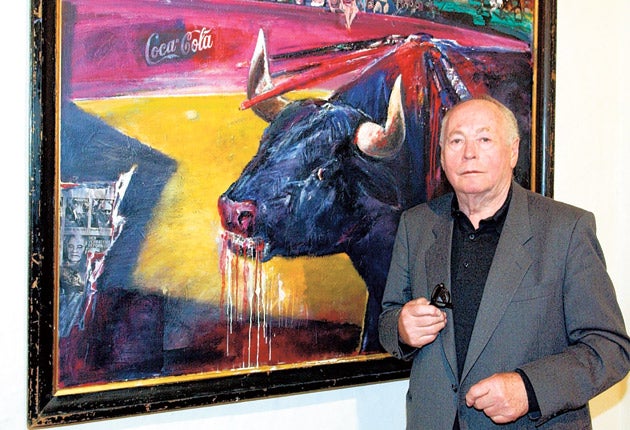
Walter Womacka, one of the best-known East German artists, was lionised by the Communist state, the German Democratic Republic (GDR). In the years that followed the breakdown of the state in 1990, Womacka, aged 64, saw some of his major works destroyed or dismantled. Naturally somewhat embittered, he remained loyal to the GDR's ideals, politics and policies. The Berlin Wall really was for him the "Anti-fascist, defensive wall", and the invasion of Czechoslovakia in 1968 really was a necessary defensive measure.
Walter Womacka was born in the German village of Obergeorgenthal, in the Sudetenland of Czechoslovakia, in 1925. In 1927 the family moved to Brüx (Most), where Womacka attended school. The industrial and mining town was incorporated into Hitler's Reich in accordance with the Munich Agreement of 1938. After repeated wartime bombing, all the German inhabitants were expelled in 1945.
From 1940 to 1943, Womacka trained as a painter and decorator at the State School for Ceramics in the historic spa town of Teplitz-Schönau in Bohemia. He was then called up for militaryservice, during which he was wounded and captured by the Americans. On his release, he worked as an agricultural labourer.
From 1946 he studied at the School for Creative Handwork, Braunschweig, West Germany. Because his family had been "resettled" in Thuringia, in the Soviet zone of Germany, he moved to Weimar's College of Technology for Architecture and Visual Arts. The GDR was founded in that year and was searching for young artists who would promote its cause.
From 1951 to 1952 Womacka studied at the Hochschule für Bildende Künste, Dresden, tutored by Fritz Dähn and Rudolf Bergander, both emerging "giants" in terms of the ruling cultural orthodoxy of the GDR. That orthodoxy was, especially after 1952, Socialist Realism. The enforcement of Stalinist norms in all spheres of life led to a massive flight from the GDR, especially of the intelligentsia and the young; more left after the failed revolt of 17 June 1953.
Womacka stayed, an act which was recognised by the state. He was able to travel on scholarships to Bulgaria, Italy, Egypt and Greece and his oil paintings inspired by these visits were exhibited. Awards followed: in 1957, he travelled to Moscow for the first time and gained a prize for his painting, The End of the War.
His second prize was awarded to him in 1958 by the Society for German-Soviet Friendship, a body which had millions of members who sought to prove their regime loyalty by nominal membership. The prize was for Rest from Harvesting, depicting five happy peasant girls and two boys eating their picnic lunch. In 1959, he received a GDR prize for the same work.
In 1960, when farms were being forcibly collectivised and there was a flight from the land, Womacka was awarded a prize by the official trade union organisation for his painting of a young collective farm woman. Backed by the ruling SED party leader, Walter Ulbricht, he worked hard and made rapid progress, and other prizes were awarded to Womacka throughout Ulbricht's reign until his removal from power in 1971.
Of Womacka's many oil paintings, perhaps Am Strand (On the Beach, 1962) was best-known, depicting a young couple relaxing. The painting was reproduced on calendars, postcards and, in 1969, on a stamp.
In 1952, Womacka joined the SED, and in the following year was appointed lecturer at the Kunsthochschule Berlin-Weissensee. By 1963 he headed the Department of Painting at the Kunsthochschule; two years later he was appointed professor, and, in 1968, he took over from Dähn as rector, holding this position until 1988. From 1959 until 1988, he was vice-president of the VBK, the official body that all painters had to belong to in order to work. Among those expelled and arrested for their "dangerous" painting were Roger Loewig and Bärbel Bohley (obituary, 15 September).
In retirement, Womacka continued travelling and painting. In 1988 he spent time in Syria and was asked by President Hafez al-Assad to paint his portrait. Womacka was best-known for his huge murals on public buildings, including the Humboldt University (Berlin, 1962) and the Council of State building (1963-64). His frieze on the Haus der Lehrer ("teachers' house", Berlin, 1964), is one of Europe's largest murals at 125 metres long.
After the fall of the GDR, Womacka concentrated on painting still life, but he continued to defend the GDR and denounce the US and Nato. He expressed these views in his autobiography, Farbe Bekennen ("Show Your Colours", 2004), when he wrote: "Capitalism remains the dictatorship of big money." His supporters founded a society to preserve his public works.
David Childs
Walter Womacka, artist: born Obergeorgenthal, Czechoslovakia 22 December 1925; married Hanni; died Berlin 18 September 2010.
Join our commenting forum
Join thought-provoking conversations, follow other Independent readers and see their replies
Comments