Yang Xianyi: Translator who fell foul of authority during the Cultural Revolution
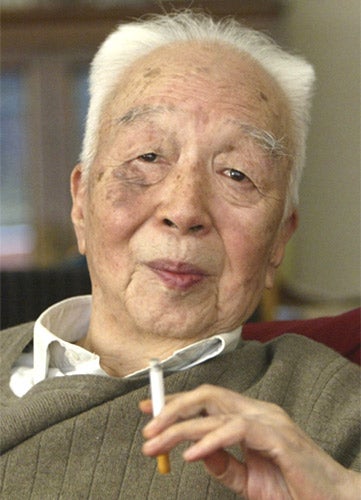
Yang Xianyi, who has died in Beijing aged 93, was a distinguished literary translator remarkable for the range of his work. He was also a principled and patriotic intellectual who managed to retain wit, integrity and a sense of fun, even in the most difficult days of the Maoist period.
In the West he is best known for translations of Chinese literature into English. With his wife, Gladys Yang (see the Independent obituary of 1 December 1999), he published English versions of a great range of Chinese literature from the past two millennia. Among the most memorable of these are Records of a Historian, a selection from the historian Sima Qian, who died around 85AD; The Courtesan's Jewel Box: Chinese Stories from the Xth to the XV11th Centuries, a collection of lively stories from the Ming Dynasty; and the great Qing dynasty novels, Dream of Red Mansions and The Scholars. Their Selected Works of Lu Xun made the greatest writer of China's early 20th-century literary renaissance available in English.
Yang Xianyi also worked to make western classics available to Chinese readers, producing translations of Homer's Iliad, Aristophanes' Birds and Le Chanson de Roland as well as plays by Synge and Shaw. The Yangs contributed directly and indirectly to the development of Chinese studies in the West as generations of China scholars benefited from their scholarship and their generous hospitality.
Yang was born to a wealthy banking family in the westernised port city of Tianjin. As his father died when he was five, two formidable women, his father's principal wife and a younger concubine who had given birth to him, brought him up. He addressed both as mother. As the only boy in the family, he was indulged and protected. He received a largely traditional education from private tutors until he was 12, when his birth mother finally managed to persuade the senior wife that he should be allowed to attend school. A missionary foundation, the Tianjin Anglo-Chinese College, was selected. On the advice of his teachers there, he went on to higher education at Oxford University, where he became engaged to Gladys Tayler, the university's first graduate in Chinese.
Yang returned to China with Gladys in 1940 and spent the war years teaching in the interior of China where many intellectuals had fled from the Japanese occupation. Life was not easy for them. Their left-wing sympathies sometimes got them into trouble; Yang's family had lost its money and academic salaries were low. After the war, they made the journey down the Yangzi to Nanjing on an overcrowded wooden junk. Their possessions were lost when the baggage junk sank but they arrived safely with their two young children.
After the establishment of the People's Republic in 1949, Yang Xianyi was at first treated by the new government as an honoured intellectual. However, his many foreign contacts and his tendency to speak too frankly made him vulnerable in an increasingly conformist climate. By the mid-1950s he had been demoted. He and Gladys had had great hopes of the new communist regime and they continued generally to speak in its favour while sometimes voicing reservations. Like other cadres of the new state they worked an eight-hour day, six days a week, a fact that perhaps partly explains their extraordinary productivity.
As salaried workers for the Foreign Languages Press, the Yangs sometimes lacked control over what they translated. In addition to their translations of the classics and of many of the best-known modern Chinese writers, they also had to waste their talents on propaganda literature of little merit. In his spare time, Yang wrote many introductory articles about western literature for newspapers and journals that now needed cultural and educational material to meet new policies, penned satirical verse for his friends, and also produced his translations of western classics. They also continued with extraordinary courage to read, think and discuss freely, faithful to the liberal intellectual tradition they had both embraced.
The Cultural Revolution brought catastrophe. Criticised and ostracised by his colleagues, Yang Xianyi suffered a breakdown and began to hear voices. This, he was later to insist, had been his worst time. In 1968, he and Gladys were arrested and held without news of each other or the outside world for four years. Apparently, he felt less pressure in this period, resigning himself calmly to his fate and living from day to day. Later, he described episodes in his prison life such as the races he and his cell-mates organised between the bedbugs with which their sleeping platform was infested.
On their release, the Yangs took up the threads of their old lives again. Once again they were generous hosts to the many friends, Chinese and foreign, who ate, drank, and talked at their house every evening. Paid back-dated salary for their years in prison, they were able to acquire their first fridge and to help writers and artists who could not sell books or pictures in the still repressive cultural climate. In 1979, they were deeply grieved by the suicide of their son, who had become mentally ill during the Cultural Revolution, but they took pride and pleasure in the achievements of their daughters and grandchildren. They enjoyed the more lively and critical writing that began to emerge in China after the death of Mao and they helped and encouraged many young writers. As editor of the journal Chinese Literature, Yang published translations of the more lively and critical writing that began to emerge in China after the death of Mao. He also established an English language paperback series, Panda Books.
He was able to go abroad again for the first time since 1940 and the couple were invited to universities in Europe, Japan and India. They became hopeful once more about the future for China and in this spirit of optimism Yang applied for and was granted membership of the Communist Party in 1985.
In the spring of 1989, Yang voiced his support for the peaceful student demonstrations in interviews with foreign journalists. A few months later he was enraged and horrified by the Tiananmen massacre. Having denounced the suppression in telephone interviews with foreign broadcasting stations on 4 June, he went into hiding for a couple of weeks. Later that year, when things had settled down a little, he attempted to leave the Communist Party. He was amused to be told that resignation was not permitted but that he would be expelled. His refusal to recant won him great respect among younger intellectuals.
From the early 1990s, Gladys's health gradually deteriorated. Yang cared for her until her death in 1999. Yang Xianyi lived out his last years surrounded by loving family in his daughter's house. His enormous gift for friendship survived and when he could talk of things that interested in him his vitality revived. But he missed Gladys. His fine poem of farewell to her, written in classical Chinese, "I thought that you and I would fly away together but you have gone before..." expressed his own readiness to die. He is survived by two daughters and four grandchildren.
Delia Davin
Yang Xianyi, literary translator and writer; born Beijing 10 January 1915; married Gladys Tayler (died 1999; one son deceased, two daughters); died Beijing 23 November 2009.
Join our commenting forum
Join thought-provoking conversations, follow other Independent readers and see their replies
Comments