Assange feels under attack from his British media partner
'Guardian' article detailing women's statements to police about Wikileaks founder angers his supporters
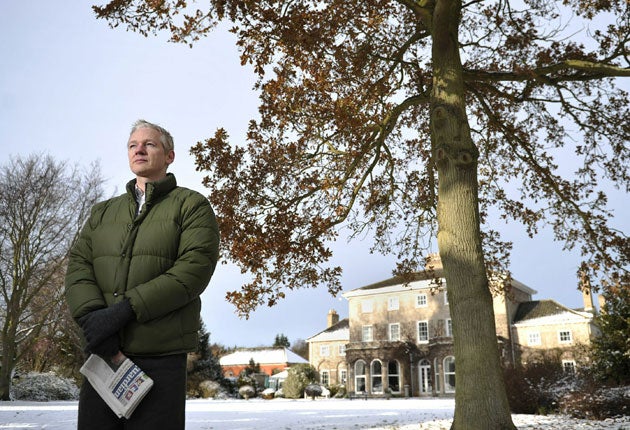
The plot that no one thought could possibly get even thicker, expanded its dimensions quite considerably this weekend. Fresh details from the statements made to police by the two Swedish women who have made sexual allegations against the WikiLeaks founder, Julian Assange, were published by The Guardian newspaper, his principal British media partner and supporter.
The story – bylined Nick Davies, the journalist and author who first suggested a tie-up between WikiLeaks and the newspaper – says that the new material offers "a detailed account of a number of disputed incidents involving the women that appear, at least, to warrant investigation". It also claims that the reason Swedish authorities applied for an international arrest warrant was that Mr Assange did not come back to the country for a scheduled meeting with prosecutors.
It is understood that there was a debate inside the paper about whether, and how, to run the article, but that, in the end, The Guardian decided to publish. A close friend said yesterday that Mr Assange regarded the article as "an attack by somebody who he'd hope not to receive it from".
The police statements deal with what the women say happened when Mr Assange visited Sweden to speak at a conference in August. Accuser 1, who was involved with the host organisation, offered him her vacant apartment, but she returned early, and later they had sex. This much is not disputed. However, according to The Guardian, she claims in the newly revealed police statement that: "he began stroking her leg as they drank tea, before he pulled off her clothes and snapped a necklace she was wearing". Her statement adds that she, uneasy at the speed of developments, put on some more garments, but that "Assange ripped them off again". She then let him undress her, and, as he attempted to have unprotected sex with her, she tried several times to get out a condom, but that, as The Guardian reports: "Assange had stopped her by holding her arms and pinning her legs." It was said he freed his grip, put on a condom, but that, in her words, he had "done something" to the condom so that it ripped. He denies doing so.
The next day, as we reported last week, he went to the cinema with Accuser 2, a young woman who had gone out of her way to make his acquaintance. According to the new information, they sat in the back row and, says The Guardian, "he put his hands inside her clothing". That evening, at a party, Accuser 1 told a friend about her encounter with Mr Assange. "Not only had it been the world's worst screw, it had also been violent." This was Saturday 14 August. Two days later, Accuser 2 rang him, they met, went back to her out-of-town flat and began to have sex. She stopped this, as he was not using a condom; they had sex in the night when, she claims, he "unwillingly" agreed to a condom; and then, in the morning, she woke to him having sex with her without a condom. She had never had unprotected sex before, even with her boyfriend, and was perturbed by this, even more so when Mr Assange declined to undergo an HIV test.
She did have a test herself, and, in her efforts to contact Mr Assange, who was proving elusive, rang Accuser 1. They compared notes, and then went to the police, asking if Mr Assange could be forced to have a test. He later agreed to one, but by then clinics had closed for the weekend. Police thought the women's stories meant possible offences had been committed (it can be illegal in Sweden to have sex without a condom when one partner has insisted upon it), and the ball was set in motion that led to his extradition case.
It must be emphasised that Mr Assange denies any wrongdoing. Nor has he presented his side of these events. Should the case ever come to court, it would be a matter of one person's word against another's. But, wherever the truth lies, the allegations and their timing have had a polarising effect.
Last week, The Independent on Sunday revealed the extent of online abuse being directed at Mr Assange's two accusers. Both have been widely named, and their pictures, addresses and even mobile phone numbers have appeared on the internet, in defiance of the anonymity normally accorded alleged victims of sex crimes. He has been subjected to death threats. Meanwhile, he may yet have to face the US charging him with information offences. He remains at Ellingham Hall, Suffolk, waiting for the next hearing in connection with the process of extradition to Sweden.
His most prominent supporters were certainly unmoved by the new details from the police statements. Vaughan Smith, who is putting Mr Assange up in his 18th-century mansion, said his guest thought the article in The Guardian was "an attack by somebody who he'd hope not to receive it from". Mr Smith added: "I'm not going to criticise Nick Davies. I'm not accusing The Guardian of any wrongdoing. I don't think it delivers any new revelations. I'm sad to read it. The article was critical and I wondered to what extent The Guardian maintains a level of criticism politically to keep off the flak of publishing the leaks. I wonder how much of this is politics. It hasn't made me think that Julian is guilty but it makes me think, perhaps, newspapers feel the need to put in criticism."
The Australian author and journalist Phillip Knightley, one of those who put up bail for Mr Assange, said: "I've had no change of heart. I have no opinion one way or another on the sex charges; they're distinct from the WikiLeaks business and I support his stand on WikiLeaks. I felt that he deserved the principle of innocent until proven guilty. I do think there are dark forces at work to attempt to punish him, and I believe the Swedish allegations are part of that. I spent some time with him at the Frontline Club. I admired him and I still do."
Sarah Saunders, a catering company manager in Kent, a personal friend of Mr Assange and the person who came up with the biggest pledge for his surety, said: "People are interested in the smutty detail, but as a friend of Julian's I can absolutely, categorically, say that I stand by him. As a single woman, I never felt personally vulnerable or at risk in his presence. He's not an aggressive man. I cannot understand the allegations; to me, they don't make sense. He needs to be heard in a fair way and I hope he's given the opportunity of a fair assessment of the facts which he deserves."
Bookmark popover
Removed from bookmarks