After the floods, Britain's rain defences put to test

Get the free Morning Headlines email for news from our reporters across the world
Sign up to our free Morning Headlines email
Britain's biggest civil emergency exercise, costing £1.8m and involving 10,000 people, begins today, in response to the country's biggest peacetime emergency – the floods of 2007.
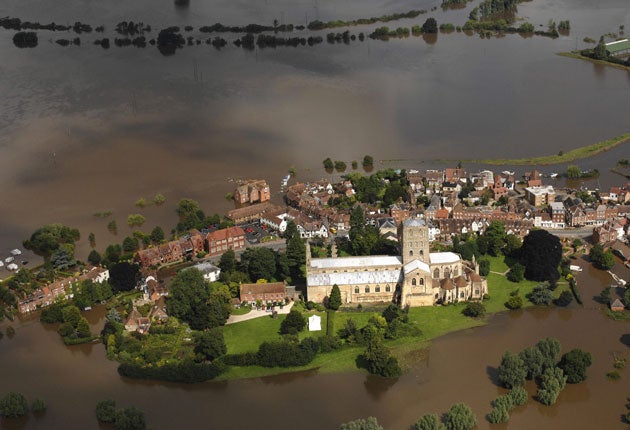
Exercise Watermark is designed to test national readiness for another episode like 2007's disastrous flooding in Yorkshire and the Severn valley in Gloucestershire, which damaged 55,000 properties.
More than 7,000 people had to be rescued, 42,000 people were left without power and 350,000 people had no mains water supply for up to 17 days. And it could have been worse.
If the Ulley reservoir dam near Rotherham had burst – and in June 2007, it nearly did – almost a million people might have been without any power in the Sheffield area.
The floods were so severe the Government commissioned a special study by engineer and former local authority chief executive Sir Michael Pitt, who said in his report that the importance of flood risk should now "be brought up alongside the risk of terrorism or a major flu pandemic".
This week's exercise is to test the new precautionary measures Sir Michael said should be put in place for the possibility of catastrophic flooding.
It will last four days and is being coordinated by the Environment Agency, which will bring together ten government departments, 34 local resilience forums, emergency services, water companies, hospitals and schools to test responses to a range of flood scenarios across England and Wales.
Some of the planned exercises include the evacuation of coastal communities in Lincolnshire, and live floodwater rescues by the RAF from rooftops and submerged vehicles. The Government's crisis response committee, usually referred to as Cobra, will also meet as part of the exercise.
Today, Watermark will test responses to flash flooding across London, West Yorkshire and Devon and Cornwall.
Tomorrow, it will look at readiness for overflowing rivers in London, Surrey and the Thames Valley, as well as in the West Mercia police area and Dyfed-Powys in mid-Wales.
On Wednesday, there will be a simulation of a reservoir collapse in Derbyshire; and on Thursday there will be a simulated threat of a North Sea tidal surge hitting the east coast of England from Humberside to Kent.
It was such a surge which caused Britain's biggest modern flooding disaster in January 1953, when 307 people drowned after the North Sea broke through coastal defences.
"If all of that did happen at the same time, I think we would have our work cut out," said the Environment Agency chairman, Lord Smith of Finsbury (the former Labour Culture Secretary Chris Smith).
"But what we want to do is test all the levels of response we have, the way in which we're prepared for this, the systems we have in place and whether we're ready to cope with these sorts of emergencies in the very best and most professional way we can."
The Environment Minister Richard Benyon, who is the minister responsible for flooding, said: "This is a really major event – it's the largest civil defence exercise that's ever been carried out in this country." He added: "We won't get everything right, we're honest about that. But we will learn from the mistakes and the successes."
One of the new dangers the exercise will examine is the threat from surface water. This is not flooding caused by overflowing rivers or the invading sea, but by rainfall so heavy that urban drainage systems cannot carry it all away and it starts to accumulate, or "pond". This was a feature of the floods in Hull and Doncaster in June 2007.
Sir Michael Pitt said all local authorities should map the threat from surface water flooding.
These maps are now being produced and will be published this summer – some of them will be used in Exercise Watermark.
Tewkesbury and the new threat from rainfall
n Exercise Watermark is being taken so seriously by the Government because what happened in 2007 may be a pointer of things to come: flooding in an age of climate change.
The rain in June, July and August of that year made for the wettest summer Britons had ever seen, breaking all rainfall records, going back to 1766. The two key downpours, which hit Yorkshire, from Hull to Doncaster, on 24 June, and the Severn valley on 19 July, were probably as heavy as anything Britain has experienced.
Although scientists are hesitant to blame climate change for individual weather happenings, there is no doubt these "extreme events" are consistent with predictions of global warming, which scientists think will lead to much heavier rainfall because a warming atmosphere holds more water and energy.
In 2004, the government published the Foresight Future Flooding report, which warned about the heavier rainfall expected in a warmer atmosphere over a 30 to 100-year timescale.
Sir Michael Pitt reassessed the Foresight report's conclusions for his review – and came out with a gloomier forecast. The potential increase in winter precipitation because of climate change was projected to be 25 per cent in the original report; it was 40 per cent in the revised predictions.
Subscribe to Independent Premium to bookmark this article
Want to bookmark your favourite articles and stories to read or reference later? Start your Independent Premium subscription today.
Join our commenting forum
Join thought-provoking conversations, follow other Independent readers and see their replies