Blair: Denounced as liar and murderer
An unrepentant Tony Blair failed to apologise to the bereaved in the gallery – and even suggested Iran should be targeted next
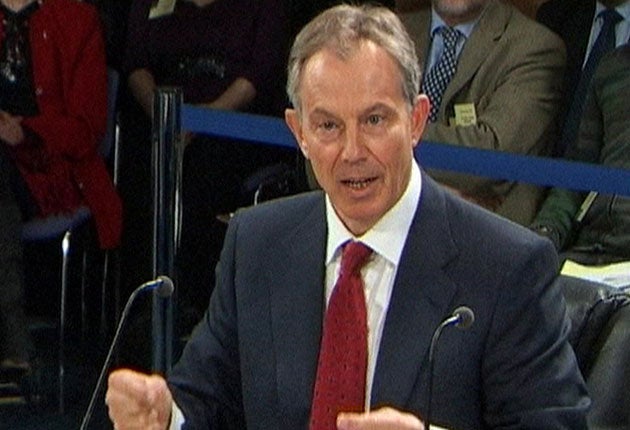
Friends of the former prime minister had pre-briefed that his performance at the Chilcot inquiry would be contrite while remaining defiant about his decision to go to war. But in his six-hour testimony, he conceded very little, constantly shifted his position and even came up with a new version of his justification for war.
Mr Blair acknowledged that the Government should have made it clear that the claim that Saddam Hussein could launch weapons within 45 minutes referred to battlefield, and not ballistic, missiles. He also admitted that the intelligence evidence should have been produced directly from the Joint Intelligence Committee, rather than "presented" by Downing Street in the notorious September 2002 dossier.
Mr Blair said he was "sorry" that the war was divisive, but this suggested he felt sorrier for himself than for Britain's war dead.
He misjudged the public gallery when Sir John Chilcot invited him to say he had regrets for those who had lost their lives. "Responsibility but not a regret for removing Saddam Hussein," he said, to cries of: "What, no regrets?" Mr Blair added: "I think he was a monster. I think he threatened not just a region but the world." "You are a liar", "And a murderer" came two shouts from the gallery.
Mr Blair may not have lied, but he stretched and contorted his reasoning. Of the 45-minute claim in the dossier, he said: "I didn't focus on it a great deal at the time... I mentioned it without any great emphasis and I mentioned it, I think, in reasonably sensible terms." Yet in evidence to the Hutton inquiry in 2003, Mr Blair said: "There was absolutely no reason for us to doubt that intelligence at all" – suggesting it did carry great emphasis in Downing Street.
Mr Blair gave a staunch defence of the intelligence in the dossier and his statement to Parliament on 24 September 2002, in which he said Saddam Hussein's weapons capability was "active, detailed and growing", telling the Chilcot inquiry: "I did believe it, frankly, beyond doubt." But later he said it was the future threat that Saddam posed that meant action had to be taken.
He took refuge in the hypothetical. So he posed the "2010 question": if Saddam had been allowed to continue, he would have restarted his nuclear and chemical weapons programmes and potentially killed hundreds of thousands of people.
Mr Blair had claimed that his comments to Fern Britton in a TV programme last month that he would have removed Saddam regardless of whether he had WMD were because he still had "something to learn" about interviews, and that he hadn't meant to imply regime change was the real reason for war. But then he made it plain he stood by what he had said.
He even calibrated a new position: that people were making a false "binary distinction" between WMD and regime change, when actually the two were part of the same reason to prosecute a war. He said: "The truth of the matter is that a regime that is brutal and oppressive, that, for example, has used WMD against its own people, as Saddam did, and had killed tens of thousands of people by the use of chemical weapons, such a regime is a bigger threat if it has WMD than one that is otherwise benign."
Observers will find it odd that Mr Blair has never put forward that argument in the past eight years.
Join our commenting forum
Join thought-provoking conversations, follow other Independent readers and see their replies
Comments
Bookmark popover
Removed from bookmarks