Brown backs new tax on banks – but the US is opposed
Britain will not act alone, the Prime Minister tells finance ministers at the G20 summit in St Andrews
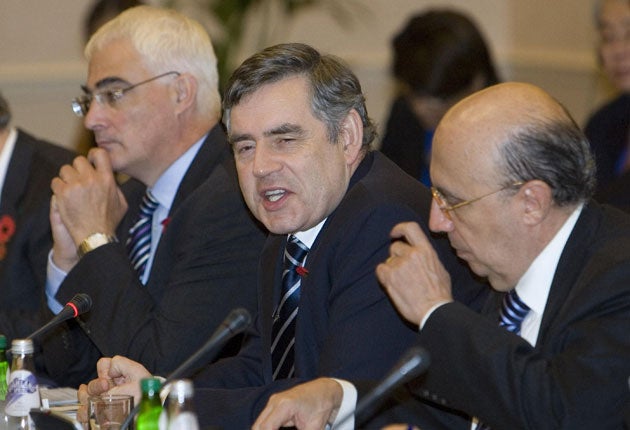
Gordon Brown suffered a rebuff from Washington yesterday after he signalled Britain's backing for plans for an international transactions tax on banks to help the world recover from the financial crisis.
At the G20 summit in St Andrews, Fife, the Prime Minister dropped Britain's longstanding opposition to the scheme, which could raise billions a year for poor nations.
But within hours of the significant shift in UK policy on the so-called "Tobin tax", the US Treasury Secretary Tim Geithner dismissed the move, saying Washington was "not prepared" to support it.
The Prime Minister called on the IMF urgently to consider the tax on financial transactions which experts say could raise as much as $600bn (£360bn) a year. Mr Brown said the financial collapse last year showed "there must be a better economic and social contract between financial institutions and the public based on trust and a just distribution of risks and rewards".
Addressing finance ministers from the world's richest nations, including Mr Geithner, the Mr Brown added: "I believe we should discuss whether we need a better economic and social contract to reflect the global responsibilities of financial institutions to society. There have been proposals for an insurance fee to reflect systemic risk or a resolution fund or contingent capital arrangements or a global financial transactions levy."
But Mr Geithner, when asked on Sky News whether the US was behind the Tobin tax, said: "That is not something that we are prepared to support. [But] I think we all share a basic interest in trying to make sure we run a system where taxpayers are unexposed in the future and where the financial institutions are bearing the consequences of their mistakes, that they're responsible for the risks they take."
Downing Street insisted Britain had never said it would act alone on the issue. And a No 10 source claimed that some advisers in the Obama administration deemed the transactions tax worthy of examination, despite what Mr Geithner said. Mr Brown also called on finance ministers to agree the cost of tackling climate change, ahead of next month's Copenhagen summit.
Downing Street said the financial transactions tax – named after the economist James Tobin who first proposed the measure in the 1970s – was one of a number of options to restore trust between citizens and banks.
But Mr Brown's decision to put the Tobin tax on the table marked a significant shift in Britain's position. It is also a key development because London is a world centre of finance.
The IoS reported in September divisions between governments over the plan. Anti-poverty campaigners accused Britain of stalling on the tax, which was being pushed by France and Germany at the G20 summit in Pittsburgh that month.
Under one model of the scheme, a tax of 0.05 per cent would be levied on currency, share and derivative transactions. A research paper published last month by the Austrian Institute of Economic Research said this would raise £360bn annually. Yet if a global agreement were to be met, a smaller levy of around 0.005 per cent would be more attainable, raising £36bn.
Mr Brown said any such measure would have to be agreed by all major financial centres and that Britain would not act alone. Sources said the "ball is now in Washington's court" – acknowledging that implementation of the tax would be impossible without the backing of Barack Obama.
Max Lawson, a senior policy adviser for Oxfam, said: "A tax on banks would be a major step towards clearing up the mess caused by their greed. The G20 has a responsibility to act. Every minute, around the world 100 people are forced into extreme poverty as a result of the economic crisis. Money raised by a financial transactions tax on banks could make a massive difference to their lives."
The Liberal Democrat Treasury spokesman Vince Cable said: "A Tobin tax is a good idea, but it has been a good idea for decades and governments haven't yet found a way of putting it into practice. It would be a much better use of the short period Gordon Brown has left in office to introduce practical measures such as a government levy on banks which are too big to fail."
Join our commenting forum
Join thought-provoking conversations, follow other Independent readers and see their replies
Comments