Cameron faces backlash on Europe as conference begins
Ireland's resounding 'Yes' to Lisbon Treaty leaves leader trying to appease right-wingers as <i>IoS</i> poll highlights voters' uncertainty over a Conservative government's programme
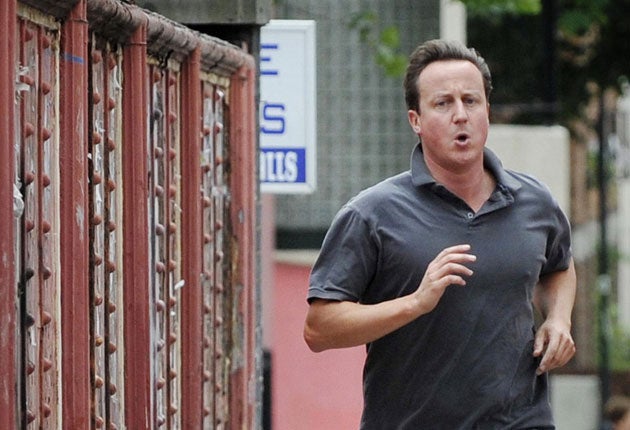
David Cameron heads into his party conference today as prospective prime minister amid an increasingly bitter row over Europe and a new poll showing half of voters are uncertain over what he stands for.
The start of the Conservative conference in Manchester looked set to be overshadowed by escalating demands for a referendum on the Lisbon Treaty after Ireland voted decisively in favour of EU reform. After the country rejected the charter in June 2008, 67.1 per cent voted "Yes" this weekend, on a 58 per cent turnout.
Mr Cameron yesterday refused to bow to right-wing demands for a vote under a Tory government in any circumstances – even if the treaty is ratified across Europe. So far he has promised a referendum if Lisbon has not been accepted in every EU state.
The Tory leader also faced growing anger over his allies in Europe with links to the far-right, who are to address the Manchester conference.
The difficulties over Europe – for years the toxic issue for Conservatives – threatened to dampen Tory spirits at the start of the final conference before the 2010 election.
After a difficult week for Gordon Brown in which The Sun dropped its 13-year support, a ComRes poll for The Independent on Sunday showed Labour has narrowed the gap between it and the Tories by just three points, and is 12 points adrift on 28 per cent.
But the poll revealed that 49 per cent of voters "don't really know what David Cameron stands for", against 47 per cent who said they did. Among C2, D and E voters – the typical readership of The Sun – the proportion is even higher – 53 per cent.
This finding echoes research by the IoS into Mr Cameron and his party's policies on a number of key areas (see box, right). It also suggests that voters are still confused after nearly four years of his leadership which began with his striking decontamination strategy but has ended with the Tories giving more prominence to their party's more traditional positions on law and order, Europe, immigration and public spending.
Mr Cameron's strategists argued that issues such as the environment and the promotion of ethnic minorities and women in the party are still priorities. They also pointed out that the economic climate had shown how the Tories have kept an open mind on tax – including refusing to scrap immediately the 50p top rate of tax if they win power and admitting that other tax rises may be "unavoidable".
In a further blow to Mr Cameron, Rupert Murdoch's biographer Michael Wolff, writing in The Independent on Sunday today, says the owner of The Sun newspaper is sceptical about the would-be prime minister. Mr Wolff quotes Mr Murdoch saying of David Cameron: "I don't take him seriously. Who would?"
In an interview with the IoS, Greg Clark, the shadow Energy and Climate Change Secretary who was head of policy for the Tories for four years under William Hague, Iain Duncan Smith and Michael Howard, insists that the party has not ditched its commitment, famously announced by Mr Cameron in 2006 on the eve of his trip to a melting glacier, to "vote blue, go green". He says: "I think what David is doing is to show that climate change is in the mainstream of all these different policy areas – economic policy, international policy, security policy. There is a real coalition of interest in this, that people are concerned about our national security, economic security, household budgets, future jobs, the future of the planet."
However, today Labour is expected to seize on a Tory announcement of its intention to scrap the New Deal as evidence that the party is retreating from progressive policies.
The shadow Work and Pensions Secretary, Theresa May, will announce that Labour's decade-old scheme will be replaced with a "radical, simpler" system to get people back to work. The party refused to reveal more details of the plan – entitled "Get Britain Working" – yesterday, including if it would cost more or less than the New Deal, saying only that it would cover universities, schools and training as well as the typical jobless queue.
Ministers stepped up criticism over the appearance in Manchester this week of Michal Kaminski, the Polish politician and head of Mr Cameron's European Conservatives and Reformists grouping, accused by David Miliband of an anti-Semitic past. The Foreign Secretary cited the downgrading of German Chancellor Angela Merkel's CDU party's relationship with the Tories as further evidence of isolationism in Europe.
Mr Miliband said: "Three years ago the Conservatives wanted President Sarkozy to attend their conference. He declined. Last year they boasted of their relationship with Chancellor Merkel. This week she downgraded her party's relationship with them because of Conservative European policy. This year they are reduced to inviting fringe groups to fringe meetings. This is the kind of isolation that Tory Europhobia threatens for Britain if they were to come into government."
Mr Cameron faces pressure from hardliners to call a referendum even if the treaty is ratified before the Tories take power. He said he would commit Britain to a referendum if the Czech Republic – likely to be the one country out of 27 not to ratify by the end of this year – had not signed. Poland is expected to sign this month.
He added: "There are still two other countries in Europe yet to ratify. I don't want to do anything or say anything that prejudices the outcome in those countries; you can only have one policy at once so I am pushing for that referendum and that will not change."
The Eurosceptic Bruges Group said: "If David Cameron is serious about becoming prime minister, then he must show leadership and announce that a retrospective referendum will be held in Britain. This will rule the Lisbon Treaty null and void in the UK and withdraw us from its provisions."
Yesterday Gordon Brown finally signalled that he is ready to take part in a series of television debates with the other main party leaders. Mr Cameron said: "At last he has come off the fence. I've been calling for these debates for ages now. So I'm delighted at this news; now we have to get on and fix them up. I've believed in TV debates when I'm behind in the polls, when I'm ahead in the polls and when I'm level in the polls."
Running for office, but what does he stand for?
Gay rights
David Cameron apologised for section 28, but is allied in Europe to parties that oppose gay rights.
Reform
He wants to reform politics and Parliament with a 10 per cent cut in the number of MPs and a 5 per cent cut in ministers. But he is opposed to any form of electoral reform.
Climate change
He is opposed to a third runway at Heathrow airport, but is also opposed to higher taxes on polluting cars.
International aid
He is committed to keeping spending on international development at 0.7 per cent of GDP.
NHS
He has pledged to protect NHS spending, but wants to abolish targets in the health service.
Education
He wants more school providers and more parental freedom, but would allow no appeals against exclusions.
Economy
He has pledged to "sort out national debt and public spending", but opposes the fiscal stimulus of the economy.
Unemployment
He has said tackling joblessness is a top priority, but would scrap the New Deal.
Energy
He has promised a smart meter in every home, but is opposed to wind turbines in the countryside.
Foreign policy
He says he is sceptical about intervention and is not a neocon, but is hostile to the EU.
Diverse society
Wants more ethnic-minority Tory MPs, but also a fixed "limit" on immigration.
Join our commenting forum
Join thought-provoking conversations, follow other Independent readers and see their replies
Comments
Bookmark popover
Removed from bookmarks