End of an era as Paisley steps down
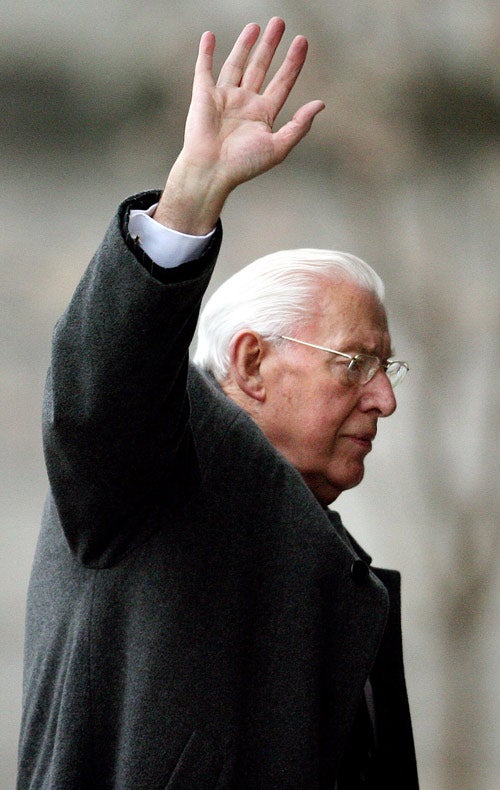
The Rev Ian Paisley has signalled the end of an era by announcing he will step down as leader of Northern Ireland's power-sharing administration and the Democratic Unionist Party.
The news represents a huge moment in the politics and recent history of Northern Ireland, removing from the scene as it does one of its most striking figures.
There will be endless argument over the merits and faults of an outsize personality who for decades sabotaged many political initiatives. He then astounded the world by forging an alliance with Sinn Fein, his sworn enemies.
It was in May of last year that he made one of Irish history's great U-turns by casting aside his decades of appetite for discord and speaking of a future of "wonderful healing". The astonishment was all the greater for the rapport he established with Sinn Fein's Martin McGuinness, who for decades he had regarded as a bloodstained terrorist. Mr McGuinness last night lauded Mr Paisley for showing "courage and vision".
But their exceptionally affable relationship may have played a part in Mr Paisley's departure. While there was widespread Protestant acceptance that the time had arrived for a deal, many felt the relationship was over-friendly.
The other major factor in Mr Paisley's decision to stand down in May was a period of bad publicity for his party, much of it generated by his son, Ian Paisley Jnr. His son's relationship with a developer in the Paisley heartland of North Antrim produced many stories of behaviour which, while not illegal, smacked of unsavoury sleaze.
The central political question now is who will take over from Mr Paisley at the head of the party. The political world expects his successor to be Peter Robinson, his deputy for decades and the current finance minister in Belfast's power-sharing executive.
His experience and reputation for efficiency may mean he will face little serious opposition for the two top jobs now becoming vacant. A smooth transition and a Robinson promotion would suit most of the political spectrum, including the British and Irish governments and Sinn Fein.
Unlike some in the DUP ranks, he is committed to Belfast's new brand of power-sharing. He is also more of a details man than Paisley. Since he is also thought of as cold, he is not expected to be as friendly towards Sinn Fein, though the executive may gain in efficiency what it loses in cordiality.
Mr Paisley last night refrained from indicating a preference, intoning: "This is not the Church of Rome. This is not Apostolic succession and I have no right to say who will succeed me."
With Mr Paisley due to reach his 82nd birthday next month, many have been speculating on exactly how long he might stay in office. His own personal inclination may have been to linger longer, but his son's activities may have hastened his departure.
May will bring both an important economic conference in Belfast and the first anniversary of Mr Paisley's assumption of power.
Last night he hotly denied his departure came as the result of pressure, in line with his declaration that "I have a fairly hard rhinoceros skin". But it has been clear enough that discontent in the DUP has been growing. It led to his son's recent resignation as junior minister, and then seems to have increased as Paisley Snr awarded Paisley Jnr the consolation of a seat on the Police Board.
Speaking of the controversies surrounding his son, Mr Paisley said: "I felt that my son was very badly treated. I am not a fool. People who thought that they could get at me, got at him."
Mr McGuinness said: "The historic decision he took to go into government with Sinn Fein has changed the face of Irish politics forever. I think that he will be fondly remembered by the people of Ireland – north and south – for the very courageous leadership that he showed."
A different view came from the MEP Jim Allister, who quit the DUP in protest at the power-sharing agreement. He said: "It has been quite clear for some time that Ian Paisley was going to be hung out to dry by the DUP pragmatists. He had delivered what they had devised but could not sell themselves – government with unrepentant terrorists."
Gordon Brown said: "Progress on bringing a lasting peace would not have been possible without his immense courage and leadership." The Irish Taoiseach Bertie Ahern added: "He is a giant figure in the history of these islands."
Faith and pragmatism: A life in politics
1926 Born in Armagh, Northern Ireland, and brought up in Ballymena, Co Antrim, the son of a Baptist minister.
1946 Ordained.
1951 Creates the Free Presbyterian Church.
1974 Enters Parliament.
1985 Leads Unionist opposition to Anglo-Irish agreement with the slogan "Ulster Says No".
1986 Declares "never, never, never" to power sharing.
1998 Enters NI Assembly while opposing Good Friday Agreement and devolution.
2004 Steps down as MEP after denouncing Pope as anti-Christ; meets the Taoiseach Bertie Ahern in Dublin; tells the IRA to "wear sackcloth and ashes".
2006 Sinn Fein leader Gerry Adams says he will nominate Paisley for First Minister.
2007 Enters power sharing with Sinn Fein. Becomes First Minister of Northern Ireland.
2008 Ian Paisley Jnr – Paisley's son – steps down as a junior minister after allegations about his financial affairs.
Join our commenting forum
Join thought-provoking conversations, follow other Independent readers and see their replies
Comments
Bookmark popover
Removed from bookmarks