Revealed: Blair's role in Megrahi release
MPs want to know what deal was struck over the Lockerbie bomber at a meeting in a London club in 2003 – long before either the Scottish government or Gordon Brown was involved
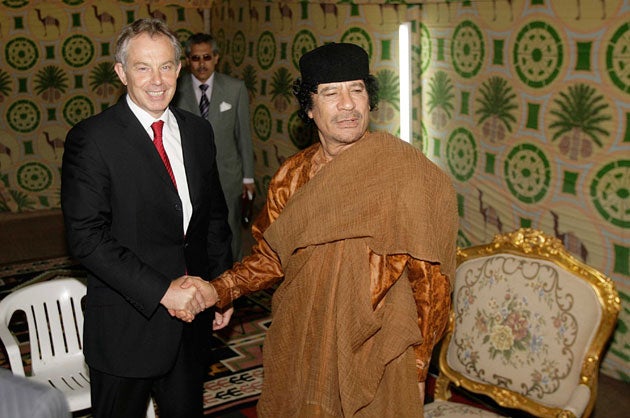
Tony Blair will be thrust into the controversy over the release of the Lockerbie bomber Abdelbaset Ali al-Megrahi with questions in Parliament over a secret meeting the then Prime Minister orchestrated that brought Libya in from the cold.
MPs are set to demand the minutes of an extraordinary cloak-and-dagger summit in London between British, American and Libyan spies held three days before Mr Blair announced that Colonel Muammar Gaddafi was surrendering his weapons of mass destruction programme.
At the time of the secret meeting in December 2003 at the private Travellers Club in Pall Mall, London – for decades the favourite haunt of spies – Libyan officials were pressing for negotiations on the status of Megrahi, who was nearly three years into his life sentence at a Scottish jail.
Whitehall sources said the issue of Megrahi's imprisonment was raised as part of the discussions, although it is not clear whether Britain or America agreed to a specific deal over his imprisonment, or a more general indication that it would be reviewed.
MPs are to investigate what was promised by Britain at the talks on 16 December, and the role that Mr Blair played in the affair. Until now, the controversy over Megrahi's release last month has centred on discussions between Gordon Brown's government and the Scottish executive and Libya since 2007, with Mr Blair apparently not involved in any way.
It has also focused on claims that the deal was related to oil deals, with Jack Straw admitting yesterday that BP's interests in Libya played a "big part". But authoritative sources said the seeds for Megrahi's release were sown in 2003, when Libya made the historic agreement to end its status as a pariah, and that the focus on oil and trade was a "red herring".
Yesterday the Libyan Foreign Minister, Musa Kusa – who himself was present at the Travellers Club meeting – told The Times that Megrahi's release was "nothing to do with trade".
Two days after the meeting Mr Blair and Col Gaddafi held direct talks by telephone; and the next day, 19 December, the historic announcement about Libyan WMD was made by Mr Blair and President Bush.
At the time, the British government was in desperate need of an intelligence victory after the debacle of going to war in Iraq in the belief that it had weapons of mass destruction.
The Iraq Survey Group had just reported it had found no biological or chemical weapons. Two months after the talks, Mr Blair travelled to the Libyan desert to extend the "hand of friendship" to Col Gaddafi in a Bedouin tent, calculating that the PR coup of Libya dismantling WMD programmes outweighed American outrage.
Yet, in the end, it was revealed that Libya had not developed a nuclear- weapons capability and so did not pose as great a threat to the West as was feared.
Nine top-level MI6, Foreign Office, CIA and Libyan officials were present for the negotiations at the Travellers Club. The revelation that two senior American officials were present risks causing embarrassment to the White House, as Washington has made clear its criticism of the release of Megrahi by the Scottish government last month.
Yet, as the focus shifted to the former prime minister last night, it can also be revealed that Mr Brown and Barack Obama have not spoken to each other for more than a month, in a sign of the growing tensions in the US-UK relationship which has been put under intense strain by the Megrahi affair.
Despite Washington's concerns over the release of Megrahi on 20 August, Downing Street confirmed that Mr Brown and President Obama last spoke by telephone on 24 July about Afghanistan.
No 10 last night denied that Mr Brown vetoed an attempt to force Gaddafi to compensate IRA victims. The Sunday Times quoted documents saying Mr Brown felt it was inappropriate to enter talks with Libya on the issue. In an interview with CNN after Megrahi's release last month, Mr Blair denied he personally raised the case of Megrahi, adding that he "didn't have the power" to release him.
Last night, a spokesman for Mr Blair could not be drawn on the December 2003 meeting. In fact, The Independent on Sunday has established that Mr Blair's involvement with the Travellers Club meeting was at arm's length, via his then foreign affairs envoy, the current ambassador to Washington Sir Nigel Sheinwald.
But MPs on the Scottish Affairs Select Committee, one of two committees poised to investigate the affair, are to probe suspicions that the Travellers Club talks involved giving the green light to Megrahi's release. A Conservative frontbencher and member of the Scottish Affairs Committee, Ben Wallace, said: "This is the sort of thing a parliamentary inquiry can get to the bottom of. We need the Government to clarify how the Libyans raised the subject of Megrahi, what was the UK's response, and did the WMD negotiations spark verbal or written correspondence with the then Scottish executive, which was run by the Labour Party at the time.
"We know the UK and Tony Blair were desperate to maintain the special relationship with the WMD deal – what price did they pay? We need assurances from the Foreign Secretary that Megrahi was not part of the deal."
Details of the December 2003 talks are straight out of a scene from a spy thriller. In a darkened corner of the 190-year-old gentlemen's club, surrounded by secret doors disguised as bookcases, the negotiations began at lunch but stretched on for eight hours.
Sir Nigel was in Downing Street and was kept informed of negotiations. He in turn kept the Prime Minister up to date. Full details of the meeting, and the identities of those present, have not been revealed until now.
Mr Kusa, the Libyan head of external intelligence, was at the time banned from entering Britain after allegedly plotting to assassinate Libyan dissidents. But because of his closeness to Col Gaddafi, he was essential to the talks and was given safe passage to London. Also in the Libyan delegation was Abdulati Alobidi, now the minister for Europe, who extracted the assurance from Foreign Office minister Bill Rammell this year that Mr Brown did not want Megrahi to die in a Scottish jail. Mr Alobidi said last week: "In my negotiations with the British and the Scottish, I didn't mention anything about trade relations."
For the Americans, Stephen Kappes, the CIA deputy director of operations, and Robert Joseph, counter-proliferation chief, led the talks. Britain was represented by William Ehrman, Foreign Office director general for defence and intelligence, and David Landsman, then the head of counter-proliferation at the Foreign Office. A CIA source said last night that a Lebanese businessman, while not at the meeting, was the key go-between, bringing together Libyan officials and British and US spies. The same businessman also put together a team of private investigators on Lockerbie to undermine the case against Megrahi.
An official with knowledge of the talks said of the Travellers Club meeting: "That was where the real negotiations were made."
Teflon Tony: How nothing sticks to the ex-PM
Iraq
Tony Blair was forced from office in part because of the Iraq war, yet so far he has not had to face an independent, public inquiry into his handling of the invasion and its aftermath. He refused an independent inquiry while in office, saying the Foreign Affairs Select Committee, the Intelligence and Security Committee and the Hutton and Butler inquiries had been sufficient – yet critics say these failed to get to the heart of the failures of the war. Later this year Sir John Chilcot will begin his inquiry; Blair is not expected to give evidence before next year – perhaps not until after the election.
Afghanistan
It was Blair, with President Bush, who in October 2001 sent troops into Afghanistan to defeat those responsible for 9/11. By December the Taliban were defeated and Blair, with Bush, took credit for helping the installation of a new Kabul government under Hamid Karzai. Since Blair stood down in 2007, Britain's commitment has increased, with demands for a clear exit strategy, while Karzai's administration stands accused of vote-rigging in this summer's elections.
Economy
Blair stood down as PM on 27 June 2007, after 10 years when Britain enjoyed low interest rates, low inflation and a booming housing market. The first big signs that the US and UK economies were on the brink of collapse came that August, and a major credit crunch took hold.
MPs' expenses
Blair's name was top of the list on a freedom of information request of MPs' expenses, first lodged in 2005. It was not until May 2008 that the High Court ruled for publication. This resulted in the eventual release of all MPs' expenses this year, which triggered public outcry. Blair's mortgage expenditure raised eyebrows – but he was no longer in office so the impact was blunted. JM
Join our commenting forum
Join thought-provoking conversations, follow other Independent readers and see their replies
Comments